
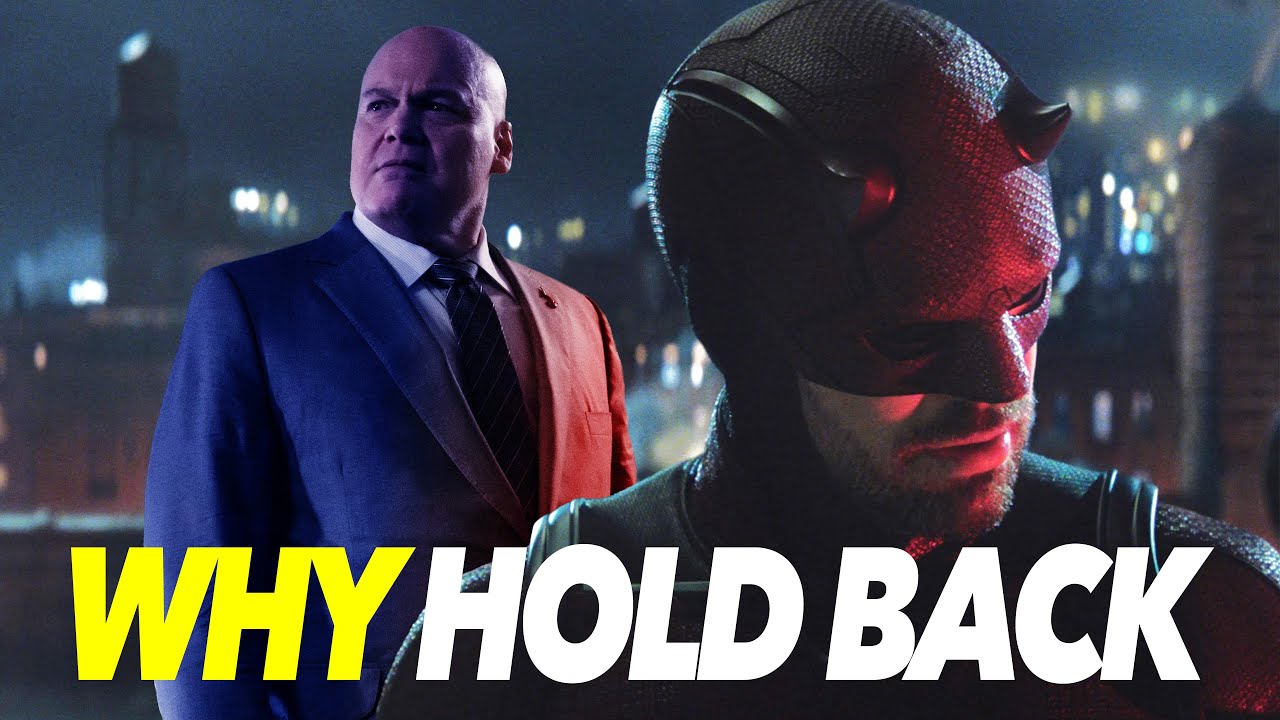
Daredevil season 2 starts next week, and I keep coming back to the same idea.
I don’t think Daredevil: Born Again season 1 comes up short because Marvel didn’t know what Daredevil was. That’s just silly. I think it comes up short because it did know, and it kept handing attention back to the wrong material.
That’s worse. Confusion is one thing. Knowing better and still smoothing the thing out is something else entirely.
So no, I’m not doing a recap. I’m not doing here’s what you need to remember before season 2. Everybody else can go do that, and trust me, there are plenty of channels out there doing it. What I care about is what season 1 actually was. Not as a weekly reaction cycle. As a season. As a built thing.
What was this show trying to be? Where did it actually work? Where did it weaken itself? And now that season 2 is almost here, what does all of that tell us about what Marvel has to stop doing next?
For me the answer is pretty clear now. Season 1 proves Daredevil works. The problem is that it keeps choosing against the strongest version of itself.
The Easy Explanation Isn’t the Real One
The easy explanation is the obvious one. This was a rebuilt season. Period. And you can feel that.
You can feel a more legal, more episodic, more procedural show inside this thing. You can also feel the darker, more serialized, more this is the real Daredevil again version pushing against it. Fine. That explains the scenes. It does not explain the real problem.
Because if this were just a compromise season, the whole thing would feel compromised in the same way. And it doesn’t. Some of it is clearly stronger than the rest. I don’t think anybody would argue that.
Once that happens, the question changes. Now I’m not asking why is this uneven. I’m asking why does this material feel so much more alive than the material around it?
Here’s the answer I keep landing on. The stronger material is solving dramatic problems. The weaker material is solving assembly problems.
That’s the spine of the whole thing. When the show is at its best, a scene or an episode gives Matt a concrete problem and forces character through action. When the show is weaker, it’s carrying future importance. It’s moving pieces. It’s patching transitions. It’s setting the table for something else.
That one distinction explains almost the entire season.
Why the Legal Material Works
The legal material works because it gives Matt actual dramatic problems. Not mood, not waiting. Problems.
Matt in court is where the show gets sharp, because that’s where law, morality, and identity all become the same scene. He’s not just emoting. He’s trying to make justice happen inside a system that can’t fully carry what he needs it to carry. That is Daredevil.
And the bank episode is the clearest example of what the whole season should have been learning from, because that episode is complete. Not important. Complete. It traps Matt inside one contained objective. It gives him immediate stakes. It forces him to solve the situation as Matt Murdock, not as a guy waiting for the suit to matter again. Lawyer instinct, physicality, restraint, all inside the same problem.
That episode carries its own dramatic load. It doesn’t feel like it exists to help the season. It feels like it exists to be an episode.
And once you’ve seen that, the rest of the season loses cover. Now you know what this show looks like when it stops managing itself and just does the job.
The action works the same way when it’s built around restriction. That stairwell sequence works because the scene has an objective and a limit. He has to move fast, stay quiet, contain the violence, and solve the problem without blowing the whole situation open. The tension comes from management, not spectacle.
And Matt and Fisk together remain the clearest proof the show understands itself. That’s the real engine. Two men trying to present revised versions of themselves while the story keeps dragging them back toward what they really are. Every time the season leans into that, it works. No debate.
The White Tiger Problem
White Tiger is where the season starts exposing its own weaknesses, and it’s not because the idea is wrong. The lane is perfect. Vigilantism becomes law, law becomes politics, politics becomes pressure on Matt. Exactly right.
But the show wants Hector Ayala to carry more weight than it fully builds into him before it cashes him out.
That’s the issue. It isn’t that he needed more scenes. He needed more embodied presence before the season started spending what his loss was supposed to mean. The show asks us to process the aftermath of a character it hasn’t fully let become dramatically heavy on screen.
So yes, you understand why he matters abstractly. But understanding importance and feeling cost are not the same thing.
This is the season wanting aftermath weight without earning front-end embodiment. And that’s not just a White Tiger problem. That’s a season problem.
Foggy, Karen, and Imported Emotion
Foggy is harsher, because Foggy’s death lands. No doubt about it. But it lands partly because you brought the old show with you.
That’s the blunt note, but it’s true. The season is importing emotional authority instead of rebuilding it in the current tense before spending it.
And the proof is Karen. The second Karen comes back, the show’s emotional architecture gets stronger immediately. Not because nostalgia is magic. Because Matt is suddenly back in scenes with someone who changes the pressure inside the room. Someone who knows him, cuts through him, carries shared damage with him.
That should tell you what was missing. Not fan service. Relational density.
The season wanted the impact of those old relationships before it rebuilt the living, present-tense version of them.
This is also why I don’t think “the season is slow” is the right criticism. The problem isn’t speed. The problem is that too much of this season is doing assembly labor instead of dramatic labor. Scenes are positioning, redirecting, connecting, preparing. But are they deepening? Are they trapping character? Are they worsening the conflict inside the scene? Too often, no.
That’s why parts of the middle feel busy but thin. Movement is happening. Pressure isn’t always accumulating.
Fisk and the Performance of Darkness
Fisk is where the show gets especially revealing.
D’Onofrio is still good. That is not the issue. The man is amazing, he can do no wrong. The issue is that some of the Fisk material, especially the therapy material, is used to signal prestige darkness more than to generate worsening inside the scene itself.
That’s the harsher version of the note, but I think it’s the correct one.
The show knows there’s rot in the room. It knows the marriage is poisoned. It knows Fisk is suppressing violence behind civility. But some of those scenes plateau once they’ve communicated that function. They don’t always intensify. They don’t always trap the characters harder at the end than they were at the beginning.
So instead of the scene becoming uglier as it goes, the scene becomes legible. The scene is performing darkness instead of making darkness do work.
I think that’s part of the broader Marvel issue too. Not just smoothing tone, but presenting darkness in a way that stays watchable, manageable, and really clean.
When Hesitation Stops Looking Like Confusion
Here’s where the read gets uglier.
Once the season has already shown you the better version of itself, hesitation stops reading like confusion. It starts reading like an institutional choice.
The show knows the legal material is stronger. It knows contained episodes are stronger. It knows embodied action is stronger. It knows relationship architecture matters more than symbolic legacy deployment. It knows all of this.
So if it keeps backing away from that anyway, what you’re left with is not “they didn’t know.” It’s that Marvel still seems uncomfortable letting Daredevil be fully, specifically, abrasively Daredevil for an entire season.
Not just dark. Definitely not just violent, there’s plenty of that. I mean morally dirtier, more relationally dense, smaller in scale, more complete at the episode level, and less interested in smoothing itself into a broader franchise comfort.
That’s the real thing season 1 reveals. Which is why my reaction at the end wasn’t triumph. It was relief. Relief that the show was actually in there. Relief that the right show was actually in there and I wasn’t imagining it.
But relief is not payoff. Relief is what you feel when a season finally admits the thing it should have been leaning into all along. Useful? Yes. Complete? God, no.
Why This Matters Beyond Daredevil
The MCU fatigue problem is not just volume. It’s that Marvel keeps making projects that don’t fully trust their own distinctness. They keep sanding them toward this weirdly institutional comfort.
Born Again proves it, because its strongest material is so obviously stronger than its weakest material. The season itself is telling Marvel the answer. Less smoothing. More present-tense dramatic force. More trust in the property’s own pressure system.
Daredevil doesn’t need bigger stakes to feel alive. He needs cleaner identity and harder commitment. That’s it.
What Season 2 Actually Has to Prove
Season 2 doesn’t have to prove that Daredevil works. We’re well past that. It has to prove that Marvel will stop repeating the specific behaviors that weakened season 1.
Stop treating Matt’s dual life like separate modes instead of the contradiction that powers the whole show.
Stop using supporting characters as preloaded emotional accelerants unless you’re willing to rebuild present-tense density around them.
Stop solving season assembly problems with scenes that should be solving dramatic problems.
Stop signaling consequence without metabolizing consequence. That one is huge.
Stop sanding action into franchise language when the character works best under bodily restriction and scene-specific cost.
That’s the actual assignment.
And yes, the signs are promising. Punisher, Jessica Jones, the black suit, more street-level expansion. Fine. But all of that can still be managed instead of lived in if the underlying behavior doesn’t change.
So there you go. Now you know. And if knowing is half the battle, you’re halfway to being a know-it-all yourself.
Season 1 showed us the version of Daredevil that unabashedly, unashamedly works. The problem is that it kept hesitating. If Marvel wants to fix what people are feeling right now, they don’t need to reinvent anything. They need to stop replacing present-tense dramatic force with inherited weight, future performance, and institutional smoothing.
They need to let Daredevil be fully, specifically, and unapologetically Daredevil. For an entire season, without flinching.
The question going into season 2 is not whether Daredevil can work. We already know he does. The question is whether Marvel will finally trust the right version of this show for a whole season.
Where did you land on season 1, and more importantly, what does season 2 need to stop doing if this show is finally going to commit to the version of itself that works? The conversation lives in the comments on the video above.


