
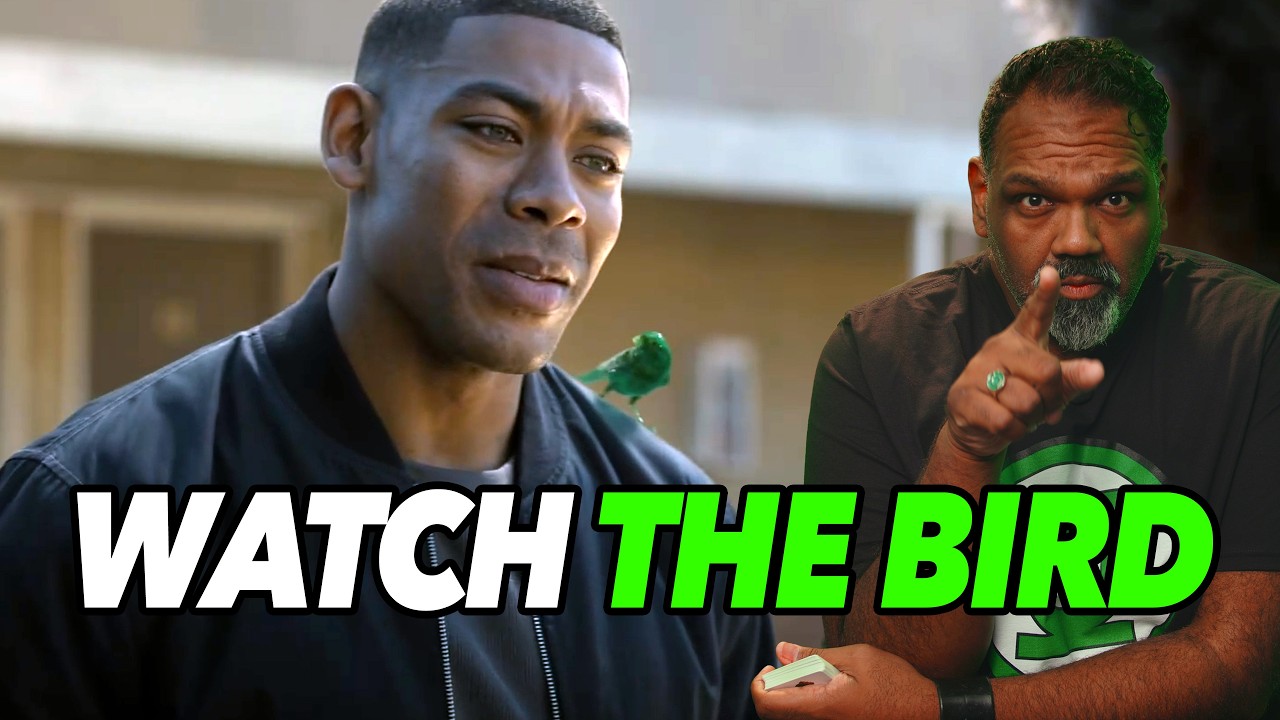
The most dangerous thing in Episode 2 of Lanterns is not the Manhunter.
Somewhere in the middle of this episode, John Stewart builds a little green bird. It’s easy to laugh at. The bubble wrap was easy to laugh at too. Except this bird doesn’t pop. It stays. It stays alive while John isn’t even wearing the ring. Hal has carried that ring for 40 years, and he has never done that. He looks at the bird and calls it advanced.
And John looks at the most extraordinary thing this show has put on screen, says, “It’s just a bird,” and turns it to dust.
Then the episode ends with an alien in a prison cell being asked about Manhunters, and instead of answering, he asks a question of his own. He wants Hal to tell him about John Stewart.
Lanterns is playing a card game with you. Episode 2 is the hand where I finally watched the dealer’s fingers move.
A Principle Called Fair Play
In detective fiction there’s a principle called fair play. The idea is simple, and it’s old. A fair mystery shows you everything. Every clue the detective gets, you get. The groundwork gets laid in plain sight, so that when the answer comes, you realize you could have gotten there yourself. Sherlock Holmes runs on it. House ran on it for eight seasons, the same rule applied to medicine. The mystery isn’t fair because it’s easy. It’s fair because nothing was hidden.
Episode 2 of Lanterns convinced me this show is playing fair. And here’s the thing about a fair mystery: if the show really is putting every clue on the table, then we’re allowed to read the table. I watched this episode like a fan, and I loved it. Then I watched it like a detective, and I have to tell you what I found, because the clues on the table are not pointing at who killed Hal Jordan.
They’re pointing at what John Stewart is.
Everything They Said We’d Never Get
First, the fan watch, because the episode was generous in a way that genuinely surprised me. We got Hal in the suit. The lantern itself comes out of storage, and he speaks the oath over it while the ring charges, which is a thing I would have bet money this show was saving for the finale. There’s an honest-to-goodness prison planet, and sitting in a cell on it is Sinestro in the flesh, because, as this episode tells us, he tried to take the Corps by force, killed a Guardian doing it, and Hal is the man who stopped him. That’s a comic book television show refusing to apologize for being a comic book television show.
And I have to take my little victory lap here, because this week I said out loud that I did not expect this show to go anywhere near Mogo. So what does Episode 2 do? Hal’s power battery is sitting in a pocket dimension, because apparently DC has pocket dimensions to spare now. Lex Luthor’s got one, Peacemaker’s got one, now Hal’s got one. And the password that opens it is “Mogo doesn’t socialize.”
That’s not a random line. That is the title of a Green Lantern story from 1985, Green Lantern #188, Alan Moore and Dave Gibbons, the story that introduced Mogo, the living planet who’s also a Green Lantern. This show reached 41 years back into the weirdest corner of the mythology and used it as a password. A show that’s ashamed of its comic book does not do that.
The noise, of course, has an answer for all of this. All week it’s been the same line: it’s grounded because they’re cheap, it’s holding back because it’s embarrassed. But the record already answered back. TheWrap reported the premiere pulled 9.3 million viewers in three days, DC Studios’ biggest series launch on the platform, ahead of what The Penguin did. Audiences have it sitting at an 89 on Rotten Tomatoes next to a 95 from critics, the best reception any DC Studios show has gotten from the people actually watching it. The idea that this show is choosing this lane out of poverty sounds foolish to me. The restraint is a style, the audience is showing up for it, and the record is public.
The Clues, Dealt Face Up
Fair play means the clues are face up, so let me deal them back to you one at a time, exactly as the episode showed them. None of this is freeze-framing hidden props. The camera looks directly at every one of these.
Hal’s ring runs out of charge in the first ten minutes. That’s not a gag, that’s the engine of the whole episode. It’s why John gets sent to Coast City alone, and it’s why Hal spends the hour as a detective instead of a superhero. Last week I told you the show treats the ring like a service weapon. This week the show handed you the paperwork: John comes back with a clock attached, 48 hours to find the Manhunter or the people holding the leash blow up half of Nebraska. Restraint isn’t an aesthetic anymore. It’s a hostage situation.
Then the rest of the hand. Episode 1 already told us 14 alien species can pass for human, even under testing; Episode 2 escalates it, because a Manhunter doesn’t just pass, it embeds, living inside a community as one of its people for years. The hospital is wrong, and Hal notices on camera: blank sign-out sheets, equipment nobody’s used, a town where people apparently don’t get sick the way people get sick. There is alien detection tech wired into the town’s own football field. And behind all of it, the clue the whole season stands on: the body in 2026 is missing the ring, the one object in this universe that knows its bearer.
One at a time, those are Easter eggs. Together, dealt on one table, that’s a hand. This town is constructed. Something has been living inside the construction long enough to build plumbing around itself, and the show told you all of it to your face.
Who Hunts the Manhunters?
A table full of clues still needs a hunter sitting at it, and the episode delivered one. John gets taken by an alien named Antaan, and what Antaan does to him is one of the darkest things I’ve seen a superhero show do this year. He doesn’t threaten John. He downloads a genocide into his head, makes him live what a Manhunter did to his people, a machine that spent years passing as one of them and then quietly engineered their end. Then he gives John the job. Find it. Kill it. 48 hours.
The Manhunters go back a long way in the comics. The nod that matters is Justice League of America #140, from 1977: before the Guardians ever built the Green Lantern Corps, they built machines to police the universe, and the machines went wrong. But the story I actually want is Green Lantern #25, Geoff Johns, the closing chapter of the Sinestro Corps War, which is a fun coincidence given who just showed up in this episode. That’s where we learn what the Manhunters’ malfunction actually cost: an entire space sector, Sector 666, billions of lives and five survivors. One of those survivors dedicates everything he has left to vengeance against the machines and against the little blue immortals who built them. His name is Atrocitus, and if you know where his story goes, you know the word crucifixion is involved, and you know he ends up wearing a very different color. It is, and I mean this in the best way, a completely insane story.
So ask the question this episode is really asking. A machine that exterminates worlds, that no one escapes, that can wear any face it wants. Who hunts a thing like that? The comics answer with one name, and everybody watching said it at the same time. That’s Atrocitus. The theory is everywhere already, and this is one of those rare weeks where the crowd is right, because the machinery underneath the vibe checks out.
So I’m putting it on the record as a call, because that’s what we do here. The massacre Antaan poured into John’s head is this show’s version of the Sector 666 massacre, and Antaan is not just shaped like Atrocitus. Antaan is Atrocitus, and the season is holding that name back the same way it held back the suit and the oath, until the reveal earns it. Showrunner Chris Mundy told TheWrap they tried to make everything relatable without undermining what came before, that a creature destroying your whole world and you hunting it for vengeance is, in his words, a real emotion. That’s a man telling you he kept the machinery of the comics and rewired the feelings to run through people. The machinery of the comics says this exact grief, in this exact hunter, has a name and a destiny.
(I’ve got a lot more on the history here, the full Manhunters rap sheet going back to the ’70s and where the Atrocitus story actually ends up. I go a good bit deeper on all of it in this week’s sidebar video for members. If that’s your thing, I hope you’ll join me over there.)
Episode 3 gets the first shot at making me look ridiculous. Fine. Predictions earn their place by surviving the next episode.
The John File
The episode also quietly told us who Hal is now. John walks through Hal’s house this week, a mansion, a gift from somebody grateful, and it’s gorgeous and it’s completely empty. The producers said it straight out in the after-show: the house is a monument to who Hal is. Beautiful, hollow, and quiet. This is a man 40 years into being the most important person in every room, and the sum of it is a big empty building with a carnivorous plant named Earl. John isn’t just his replacement. John is the answer to the question Hal can’t ask, which is what any of it was for.
Which is exactly why the bird scene is the scene of the episode. On Friday I put five calls on the record in the Files video. Call 2 said the season would give John a signature construct that announces the architect underneath the Marine, and that Hal’s laughter would give way to recognition. So watch what Episode 2 does. John, trying to fly, builds a bird. Not a fist, not a weapon, a small living thing, and it persists, staying alive while he’s not even wearing the ring. And Hal, the 40-year veteran, stops and marvels and calls it advanced. Am I claiming the win? No. A bird is not architecture, and the structural, layered construct I called hasn’t happened yet. But the recognition beat happened, and the rest of the call stays on the table.
Here’s what I didn’t call. The show took the exact ability I predicted would be John’s crowning moment and used it to plant its darkest seed. Follow the sequence. The episode establishes that sustaining a construct without the ring is beyond anything Hal can do. It gives that ability to the rookie. Hal says it means something, says it’s deep. And John, this man whose whole life has been aimed at this ring, looks at the proof of his own gift, says it’s just a bird, and kills it. He turns his own creation to dust rather than let it mean something. Then Antaan doesn’t give the 48-hour kill order to the 40-year veteran. He gives it to John.
And then the last scene. Hal puts on the suit, flies to an alien prison, and asks Sinestro about Manhunters. And Sinestro, the man who knew the Corps well enough to nearly take it, doesn’t answer the question. He says that if a Manhunter still existed, it would only be the second biggest threat Hal is facing. And then he asks Hal to tell him about John Stewart.
That’s the last card of the episode, and the show dealt it face up like all the others. For two weeks, Lanterns has been a story about succession: the old Lantern, the chosen replacement, who inherits the light. Episode 2 just re-filed John Stewart from successor to suspect, and it did it so quietly, behind the suit and the oath and Sinestro, that almost nobody’s talking about it. I know the objection, because I made it too: come on, it’s John Stewart, the most trustworthy man in DC. Right. And this episode just spent an hour showing us a monster whose entire nature is being somebody you already trust.
The mystery was never just who killed Hal Jordan. The show is asking a colder question. It’s asking what John Stewart is.
What Would Prove Me Wrong
Fair play cuts both ways. If I’m going to tell you the show plays fair, my reading has to play fair too. Next week looks like John’s origin episode: the childhood, the father, the training. If that hour explains John’s gift innocently, the suspect file gets a lot thinner, and I’ll say so. Second, the clues might resolve onto the town instead of the man, the whole of wrong Rushville assembling into the Manhunter’s nest and nothing more. If that’s the answer, the method still stands and I lose the suspect. That’s fine. That’s what a real call costs.
Third, my one production hold, because this episode earned honesty. In Rushville the show is a noir: nighttime, patience, dread, that True Detective grammar I praised last week. When John is running around Coast City in broad daylight, for a stretch it turns into something else, sharing DNA with Peacemaker or some of Marvel’s daylight material, and it loses a hair of the cinematic quality the show had held for every previous minute. Those sequences also delivered exactly what people have been begging for, so I’m not sure yet whether I watched an identity wobble or a deliberate design, a show giving its two worlds two different looks. I’m watching the episode again with that question in front of me.
And one more thing, since some viewers have been throwing Watchmen at this show like it’s an insult. The structure Lanterns is running, the dead legend, the timelines, the past being interrogated by the present, that is the Watchmen grammar, and it’s the Strange Adventures grammar, and those are the storytellers this show hired. Using their fingerprints as the accusation gets it backwards. It’s the recipe, and it’s a strength. Maybe time proves me wrong on that one. I understand the criticism. I don’t share it.
The Verdict
Trust Fall is exciting, it’s confident, and it’s doing exactly what it’s supposed to be doing. It set the same table as last week and served the meal: the suit, the oath, the lantern, a prison planet, Sinestro, while keeping the lore so understandable, so digestible, that a viewer who’s never opened a comic can walk in and a lore head can find a Moore reference used as a password. It plays fair with its mystery, it deepened both of its leads, and its one tonal wobble is a question mark, not a wound. Lanterns Episode 2 earns a 9 out of 10 on the Know-It-All Index.
One more thing. The video version of this review ends with a card trick, and it’s the kind that doesn’t survive being written down. If you want to know whether I got you, the last minute of the video is where the eighth card gets dealt.
The clues are face up, all seven of them. Is John the anomaly, is it the town, and am I right about Antaan? Bring your read, and any clue I didn’t deal, to the comments on the video. The best catch goes on screen in the next Files.


