I really enjoyed this movie. I thought it was excellent. And when I asked Mrs. Know-It-All to describe it in a phrase, she said she didn’t need a phrase. “Satisfying. It was very satisfying. All the yeses.”
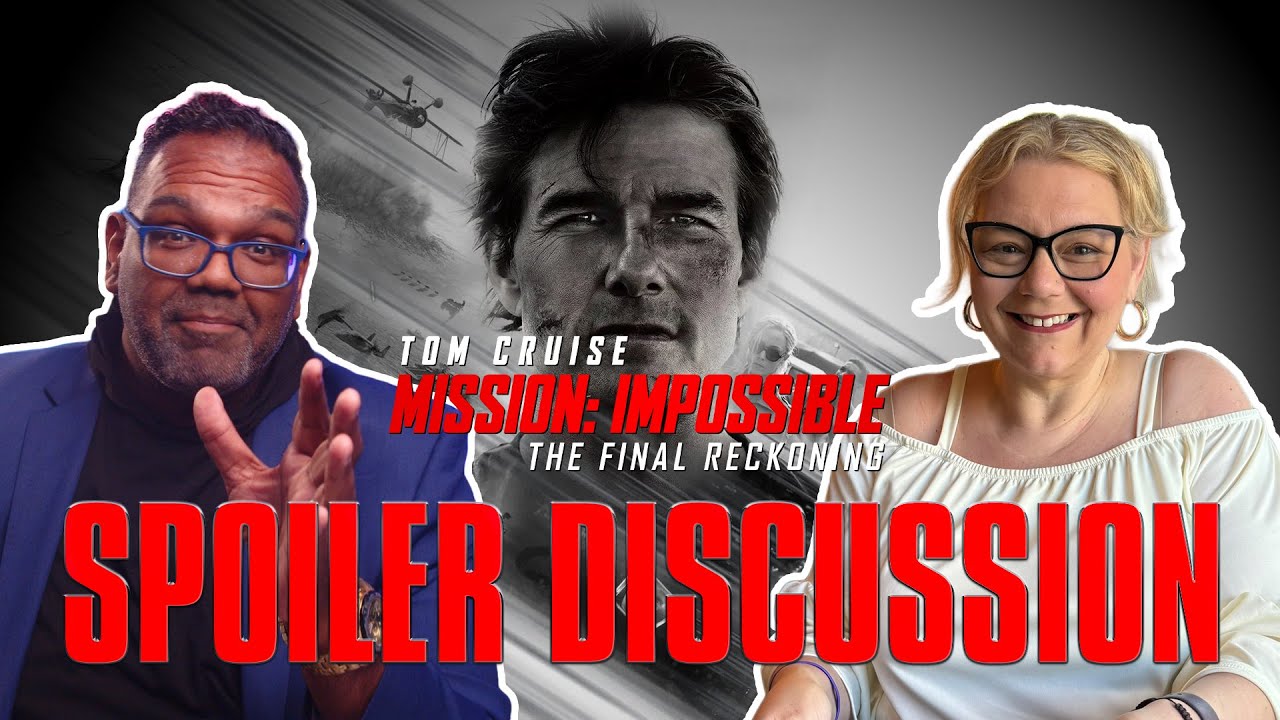
This one’s a little different. Mrs. Know-It-All and I sat down the day after we saw Mission: Impossible - The Final Reckoning and talked the whole thing through, and we’re going to spoil the heck out of it. If you’re not ready for that, sorry. My non-spoiler review is up if you need it. I’d planned to give my score there and decided to wait for this one, because this is the conversation that makes my score make sense. It’s had a day to sit with me and digest, and I changed it slightly. So did she.
It’s the last hurrah. Allegedly. He’s been playing this role for something like 30 years. We went back and forth on the date, so I looked it up: the first one came out in May of 1996.
All the Tom Cruise-isms, and a Thank You
The Final Reckoning was originally going to be Part Two to Dead Reckoning Part One, and they ended up changing the name. The word I heard, industry-wise, was that people assumed they weren’t going to get all the answers in a Part One. It’s almost a Deathly Hallows situation from Harry Potter, where they broke up the last one and everyone thought it was a cash grab, even though the story really was just too big. This was a big story too.
You get all the Tom Cruise-isms. All the running. I’m exhausted from watching him run. And you get all the Mission: Impossible-isms too, multiple versions of them: the masks, the run, this message will self-destruct.
You run into this thing watching these movies. Every time something defies logic, defies sanity, something that’s clearly a set piece of some kind, you go, “Yeah, he did this. I guarantee it.” And if not all of it, most of it. We know he’s a pilot. We know he jumps out of planes. I do believe he honestly jumped out of that plane. Whether all the climbing through and on top of the airplanes happened that high in the air, I don’t know, man. It’s hard to tell, because he does his own stunts and he’s more involved in the marketing than I’ve ever seen any talent be.
Our screening was a fan screening, and he opens it by thanking us. Thank you for coming, thank you for seeing it in theaters, I hope you like this. The only other time we’ve gotten that was when we saw The Chosen in theaters and got the thank you from the director. And he’s massive up there, like IMAX massive. They punched in so far it was his bust. You saw every pore of the poor man’s face. You saw his age, too. You saw it a lot in this.
Grace, the Team, and the Movie After This One
They built a ragtag team, which is very Mission: Impossible. Hayley Atwell plays Grace and she’s so good. In Dead Reckoning she was told she’d be given a choice, and she took it. If they ever reboot this the way Reacher got rebooted, building it around her would be kind of cool in my book.
Give it time to breathe first. Three, four, maybe five years. Give us some distance. Then you do another Mission: Impossible. You bring Simon Pegg back as Benji. You definitely bring Hayley Atwell back. Pom Klementieff I can take or leave. She’s fine, I get it, but I didn’t miss much from her. You bring back Rolf Saxon, who plays William Donloe, the CIA analyst. You bring back Degas, played by Greg Tarzan Davis, because he played a massive role in this movie and had a lot of screen time. And since Angela Bassett is still president, you have one of the people from the war room with her become president. Now you can carry that.
See, we’re writing a movie for whoever wants more ideas. Hollywood, or a really good Amazon series, because Amazon’s got Reacher and Jack Ryan, Wheel of Time is hitting on all thrusters whether you like it or not, and Rings of Power looks amazing money-wise. Announce it in about three years. We hear about the character of Ethan Hunt. Maybe Simon Pegg leads it. Let it be the other mission teams, in that small prestige eight-episode format. Not everything has to be world ending. And if you can get Tom Cruise, he doesn’t have to be on video. Have him be a voice giving the missions once in a while. He might not do it, though, because he’s big into cinema. He wants people to see these things in a theater, and I respect him for that.
The Knife, the Analyst, and a Son Named Phelps
One of the things I loved is all the flashbacks, and they don’t stop after the beginning. I don’t mean long scenes. Just shots of him, of what he’s done.
That takes you back to the CIA analyst. When Ethan broke into the vault in the first movie, the knife got left behind. So up near the Bering Sea, when he sees the analyst again, the man hands him back the knife he dropped. Unreal. And you find out that’s when he quote unquote lost his job. If you remember the scene, Kittridge leans over while they’re talking about the vault break and says, “I want him manning a radar tower in Alaska by the end of the day. Just mail him his clothes.”
This is good storytelling, because it lands right when Ethan is debating what his decisions have brought. Is this my fault? Have I made bad decisions to this point? He apologizes, and the dude looks at him and says, for what? I found the love of my life. I’d probably still be there, and I’d be miserable.
They did retcon him a little, and by that I mean they retroactively gave us new continuity. It turns out he designed the software of the Black Vault. They made him a Benji-level tech guy. We all assumed he was the analyst who comes in, does his morning work and that’s it. So when they fly all the way to Alaska for the discs, he tells Benji they’re wasting time, because he already knows what was lost. He already has the coordinates in his memory. “You know the coordinates?” “Yeah, bro. Here.” Meanwhile they’re soldering together this high-tech nonsense to read the magnetic tape, an old-school floppy drive basically. For all we know they were building a microwave.
The woman who plays his wife is Lucy Tulugarjuk, as Tapeesa. She only had a few lines, in her native tongue, and she emoted everything amazingly. She’s teaching Grace the language and how to run the dog sled. Give her some more lines in something.
Then there’s Shea Whigham’s character, Briggs, who was introduced in the last movie as Degas’s partner. You find out his last name is actually Phelps. He’s Jim Phelps’s son. In the original series, Jim Phelps was the white-haired guy, played by a different actor, and that actor didn’t want to do the movie because he didn’t like the direction they were taking the character. They were going to make him a traitor, in essence. He liked his legacy the way it was, and that’s fair. Jon Voight picked the part up instead. So making Briggs his son worked for me, especially because at the very end he finally gives his sign-off on the whole thing.
The Rabbit’s Foot Finally Means Something
It’s as if they knew they had to make sure people remember, because they went deep. They went all the way to the first movie. You see scenes from the second, but they don’t get into it much. Where they really jump back in is Mission: Impossible III, the J.J. Abrams one, which is where they introduced the Rabbit’s Foot.
This is the part that felt straight-up super contrived and also made the most sense. J.J. Abrams always gives you the question box. It’s the MacGuffin. It’s the thing you’re looking for, and they never tell you much about it. They even lampshade it in that movie, with Benji calling it the Anti-God, something so terrible nobody should ever get hold of it. Then at the very end it’s handed off and Ethan never worries about it again. They used the MacGuffin to tell Ethan’s story, about his wife at the time, the whole bit.
So you spend all those years assuming it was a virus, some kind of pathogen. Then you get to this movie and find out it was the base source code for what was going to be the Entity.
My brain exploded. One, I’m a huge continuity fan. Two, that clearly wasn’t the plan when J.J. Abrams did it. But Christopher McQuarrie and Tom Cruise were able to put that thought together coherently, and though it’s corny, it’s on brand for Mission: Impossible. As Mrs. Know-It-All put it, it’s never what you think in these movies. That goes for the people, the items and the story, and for the ending of this one.
The Villain I’d Have Written
The movie picks up two months after the last one. For two months this AI called the Entity has been running roughshod over the world and taking over the nuclear arsenals of the major nuclear nations.
Christopher McQuarrie and Tom Cruise didn’t write an amazingly deep script. There’s wonderful dialogue, wonderful moments and scenes, but this wasn’t War and Peace or Shakespeare, and that’s part of why my score changed. At its core, the enemy wasn’t even the enemy. There’s no big bad like you’re used to. It’s literally AI. And I’m sorry, Gabriel’s garbage. He’s the middleman. The Entity is the boss, and the only thing that made Gabriel matter was that he believed he could control it. So we’re stuck chasing Gabriel while the AI just tries to eliminate the human race, and that plot thread is every AI plot thread you’ve ever seen in the history of ever. They don’t tread any new territory. The AI stopped being interesting last movie.
I’m about to do that thing I do where I write a better movie, or at least a better plot.
Let the AI do everything it’s done to this point. Then there’s the moment where Ethan gets into that coffin thing and it goes into his head and talks to him. My first thought was that it would download into his brain and control him. What if it had a conversation with him instead? What if it explained that its goals were actually benevolent? It wants control because humanity will keep hurting itself. Give it this hardcore altruistic throughline, with Ethan arguing the whole time that you can’t override man’s free will. Now we’ve met the villain, and you can’t even call it a villain.
That puts ambiguity in Ethan, because he knows he can’t explain to the rest of the world that this AI isn’t trying to kill us. No one’s going to believe him. So he still has to stop it. The Entity could still want him as its new avatar. Remember, in the last movie Gabriel had that earpiece and the AI talked him through what to do, what to say, when to move. Now Gabriel’s been excommunicated and wants to take control of it himself. That’s a three-way tension, far more interesting than just the pursuit.
Then toward the end, Gabriel puts things in place so the Entity’s perceived plan becomes the real plan. The Entity never wanted to harm mankind. It tells Ethan it has to depend on him, and that there’s only some thousand-millionth of a percent chance he succeeds. And he says, that’s what I do. Have the AI hold for a second, running through its files on him again. Confirmed. Confirmed. You’re the only chance. Should you wish to accept this mission.
See, that would have been so dope.
As it stands, Ethan ends the movie in possession of the Entity. Even he says he doesn’t know that it’s the right thing to do. Grace makes the argument: I don’t trust anybody else, so who would I trust but you? He’s been the world’s guardian angel all this time. They live in the shadows and they die in the shadows, so for all we know he’s gone into hiding with this glowing USB drive the size of a Jenga block. Bro, what are you doing?
It does leave the door open. The AI is out there. Tom Cruise doesn’t have to do any more stunts, and if he comes back as Ethan it’s a small cameo, or a voice assigning the missions. The IMF has become somewhat ambiguous over this franchise anyway. They’re a clandestine service that doesn’t align with anybody but the world’s best interests. That’s way off the original mandate, because the series started as America’s response to James Bond: a team where everybody specialized. Your weapons expert, your disguise person, your tech person, your point man, and a femme fatale who usually ran the heist. Look at Grace. Greatest pickpocket ever. It’s all about timing.
So Many Bombs, and Luther
The stakes were sky high, and the tension runs the entire movie. Mrs. Know-It-All’s Apple Watch dinged her wrist because her heart rate was up, and she showed it to me in the theater. Neither of us felt the three hours.
I’d forgotten Ving Rhames’s character had been injured in the last movie. Luther’s bomb came down to a choice: nuke five miles of the city, or disarm the nuclear part and just collapse the tunnels. He was so injured and so ill that he knew he was going to die. He gave a great speech while he was undoing it. And then he thought ahead. His “this message will self-destruct in 5 seconds” also destroyed the base code hard drive, so they could never rebuild this thing. Brilliant to the end, and the most perfect fulfillment of the character we were sold in the first movie. He died doing what he was really good at, which was saving lives.
Then the end. Ethan’s falling, he puts the thing in, and Grace is sitting there waiting for the light to turn green, because the second it does, she has to pull it. In the blink of an eye. That was the big tagline. I could be wrong, but I could’ve sworn she said “Ethan” when the light went green.
There’s new lore I love too, and maybe it’s from the original show and I missed it: everybody here was once given a choice. Should you accept it, your mission is to be this safeguard, to be ready when we call, and if you get caught, we’ll disavow you. It’s such a neat concept.
The Verdict
Mission: Impossible - The Final Reckoning lands at a 9 out of 10 on the Know-It-All Index.
My original was a 10. You walk out of this thing blown away, and it doesn’t feel like its runtime. It’s one of those rare movies that throws you into high gear and keeps you there, once you get past about 20 minutes of exposition up front. I brought it down one. It’s still an amazing ending for the series. It stuck the landing. It serves the legacy of Tom Cruise, of Ethan Hunt, and of Mission: Impossible. Back in the ’90s everybody was turning TV shows into movies, and this is one of the rare ones that did it right and has stayed consistent all this time. And I really like this last run of Christopher McQuarrie’s. Pretty much since Ghost Protocol they brought back the team mentality, after it had briefly become the Ethan Hunt show.
You can call it messy, and a lot of critics are. Yes, it’s all those things. Mission: Impossible has always been messy, because that’s what keeps you guessing.
Mrs. Know-It-All took hers down to a 9.5 out of 10, for one reason: she wanted Ethan to die at the end. Luther died, and she thinks it would’ve been very poetic to see Ethan die saving the world from a nuclear catastrophe. A couple of times during the movie we leaned over to each other and said, I bet you he dies in the end. Then the parachute fails and there’s a backup. It didn’t spoil the movie for her.
Its budget was 400 million, allegedly, and no Mission: Impossible movie has ever made that much. Some people argue they don’t see the money on the screen. I kind of do. We didn’t get car chases, we got airplane chases, and they took a production of easily a thousand people on the road. I hope it makes enough for them to see it as a success. Go see it.
One more thing. I had a really great comment the other day from somebody who said they’re happy I engage with my audience, encourage discussion and don’t ridicule anyone for their opinions. Yeah. We’re trying to build a community here, and mine’s not the end-all be-all. Don’t get me wrong, I think my version of this movie would’ve probably been better. (“And there’s my husband, ladies and gentlemen.”)
Your turn. How would you have liked the ending? Should Ethan have gone out saving the world, or is the man in the shadows with the Entity the right last image? Good or bad, let’s discuss. The conversation lives in the comments on the video above.