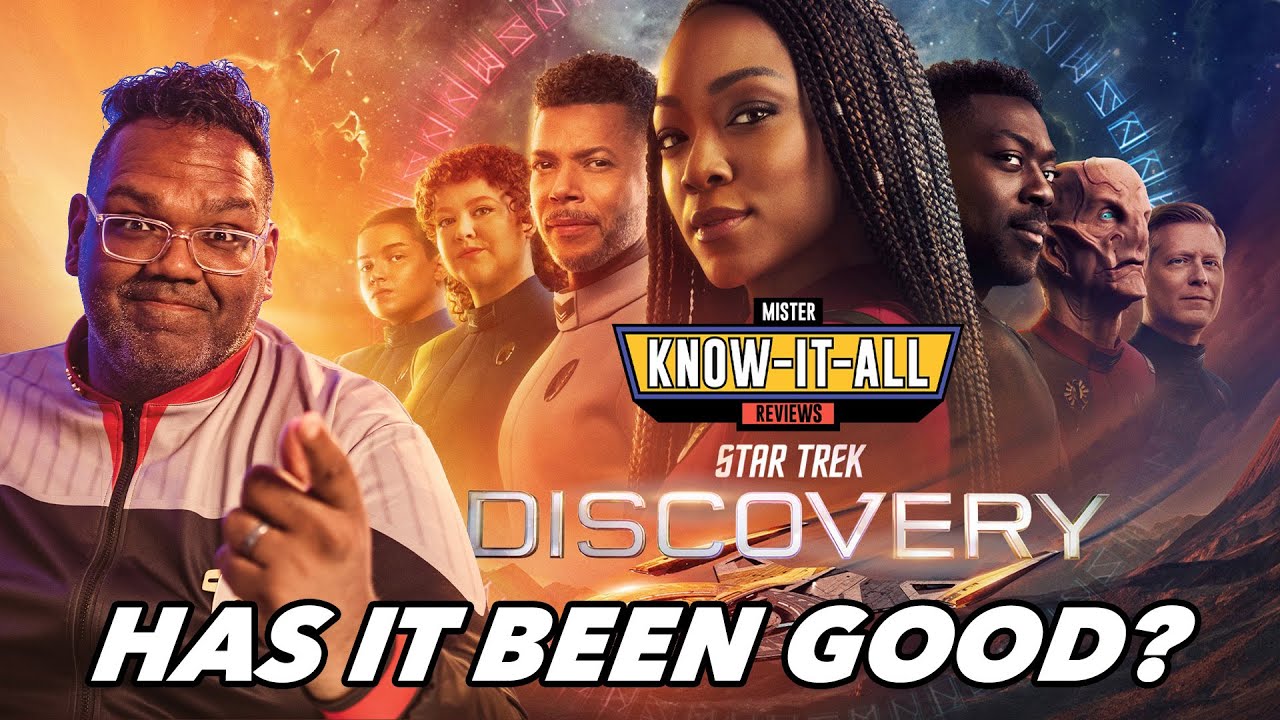
A season of Star Trek: Discovery is what we used to call a two-part episode. That seems like a way oversimplification, but stick with me, or as we like to say these days, walk with me. It took me four seasons to see it, and I know there are those of you who’ve always gotten it, who are sitting there right now like, really, you just got that now? Yes. I did.
A brand new season of Discovery is about to drop into our laps, which means I had to go back and rewatch last season, which I’d watched before but never reviewed on the channel. And I haven’t been very excited for this show, let me put it that way. It didn’t appeal to me at the start. I’ve always said the first two seasons were very messy, and I still stand by that. I think season 3 began to clean things up, and season 4 was utterly and totally amazing. Looking back, season 2 was probably better than most people think, myself included.
Then I was on YouTube clicking around and I found the episode of The Ready Room where Wil Wheaton, Wesley Crusher, whatever, talks to Sonequa Martin-Green, who plays the captain on Discovery. She said something very specific. She said, “we’re a hyper-serialized story told like a novel in chapters.”
That idea blew my mind. I just rewatched season 4 with those new eyes, and season 4 is brilliant. I kind of want to start at the beginning and watch seasons 1, 2 and 3 again the same way.
What Hyper-Serialized Actually Means
For the layperson, here’s what I’ve discovered, no pun intended.
When Star Trek began in the ’60s, it was meant to be episodic. Gene Roddenberry wanted you to be able to jump into any episode whatsoever, with zero context, and know where you were. It gave the show a universality that would make syndication very plausible and very lucrative.
Back in the day, television only ever ran once. You missed an episode, tough. You had to wait until they started doing reruns down the road. Then, after a show left its standard run, other networks would pick it up in syndication. You had to have so many episodes, and that would let the show have a life after its original run. He wanted Star Trek to have that universality for everyone, and it was a brilliant idea. The series literally stands up. You can watch any episode of TOS and jump right in, for the most part. You can watch any episode of The Next Generation and jump right in.
Later on, when you got into shows like Deep Space Nine, and after that Voyager, they began to become a little more serialized. You’d have two-parters and whatnot, though it wasn’t hyper-serialized by any stretch.
On the old show you’d have these big problems, these big issues that involved multiple cultures, and you’d get a two-parter out of it. Between the breaks you’d get, you know, captain’s log, stardate whatever, for the last week we’ve been investigating this thing, blah blah blah. What Discovery does is, instead of those jumps, you stay with them during that week. It’s almost like they’ve taken the Star Trek novels and given you what a novel would be as an entire season. You’re on one adventure for the whole year.
So I sit here and go, oh my gosh, what was I thinking? Why did I have this mentality?
How Discovery Ended Up a Prequel
There was a heyday where sci-fi became a glut, and you lost Star Trek. It went by the wayside. It was relegated to films, and we got it once in a great while, very similar to a lot of other sci-fi series of that type. There was very little by way of Star Trek. We weren’t going to get any serialized storytelling for a while. We were stuck with movies, and the movies were doing middling at best.
The J.J. Abrams reboot in 2009 kicked everyone in the butt. High octane, over the top, and it was the first time we were going to see a different actor portray Spock. Some people were like, hey, this breathed new life into Star Trek. I know I enjoyed the Kelvinverse movies, problematic parts or whatever else, and by problematic I just mean parts that weren’t very Star Trek-y. I thought Star Trek Beyond was actually the best of them. It felt the most like Star Trek. And of course they recently announced they’re not going to do the fourth one. Around that time people were very gun-shy, and it began to beg the question of when we were going to get a new series.
There’s a tiny bit of backstory here. There was an executive in TV named Les Moonves, and he wanted to keep Star Trek separate. There was the TV property and there were the movie properties, and there was a weird jiggery-pokery happening between CBS and Viacom at the time, where they were separate entities. There had been a class action thing, the company had been split, and it did its best to separate certain things, but certain agreements and contracts were stuck outside in limbo. That forced the movies to be what the movies were. Then when the series eventually came out, it couldn’t jump right in because of all this copyright nonsense.
So they went prequel, and when they went prequel they introduced things. Some people were like, what’s this, what’s that? They’ve explained everything away in storytelling mode very well. How can Michael Burnham be related to Spock? How come no one’s ever talked about it? Well, it was super highly classified, to the point of being treasonous if you talked about it. To me that excuse works as well as anything else in Star Trek does. If you try to think too much about it, trust me, there are a million and one things I can bust your chops about that don’t hold up as well as this idea does.
Star Trek of a Different Flavor
I did a video before asking whether Star Trek: Discovery was as good or as bad as it was before. It was a good video about how Discovery really sat in the lexicon, especially coming from someone who wasn’t the biggest fan in the beginning.
Well, now I’ve turned a corner. Star Trek: Discovery is Star Trek all day. It’s Star Trek of a different flavor. It told stories differently.
There are many people who’d make the complaint: why is everyone talking so much, why is it so slow? What are you talking about? Just look at this last season. This is Star Trek at its best. They were exploring a brand new civilization, and rather than going shooty shooty bang ‘em up, they were determined to have a peaceful first contact as best they could. They weren’t going to draw guns and weapons. Yes, there were people everywhere saying you’ve got to destroy the 10-C, you’ve got to destroy the controller, you’ve got to destroy the DMA. Violence, violence, violence. And there’s the crew of the Discovery, and the president of the Federation, every single one of them trying their darnedest to say no, we’ve got to be better.
That resonated with me so much as being what Star Trek has always been.
The Jump to the 32nd Century
Plus you had the introduction of Christopher Pike, from the end of season 1 into season 2, and then eventually you get to the big event, which flings Discovery and its crew to the 32nd century, way off in the far-flung future. That was arguably the smartest decision they could’ve made. I’ve never liked the fact that we continually went backward.
All of a sudden you could rewrite the entire book, because Star Trek has always been about moving forward. From TOS to The Next Generation, Gene Roddenberry wanted there to be a big enough swath that he could have a different take on the ideas. That’s why you went from Captain Kirk lording over everybody in the center chair to suddenly having command by committee with Picard and his first officer. It was a different way to look at the structure.
So now Discovery jumps to the far-flung future, and the events we’ve explored are in the past. They reference stuff. When they’re trying to figure out the 10-C, they ask, could it be the Q Continuum? And the answer is that nobody’s heard from them in so long.
If I had to knock anything, I don’t like that we’ve lost some of the supernatural of space. We’ve lost the omnipotent beings and stuff like that, in lieu of a much more grounded sci-fi structure. I’d argue that structure still presents us with pretty amazing things, and the 10-C is the example I stand on. They’re an amazing culture, an amazing species, and how we learned to communicate with them was so incredibly Star Trek it’s ridiculous.
When you look at Discovery’s impact, Discovery laid the groundwork for what would become Strange New Worlds. It’s what eventually gave us Lower Decks. It’s leading us to the Section 31 movie with Oscar award-winning Michelle Yeoh, and now into Starfleet Academy, which I’m so happy to hear is going to take place in that same era, so far into the future. In my opinion it’s establishing a brand new area of what Star Trek is and what Star Trek is supposed to be. I think it’s going to be huge.
Michael Burnham Stands With the Giants
When you take this kind of minute look at storytelling, and actually look at the chapters of the story and everyone’s relationships, what you’re seeing is growth on a level you really didn’t get to see before. Character development used to take twenty-some-odd episodes. Now you get to see everybody developing at the same time, together, because each adventure doesn’t have to fit into 50 minutes. It runs across multiple episodes.
Start with Sonequa Martin-Green’s Michael Burnham. Burnham goes from being the person who would step forward and mutiny, to being the person doing everything she can to keep the Federation together and grow it back, to the place she’s at as she’s about to begin the fifth season.
I’m going to be real here for a second. She’s shown more arc than we ever got from Captain Kirk. It took years and multiple movies to give us the kind of growth we’ve gotten from Michael Burnham in five seasons.
People have argued she’s a Mary Sue, she’s this and that. I’d argue that then Kirk was a Mary Sue, and so was Picard. These are people who arguably never failed in any meaningful way, and even their failures turned out to be successes. So that argument doesn’t hold water for me. She stands shoulder to shoulder with the likes of Janeway, with Picard, with Kirk, with Sisko. She stands with these giants in our fandom, and I believe she’s absolutely earned the place she’s at, especially with the story arc we’ve seen.
Tilly, Saru, and the Archetype
Mary Wiseman’s Sylvia Tilly has gone from being this demure, quiet, somewhat introverted, shy but awkwardly big once in a while character, to a bigger than life personality who has found the direction she wants to go in. I need to look up who’s been cast, because if she’s not in Starfleet Academy it’s a missed opportunity, with all the groundwork they’ve done on her character. I think she’d be brilliant in that show. If she isn’t one of the stars, she should definitely be a recurring cameo, because she’s unbelievable.
Then look at Doug Jones’s Saru. Doug Jones is brilliant beyond words. He’s so accomplished and so talented as an actor. With Saru they’ve taken the same model Gene Roddenberry established, which is a person, and we’re going to call him a person of color, and by that I mean an alien who can’t pass as human. Vulcans, you stick on a little bandana and you’re passing, okay? Saru is clearly a different thing, just like Spock was, just like Data was, just like Odo was. He’s the ideal version of “we’re dealing with something alien.” He’s our signpost. He’s our Google Maps flag in the ground that says, oh yeah, this is Star Trek, here he is, right here. And he’s amazing in that role.
Saru has grown from being a prey species to being a leader, and from a leader to a complex character who has, in my opinion, transcended the archetype. Not stereotype, archetype. The one Star Trek established with Worf, Odo, Quark, Data, Spock. He stands shoulder to shoulder with all of them in that role of the sage, wizened alien advisor who can dispense wisdom and understanding, and genuinely give us diversity the way only Star Trek can. I can’t wait to see how he wraps up his story in season 5.
Stamets and Culber
Then there’s Stamets and Dr. Culber, played by Anthony Rapp and Wilson Cruz. These are two beautiful human beings, and I love their story.
There are people who’ve been like, oh, it’s woke, it’s this and that. Look, I tend to take stories where they are. I play the ball where it lies, and I leave my politics and my biases out of it. It’s Star Trek, and the one thing Star Trek has always been is inclusive. They’ve always asked hard questions and they’ve always put culture front and center. This feels correct. I don’t take issue with it. This feels like Star Trek at its best.
And Stamets was such a jerk. He was the worst. The guy at the beginning was like, just get out of my face, what are you doing, I don’t care. To see him grow into a character who’s espousing the philosophies of his quote unquote adopted kid, saying look how great they are, look how wonderful they are, and into the guy who apologizes, who’s awkward because he wants to say something and doesn’t know how. That’s such growth in that character. It’s a dynamic I’ve fallen in love with, and I think it should be appreciated in a way most people don’t.
Book, Grudge, and Everybody Else
David Ajala plays Cleveland Book, and I think that character is an answer to the question: what if Han Solo existed here? Then they go deeper, and they make him part of a species that’s so in tune, emotionally and empathically, with everything, in a way Deanna Troi wasn’t and other characters haven’t been. He’s so uniquely his own thing.
Then there’s the whole storyline of how they came to meet as couriers, and eventually his partnership with Michael, which is such an eye-opening and refreshing relationship. I don’t believe you could ever have seen it with the likes of Picard or Kirk. I believe that relationship only comes from having a very talented female captain. They dipped their toe in that kind of storytelling with Voyager, but they never fully realized it.
I love what Book brought to the table: his own personality, his really cool ship that can break apart because it’s programmable matter, and his cat. Oh my God, Grudge. What a wonderful cat. The queen, if you will. And true to Mr. Know-It-All’s heart, there’s a cat lover on the ship. Hold it down, Data. Spot’s not the only Star Trek cat anymore, and I love that so much.
Then there’s the trauma of seeing his world not only destroyed but unequivocally decimated, and being humbled by the notion that the 10-C didn’t even think we were higher-order beings. And then he stands in front of the 10-C and has to tell them no. We’re either all together in this universe or we are not. You cannot allow this thing to exist. It destroys. That was so ballsy that I was like, I really love the character of Book. Now he’s having to go pay penance, and I do hope we get to see something of him in the fifth season. I hope he’s not gone completely. Seeing his journey wrap up the way it did was very significant for me.
Then you have the ancillary characters. I say ancillary, but the truth is all of them have mattered so much: Owosekun, Detmer, Rhys, Adira. Adira’s is an amazing story. The first human to be joined with a Trill symbiont is such an interesting storyline, and I loved watching that character grow. Seeing Anson Mount introduced as Pike, and his journey to where he is now in Strange New Worlds, is equally amazing.
And Michelle Yeoh’s Georgiou, the mirror Georgiou, who’s now going to be front and center in Section 31. Her arc, from being the evil, nefarious former Emperor of the whatever to suddenly being a character who can find a way to care, only happens in Star Trek. I think it’s brilliant.
The Legacy, and What Discovery Got Wrong About Itself
The series shines most when it understands that it’s telling a story that fits into the grander narrative. The times they’ve mentioned Picard’s name, Q, other people and other ships from the past, they’ve really explored the heritage of Star Trek, and I believe that heritage is upheld in every single episode. I don’t care what anybody says.
Is this your dad’s Star Trek? No. That doesn’t make it bad. If you’ve ever read a Star Trek novel, then this is the story you were reading. When I read Peter David’s Imzadi for the first time, I got this nuanced look at Betazoid culture. I got to see Riker and Troi and really understand the past, and it informs so much of the characters. That’s all this is. They’ve taken a book and turned every episode into a chapter of that story.
I believe Star Trek is better for Discovery having existed. Do I think it should’ve continued? Sure, there are more stories to tell. I also get that those are business decisions.
There’s a loud, vocal minority who’d sit here and say it’s woke, it’s this, it’s that, it’s the other. Look, I do believe there have been times the show has incorrectly tried to claim itself as being something, because I’m sorry, Star Trek has always been diverse, and it isn’t fair for Discovery to act like it’s the only one that ever did it. Every series has done it to the best of its capability. What I believe is that Discovery is the first series to benefit from a society and a culture that’s prepared for the fullness of what Star Trek has always tried to be. That’s definitely Discovery, without a shadow of a doubt.
What I Expect From the Final Season
I’m expecting adventure. I’m expecting some really great, intense storytelling, and a side of the story we’ve never seen explained on this level. I’m ready for it.
They’re not dumb. They’re going to get us to a place. And then I want to know when the Discovery movies are coming out, because as far as I’m concerned that’s the next step. Give us some more.
Because of the nature of the storytelling, this is the first series with the ability to write a story that ends the adventure in a way that makes people go, okay, I see, I feel complete. The closest thing we ever got to that was The Next Generation’s “All Good Things.” Up until Picard season 3, that was, for me, one of the best endings a series has ever gotten. Now Picard season 3 sits right up there, neck and neck if not head and shoulders above, as one of the best endings in television. It’s a victory lap.
So Discovery has an opportunity to end on such a high note that people sit here and go, man, that was amazing television. And it has been. It started in a messy place, due to internal politics, external politics, whatever, and it’s coming out as this wonderful, beautiful symphony telling an amazing story with amazing characters.
The Verdict
Star Trek: Discovery season 4 deserves a solid 10 out of 10 on the Know-It-All Index.
I never got a chance to review season 4 on the channel, so that’s a belated score for it as a season.
I think Discovery is worth the watch. If you haven’t watched it, for whatever crazy biased reason, understand something: you’ve only missed out on the adventure of a lifetime. Give yourself a shot and check it out for yourself.
It’s a different style of storytelling. They took what Deep Space Nine wanted to do, and what Voyager later tried to do as well, and they went to the furthest degree with it. I believe we as a fandom are better for having had it. And Strange New Worlds has introduced a new way of telling serialized stories that feels vibrant and exciting, and it’s breathed life back into that particular era, at least for me. I can’t wait for Starfleet Academy.
What do you think Discovery’s lasting legacy is going to be? I’d love to hear it, within the context of what I’ve outlined here. If you don’t agree, awesome, we don’t have to agree. I’m glad you like the things you like. Please respect the things that I like. The conversation lives in the comments on the video above, and the review of the first episode of the final season is next.