
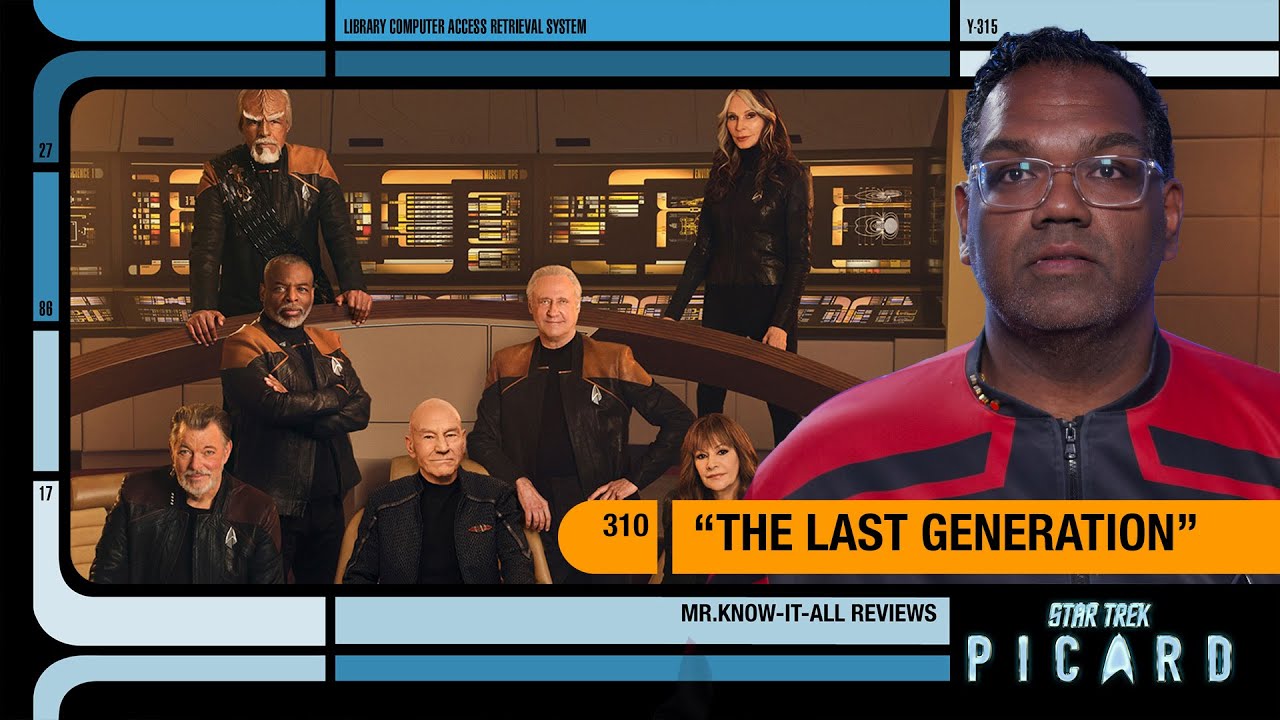
We’ve finally arrived at the end of this season, the end of the series actually, of Star Trek: Picard. The whole series has been a love letter to those of us who are fans of Star Trek: The Next Generation, but season three has been genuinely special, and I just want to take a moment and reflect on how special it’s been.
I want to say nostalgia, but it’s not really that. It’s been a journey through my past, an homage to something beautiful. It’s one of those things where you get an opportunity to talk about something you love, and then it nails it this hard. Wow.
The promos and trailers had already taken this whole encounter up to a level where I didn’t realize I could be this excited.
The Enterprise-D Is the Cavalry
On the way there, the president of the Federation, Anton Chekov, voiced of course by Walter Koenig and supposed to be the son of Pavel Chekov, is giving a warning to stay away. State of emergency. You can hear it in the background, and it’s rough, man. He’s basically transmitting an intergalactic distress signal.
Then we get the scene we’ve seen in the promos, the crew on the bridge of the Enterprise-D, heading toward trouble and scanning to figure out what’s going on. “The fleet has initiated an attack formation against Earth. Orbital weapon platforms have been destroyed, but Spacedock’s defenses appear to be repelling the assault, for now.”
So Earth is being attacked and Spacedock is being bombarded. Spacedock apparently is part of the planetary defense system, so it’s generating a shield around the planet, is my understanding. Which is cool. I don’t think I ever understood it on that level. Sorry, I’m geeking on a whole new level right now. And they basically admit there’s no one else coming. The Enterprise-D is the cavalry. Once more it’s up to the brave crew of the USS Enterprise to save humanity. You gotta do what you gotta do, man.
Can I just call this out: every beauty shot you see of the Enterprise-D mirrors a shot from the original series. There’s this moment when they arrive at Jupiter and we’re seeing the ship from behind, and it looks like a triangle. When I was younger, as an artist and illustrator, I used to love that exact framed-up shot. It was gorgeous. Not only are they giving homage to the Enterprise-D and the crew and cast, but man, are they doing homages to the filmmaking and the production design. Very on point, but what else would you expect from a show that’s been nailing it this hard all season? I didn’t expect any less.
Anybody else catch Riker leaning forward with his leg up? Frakes has got to be loving life. I wonder how much of that is “hey, can you put your leg up on the thing,” or is he just like, you know what, I’m gonna do exactly the thing I’ve always done. I loved it. Those are fun little Easter eggs. They’re not big giant ones, but they’re still pretty cool.
The First Naturally Born Borg
As they’re scanning what’s coming from the Borg cube, you find out Jack is the Borg signal. They’re funneling their signal through him. He’s the first naturally born Borg, and later on you find out that’s far more significant than most people would think. It also answers a lot of the questions that have been asked. I know my fellow Buffer Timers and I have talked about how the Borg operate now. What happened? Where’s the Jurati Borg? What’s the state of things if these are also the Borg, and they’re this dangerous?
Picard sums it up: the only way to save Earth is to sever that connection, whatever that means, and we don’t know the extent of what it means yet. But that’s what they’re doing. Boom. Set a course.
And that’s when they do that really great shot. It looks like a Borg cube, yes, but it’s more like a Borg superstructure. We’ve seen Borg cubes, and the Enterprise-D was, relatively speaking, decently matched. This thing is vastly bigger, with these protrusions coming through it, almost like pylons that have shot forward, and the Enterprise is coming up through it. It gives you this sense of scale. The D is so big that it has to move a certain way. It’s got heft and weight to how it moves, and that’s what marries it so much to the storytelling, at least for me. That’s really deep geeking, by the way. Forgive me.
Then we cut to a breathtaking scene of Spacedock being bombarded by all 200 or however many ships, just bars of phaser fire, unrelenting. It genuinely took my breath away. I don’t think I’ve ever seen anything that destructive in Star Trek. Maybe Nero’s mining ship in the 2009 J.J. Abrams Star Trek, but in Star Trek proper I’ve never seen anything that devastating.
Seven Takes Back the Titan
On board the Titan, Seven is leading what’s left of the crew, which is like a doctor, another ensign, another lieutenant, and some guy who I believe we find out is a cook or something. They take back the bridge, and they do it with weapons that transport whoever you hit away. I’m like, this is the coolest thing. You may have invented the first Beam Me Up gun. It’s neat how it worked, too, because they ran the transporter into the whatever. Sorry, former chief engineer.
Back at the fleet, they’ve worked out a plan. If it’s line of sight, how the fleet formation technology connects all the ships, then cloak the ship. They cloak and immediately they’re disconnected from the thing and can go around. So they start scrambling shields and doing strafing runs. The problem is they can’t fire unless they’re visible, so it keeps getting closer and closer, and then the fleet starts using predictive algorithms. Because why wouldn’t they? We’re doing that today. This is one of those moments where real life echoes the progression of the universe at large.
There’s a moment where the guy who was a cook but also trained as a pilot turns around and asks what they’re going to do against all those ships. And Seven stands and gives a speech worthy of a captain in Starfleet. You can totally tell that after serving under Janeway she’s learned how to give good speeches, because that’s exactly what she does. We are what’s left. We are Starfleet. I swear, if she’d said “this far, no further,” I would’ve been like, oh yeah, totally, that makes sense. It’s a wonderful speech. I enjoyed it.
And can we talk about Beverly being a tactical officer of some kind? She’s out there calling the shots, bam, torpedoes away, the whole thing. Everyone’s looking at her like, what in the world, and she says a lot’s happened in 20 years. And I’m sitting here like, yep. It’s true.
Data, Hate, and the First of Many Goodbyes
You get this really wonderful scene of our bridge crew just talking through the scenario. And Data. How do we feel about Data expressing hate? Because he’s now fully melded and merged with the Lore construct, he’s got a familiarity with those emotions. I think that’s why he’s as tempered as he is. I don’t know that I’m okay with how he expressed it, but it makes sense.
Deanna can sense that Jack is being consumed by the Collective. He’s getting harder and harder to pin down.
Then you get the first of many, many goodbyes to come. It’s going to be Worf, Riker and Picard going over to the cube, and as they leave Picard turns around and says it’s been an honor. That felt super defeatist. I’m like, bro, we’re gonna see you again, right? Hello?
Once they’re over on the Borg cube, Riker and Worf notice that the drones are being cannibalized. The ones that are left look zombified. Zombie Borg. For an enemy that already looks like zombies, they made them much more sallow, even rotting. I didn’t know that was a thing that would terrify me more, but yeah, it could. Congratulations, Terry Matalas and the folks over at Paramount. You’ve managed to make the Borg even more terrifying than I thought I could imagine.
When they arrive, Beverly says she can detect Jack on the level below, and Picard knows exactly which part of the hive that is, and Riker’s like, how in the world do you know that? Then Beverly gets this technobabble line that basically says maybe some latent part of your makeup is still connected. I don’t know if that flies. I’m not gonna be that nitpicky fan, but sometimes you don’t have to address everything. The thing you don’t talk about is often the thing people just let go. When you focus on it and say “oh no, it’s totally not that,” it makes me think it’s totally that.
They get to a junction point, and Picard tells them he’s not their captain anymore, he’s got to go be a father. Another goodbye. Number two or three at this point, and there will be many more.
Mom and Dad, Stop Fighting
When Picard finds Jack, he looks like a very young Locutus. He totally does. Same side-of-the-face apparatus. Funny enough, his hair is still properly coiffed. Here’s a Borg with a hairdo. Whatever, man. He’s standing there giving commands, saying the things everyone else is saying, and nothing sounds quite so scary as commands that remind you of high school cheerleading. Fight, fight, fight. I thought that was hilarious.
I’m not going to cover each and every moment of what follows, because it’s extraordinarily Star Trek-y and I kind of didn’t need all of it. Just saying. The Borg Queen is voiced by Alice Krige, with a body double (forgive me, I didn’t get a chance to look up who played the physical part), and they chew the scenery. You get everything from Picard doing his classic stern stare to her telling him not to be so this and that. I feel like they literally just continued the argument from Star Trek: First Contact, like an old married couple. If I were Jack I would’ve woken up just to say, Mom and Dad, come on, stop fighting. Oh, and by the way, don’t call her his mom, because you are not his mother.
My note here says the pomp-off continues. It’s a through line. Back and forth, back and forth, and it’s one of those confrontations that goes on for so long it starts to feel disingenuous. I just stopped believing the argument was still happening at that level.
A Good Day to Die
Riker and Worf, which is the reason they split off from Picard, find where the beacon’s signal is coming from. All of a sudden the local zombie Borg are sent out to attack them, and now you get some really cool classic fighting. Worf is a beast with that sword, man. The mek’leth. Bro, do your thing. At one point one of the Borg swings on him and knocks it out of his hands, Riker goes to pick it up, and come to find out it’s heavy. Way heavier than it looks. Which is awesome, because that means Worf is actually swinging it that fast. Thus, Worf is strong. Yay, Worf.
I will say that during this fight I did feel like this could be the end for one of them. They’ve given us so many goodbyes that somebody’s got to be going. I figured maybe it’s Worf. Maybe Worf finally gets his good day to die, the honorable death, because for a Klingon that would be a good ending. And they actually say that very thing.
I gotta admit, when this whole series began I was certain a legacy character was going to die. I’m actually glad I was wrong. Spoilers: nobody does. But in this moment there was always the possibility.
“I Feel It in My Gut”
They arrive at the center of this thing, Geordi assesses it fast and Data confirms it. If they destroy the beacon, it creates a cascade effect that destroys the entire cube, and they’ll have minutes, if that, to get out. Geordi says there’s nobody who can navigate them through that thing. And Data is committed. No, I can do this. They’re like, are you crazy? And he says yeah, I get it, it’s impossible. Then he looks at them and says, I feel it in my gut.
I loved that moment. What else would you have, if you have emotions now? Not to mention he witnessed impossible things happen back when he was just an android. Hasn’t he? Come on, man. Absolutely he has.
Data makes the run and it’s amazing. Brent Spiner is such a magician at looking like he’s doing stuff. His hands are flying and criss-crossing and you’re just like, wow. Very cool.
Meanwhile Spacedock has fallen, and it’s one of the most amazingly tragic things I’ve ever seen. Earth is completely defenseless before an assimilated Starfleet, and they’re out of time.
Picard Plugs In
Picard, realizing the argument is moot, starts pulling cables out of Jack. The Borg Queen warns him he’d better be careful, because Jack has to want to leave, and if he wants to leave he absolutely can. So what does Picard do? I’m not going to abandon my son. He takes one of the things out of Jack’s head and sticks it into his own neck, and immediately he’s in. He’s with the Collective.
You get this very interesting interpretation of him standing in front of Jack, with a green mist that represents the Borg stuff, because green equals Borg, whatever. Jack is very fatalistic. This has been my fate, this is what I was made for. Picard is very anti-fatalist. And finally Picard says okay, if you’re staying, then I’m staying. I’ll stay here with you, because I’m not leaving you. That sacrifice tips the scale for Jack.
I’m not going to get into all the ways I don’t necessarily agree with that. I don’t believe the character they’ve outlined for us would behave that way. But I’m okay with it. We all do things out of character, and traumatic events are always capable of altering the way we perceive things around us. Jack makes the decision: I won’t be alone, I’ll have my family, I don’t want to pull him into my misery, I’ll go with them. And boom, he wakes up.
Back on the Enterprise-D, it fires on the core. Worf and Riker get another goodbye, and this time it’s the good day to die one. And it wouldn’t be Star Trek without the last-minute rescue. Tell me about that shot of the Enterprise swooping in like it’s a shuttle. Normally you only see the exterior of the ship through a window or something. Here they’re down there looking up, the thing comes around, and all you see is this unfettered sky and the underbelly of the Enterprise. I was like, right on. I thought it was awesome.
Janeway’s Influence
Right as the thing is exploding, Seven, Raffi and the rest of the non-assimilated Titan crew are confronted by Sidney and Alandra, the La Forge girls, and the other officers and ensigns all coming in. Then the core goes, the signal dies, and everyone begins to de-assimilate.
Seven comforting Sidney is a wonderful moment. And this is me speaking not as a Voyager fan, because I really wasn’t. I liked parts of Voyager, but I wasn’t a big Voyager fan. You can see Janeway’s influence, the influence of a powerful female captain who understands how to temper command with comfort. When Seven wraps her arms around her, she’s basically saying it’s going to be okay, and she’s coming from a place of understanding, because she was a Borg drone who grew up that way and has come this far, to be the captain of the Titan. Or in command of the Titan. Whatever.
The Goodbyes I Was Down For
As the story wraps up we get Riker’s captain’s log, and a very nice moment of the two ships parting ways. It’s very reminiscent of The Undiscovered Country, where we got that send-off for the original crew.
And it’s not over yet. They put so much into this episode. Beverly is now an admiral and head of Starfleet Medical, and she’s devised a way to secretly detect changelings. I thought that was awesome.
We get a wonderful moment with Tuvok, because some of the people the changelings replaced were brought back and survived. Admiral Tuvok talks about coming to a decision on Seven, the insubordination, all of it, and she’s ready to be fatalistic about it. If you’re going to do it, just do it. And he proceeds to play her last performance review, which would’ve been recorded just before all of this started. It’s a wonderful send-off from Shaw. She’s this, she’s that, she’ll break the rules, yes. But maybe those rules were broken already.
That jibes perfectly, in my opinion, with the character he was. I believe this is a guy who internally, to himself, could reconcile the past, even if he was a bit brusque when he was faced with it. I believed it and I loved it. And she’s promoted to captain and given the ship.
Worf and Raffi have a very special goodbye, because apparently someone broadcast Raffi’s service record to the galaxy, and her family gets to see the hero she’s been, which she could never tell anybody about because it was all classified. There’s a big opportunity there, too. A lot of holes have to be filled now, starting with Starfleet Intelligence.
Data gets his goodbye, and Data gets his therapy with Deanna, which is great. Then the Enterprise-D takes her place at the Fleet Museum. This is the goodbye I’m down for: everyone turning the lights off on the D, and you get to hear Majel Barrett’s voice one more time. Riker even gives a nice little nod, saying he really likes that voice. Yeah, you do.
What I Enjoyed but Didn’t Love
A lot of people are going to love what happens next. I enjoyed it, but I didn’t love it, and that’s not normal for me.
I can reconcile Jack joining Starfleet, even though he was so adamant that he never would. Traumatic experiences have a tendency to make people rethink and reevaluate their lives, and I can see him saying, I need to find new points of connection. That makes sense to me. Seven, Raffi and Jack all assigned to the same ship? Not a problem. I love that Raffi’s going to be the Number One. I love that Jeri Ryan will be captain of the ship. And apparently Jack’s a ship’s counselor of some kind, which, I mean, maybe it’s because he’s got that insightful wisdom, I guess, in that British accent. Maybe he’ll switch to blue.
Renaming the Titan to the Enterprise-G, I didn’t need. You sold me on the merits of the Titan. Its name, its crew, its valor. After everything they went through, to go “and here’s a brand new name”? The Titan spilled blood. The Titan earned a place. Not to mention this wasn’t the first Titan. This was the Titan-A, a ship with its own legacy.
I understand it, and yes, there’s precedent for it. That doesn’t make it feel any less uncomfortable for me in this moment. Maybe it’s because I loved Shaw so much. His sacrifice, and the sacrifice of his ship and crew, was the Titan. It wasn’t the Enterprise. The Enterprise-D did a wonderful job holding down the fort and making the name proud, the F stood tall and gets its goodbye, and who knows what happened to the E. I could’ve lived without it.
I loved the poetic nature of the crew playing cards. It was a wonderful callback.
I did not need the button. I didn’t need Q giving Jack some kind of Picard send-off. I didn’t need that validation. Jack has validated himself as a character. Don’t get me wrong, I’ve got my own head canon for looking past the more obtuse parts of season two, but I don’t know that I needed John de Lancie here.
At the very least, it would’ve been interesting for someone to say, hey, my father knew your father. If you’re going to do this anyway, introduce a new Q and have that new Q be the one who says it. Or maybe that’s what this is. Maybe this is Q reborn. Maybe as a Q you reach a terminal velocity and, like a big bang, you come back down, and this is him rebirthed. Almost Doctor Who-ian, where you carry your own legacy. That would’ve been so much more interesting than the member berries of John de Lancie. On the face of everything that’s been brilliant, I didn’t need that.
I’m trying to be more critical here because this has been such a beautiful love letter, and this show has had so many wonderful things, that I wanted it to stick the landing. And it did, by the way. It absolutely stuck the landing.
The Verdict
Star Trek: Picard Season 3 Episode 10, “The Last Generation,” is a 9 out of 10 on the Know-It-All Index.
That’s for this episode specifically. I thought it was wonderful. It was everything I wanted it to be. There were some leaps of logic where I needed to connect the dots myself, but otherwise I had a wonderful time.
I’ve enjoyed this show a lot. I thought Star Trek: Picard, from the very beginning, was geared to give us something new. I liked how season one gave us a look at where Patrick Stewart’s Jean-Luc Picard was, and that it wasn’t necessarily what we thought it might be. A lot of people said it was like The Last Jedi, which people felt took the story of Luke Skywalker somewhere divergent, and some people thought where Picard went in season one was divergent too. I didn’t. I was cool with it. I thought it was really good. Season two had a lot of complicated bits, and I think the story was bigger than it needed to be. It didn’t have to be that exaggerated.
Season three is perfect. I do, I think season three is perfect in how it told its story and how it handled its legacy characters. This is how you do nostalgia when it’s not for nostalgia’s sake. It said, we’re going to give you a rare opportunity as fans of a thing. We’re going to go back to those characters, revisit them, and let you see how they’re doing today compared to where they were before. That was beautiful, and that’s why I believe this will go down as one of the greatest seasons of television ever, never mind just of Star Trek.
For the entire season, the Know-It-All Index is a 9.5. That’s not a genuine average. That’s what my heart says. I followed my gut, like Data.
What a Legacy Show Looks Like
I feel like the discussion about Legacy is important, and by Legacy I mean the prospect of a Star Trek: Legacy show. What does that potentially look like?
I don’t mean to do this cookie cutter, but take the same thought process as what’s being done right now with Strange New Worlds. You let new characters establish themselves, and you bring classic characters, legacy characters, in. Especially with Jack on the show, there’s no reason Beverly couldn’t be a recurring cameo, whether it’s calling home or something along those lines. You can have one or two Picard cameos to tell us how he’s doing. There’s a lot of room for that.
If they explore anything, I’d love for Seven to feel an obligation to find out who Shaw really was. She’d be the kind of person who, while thankful and full of gratitude, would see that there was more to that story and want to know it. I feel like that’s honorable.
Was I okay with Tuvok being the one who promoted Seven? Yeah, I was. Would I have preferred Janeway to do it? Of course. But they may be saving her for something else, and I’m okay with that too.
This has been a monumental journey, seeing this crew again and what this show means to me. It was a very emotional morning, and I know I’m going to watch this episode another dozen times or more.
Share your stories with me. What did this episode mean to you, and which moments got you? And tell me what you think a Legacy show should look like. The conversation lives in the comments on the video above.


