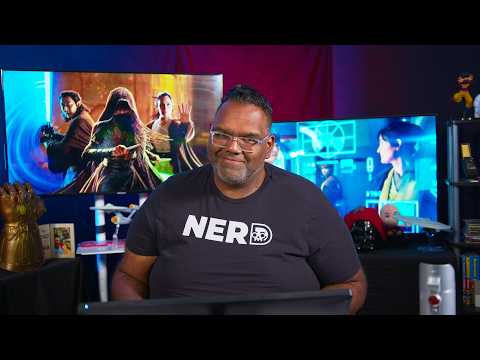
This is something like the third time I’ve tried to come in and do this, and I know there’s a whole bunch of people out there who are going to bop me for having a thought or an opinion or whatever else.
So the one thing I want to say, 100 percent, is this. If you hate this show because of woke culture arguments, or because there are lesbian witches, or whatever dumb reason you may have, we are not the same. I have real reasons for disliking this show.
I’m in Florida visiting family, which is why I’m in a different environment than normal, but I wanted to get this review out. It’s not going to be very long, because yet again the episode is not very long. I’m also not going as deep on the story stuff, and I’ll tell you the upshot right now. I was intrigued. This is not a bad episode, with the exception that it’s not an episode.
I think that’s my biggest problem with The Acolyte right now. When I tell you it’s got bad writing, I don’t necessarily mean the story they’re telling, because I don’t even know what the story they’re telling is.
There’s a Thing Called Structure
There’s a vocal group out there who’s going to say, well, just let her finish, let it all finish. Okay.
In storytelling there’s a thing called structure. More popularly, some people do it in three-act structure, and that’s usually movies. Series like this tend to do it in four-act structure, and that’s fine. You have a first act, a second act, a third act and a fourth act, and each act serves a purpose.
The very first act, generally speaking, introduces you to your character and your heroes. The second act introduces you to the situation, the dilemma, the inciting incident, whatever you want to call it. By the third act you’re deep into it, the character has had to make a choice, and now you’re moving in the direction of the resolution or the climax. Sometimes your climax comes at the end of the third act, sometimes at the very beginning of the fourth, and then you go downhill from there. Downhill, not in a bad way. Downhill in the sense that your storytelling arc has culminated and now you’re headed toward the resolution of your story, whatever that is.
Each of these acts feels cohesive and carries you from one to the next to the next. The audience should feel certain things at certain points. This is part of the formulaic way of writing. You can argue and push back against that, but trust me. I’ve written Hollywood scripts. I’ve written television scripts. I understand how this is supposed to work.
This show doesn’t do that, and it’s not even not doing it in a clever way. Quentin Tarantino in Pulp Fiction is I guess the easiest example. He does this very disparate storytelling style that jumps around the narrative, but even there, within the context of each of those narratives, you’re still getting structure.
A Movie Cut Into Smaller Pieces
Essentially what they’ve done here is Leslye Headland and her writers wrote a movie, and then they just subdivided the movie into smaller pieces.
In a normal writers room for a series, your showrunner is also a writer. Your showrunner comes up with the concept overall and says, okay, this is what we’re going to do, and you break the story together. You blue sky it, you break the story as a group, and you say, okay, this is what the story is going to be. Then everyone’s like, cool, I want to take these chunks, and everybody takes their chunk and writes their episode.
The showrunner’s job, as those scripts get turned in, is to evaluate how each one fits in the overall narrative, sure, but also how it fits within its own narrative. Every episode should still adhere to the three or four-act structure.
There are eight episodes, so I’m going to do them a favor and assume we’re going with a four-act structure. That being the case, last night’s episode was Episode 6. That means we should be at the tail end of the third act, looking down the barrel of whatever the climax is going to be. It doesn’t feel like that. I feel like we’re hip deep in the second act.
Stop Accepting Mediocrity
This entire series, tonally, has been all over the road. I went online last night and I was so floored. All these people were like, this is brilliant, I love The Acolyte, it’s so great, I love the pace and the story.
Stop being so starved for stuff that you just accept mediocrity, because all we’re going to end up getting is mediocrity.
This is a $180 million series. House of the Dragon has just north of that for a budget, and we get eight full hour-long episodes. I’m only on episode three of that, and it feels much bigger. It feels like a narrative. It feels full. The universe feels involved, the story is tight and intricate, and every episode does its job.
This is lazy. This is lazy all day. Disney shareholders, they stole your money.
What This Episode Gets Right
The acting was great. Fine. And it’s funny, because I was intrigued. I was genuinely into this episode. What Qimir is doing with Osha was really good. I was floored. If this had been what most of the series was, I would’ve been in for this whole thing with never a complaint, because this episode was excellent in terms of where it was starting.
And then it cut off.
This episode is actually the tightest, narratively speaking. It’s saying interesting things. It has stuff to say. My whole thought is, why didn’t you build the whole series off this premise? The argument would be, well, we did. No, you didn’t. You built it on a weird, messy whodunit with a very sloppy opening. You have characters who are supposed to have background and history with one another treating each other as if they’re strangers. The whole thing’s been a mess.
This entire episode felt like, look at all the fancy ways I can tell stories, look at all the things I can do. And then we cut, in what felt like the beginning of the third act of this episode, or the very tail end of the second. I feel like next episode we’re going to be in the tail end of the second act and into the third, and then finally we’ll get the rest of the story of this one. Because this is, again, part one of an episode.
I’m not sure what the runtimes are. If anyone saw those, let me know. I looked last night to see if anybody had all the runtimes of all the episodes. I’m fairly certain the last episode will probably be like the first episode was, which is a longer episode, or it may be just shy of that, a 40 or 46 minute episode. I don’t think it’s going to be a full 50-minute episode.
Twists, Telegraphed
Cutting off upset me, and so did other tiny things throughout this whole thing.
They’re already telegraphing that Vernestra, the green lady, is somehow potentially associated with the creation of the bad guy. Now we find out he’s a fallen Jedi, or a former Jedi, and everyone’s online showing the comparison pictures between his scars and the fact that she has a whip lightsaber.
Leslye Headland said in an article last week that she believes twists aren’t there, or shouldn’t be there, to surprise the audience. All twists are telegraphed on some level, and it’s just a matter of how you execute it.
First off, that’s a load of crap. Anyone who reads anything like Sherlock Holmes knows those stories give you a surprise, with hints and with red herrings about what’s going on.
Now everybody’s saying, I thought it was their mother, I thought it was this, I thought it was that. They were telegraphing it. The minute Qimir showed up I pegged him as the bad guy. There was something about him that felt off, and it was because the narrative didn’t flow correctly. He was too inquisitive. He was just wrong.
Same thing with Vernestra. Vernestra has been off the entire series. So all of a sudden you see his thing, you see her whip thing, and you go, click. Immediately all these pieces come together, and I’m like, that’s why she’s felt off.
People might argue, well, that’s how you read it. I love how dismissive the internet can be. Look, if you have an intelligent answer beyond “that’s just how it is, stop complaining, why are you watching,” I’m listening. Why am I watching? I’m watching because it’s a train wreck. I’m watching because I can’t look away, because I’m sitting here going, how in life did this get made?
Jedi Politics and Twinkie Jedi
There are allusions to Jedi politics that mean nothing, and by mean nothing I mean they’ve been there, but they’ve been nothing.
And don’t even get me started on Twinkie Jedi, her assistant Jedi, who’s just a punk. This guy is getting completely shut down, he’s weaselly, and I’m thinking, how in the world did you send a dozen or more, or eight or nine, or however many Jedi on this mission, and you bring with you two red shirts and Twinkie Jedi? I say Twinkie Jedi because he’s all, well, should we be doing this, I just, why are we doing this, okay. And she’s so dismissive.
People might say, well, maybe she’s just being characterized as a horrible person. That feels lazy, because it is. Think of any character you’ve ever hated from media. I don’t mean hated because they were badly written. I mean characters where you went, oh, I can’t stand this person. Ted Lasso has a couple of those. They’re written to be like that.
Sol, Mae, and Showing in the Abstract
I like what’s happening in this first half. The stuff with Sol and Mae is a little messy, but Sol’s doing wonderful work. Lee Jung-jae is still doing great work.
But him stunning Mae, where did that come from? Are we supposed to conjecture and assume? They’re not giving us any subtitles to know what Bazil or the droid, Pip, were saying. So I assume somehow Sol knew what Bazil was saying, or maybe Sol begins to sense that something was off in Mae’s behavior. There are a lot of assumptions we’re supposed to make.
They’re supposed to show and not tell, yeah. But showing in the abstract doesn’t help anyone.
So again, a lot of mess. A lot of mess.
Why I’m Not Rating This One Yet
I’m not rating this episode yet, and I’m not going to do what I did last week. I’m not going to split this up. Next week I’ll give a total rating for this half and next week’s half, because there has to be another half of this, the way they’ve diced it up. Next week I’ll review both together the way I normally do, the episode starts with this, then this happens, then this happens, because we’re going to get the second half of this episode yet again.
None of that, by the way, is how it’s supposed to be. People are like, oh, I can’t wait for next week. You’re not getting a full story, ever.
And if you keep shouting to the rafters, wait till she’s done, you’ll see where she’s going: understand something. That’s why I’m still on this train. It hasn’t gotten better narratively from week to week. They haven’t set up enough for me to trust this story. I don’t believe it’s going to be a satisfying enough ending, whether they end on a cliffhanger expecting a second season, or Darth whoever shows up, goes ha ha, and ends it quickly to pull her in. It all feels contrived. All of it.
I do believe every writer on every series has a responsibility to give audiences a satisfying conclusion, just in case you aren’t renewed. I heard she’s already talking about things she’d want to do in a season two, three, four, and I don’t know how this story goes to a season two, three, four, because it’s all over the road. It’s erratic.
We’ll also know more next week about whether we’re entering the fourth act, though nothing feels like it could possibly be satisfying enough. Next week is the penultimate episode, and that has its own set of rules. If you’ve followed me for any stretch, you know the penultimate episode is supposed to do certain things. It’s either where the climax happens and the downward slope begins, which sets up the final episode as the resolution, or it sets up right to the edge of the climax, which then starts the last episode.
I don’t know how you resolve all of this satisfactorily from this point.
The Postmortem Is Coming
I’m here because everyone insists, wait till she’s done. I’m going to wait. I’m going to see the whole thing in its entirety. When it’s finished, I absolutely promise you, I’m going to watch the entire series again in a day. I’m going to binge the whole thing, because I need to see if what I’ve been reading individually bears out on the bigger scale.
Then you’ll probably get a video essay. Whether you watch it or not is entirely up to you, but I have to do it, because I need to really digest what’s happening. If it holds up fully as one long thing, then the way they’ve cut it up has done a disservice to Leslye Headland.
In the industry that’s called a postmortem, and it’s exactly what it sounds like. After the fact, you evaluate everything, what worked and what didn’t, and you look at it as a whole. Shows like Saturday Night Live do that pretty regularly. Right after the show they’ll sit there and start diving into what went wrong and how to fix it.
Everybody’s trying to figure out how you fix Disney. I don’t need to fix Disney. I want to know why this story is the way it’s been. Because this feels like everybody who complains about Obi-Wan and The Book of Boba Fett and Ahsoka. This feels like all of those complaints, the real ones, in one show. Obi-Wan had its stuff. Ahsoka had its stuff. Boba had its stuff. This has all of those problems.
Oh, and trust me, Mrs. Know-It-All is not going to be happy. We were talking last night, because she’s still home in Georgia, and she says to me, “I need you to understand, I will never rewatch this show. If you want me to, I will rewatch She-Hulk before I rewatch this show.” If you’ve seen any of the reviews she and I did together, you understand what an assertion that is.
We Are Not in the Same Camp
We’ve seen wonderful things and ideas put into this thing. Please understand, I’ve always said this and I genuinely mean it. If you like the show, God bless you. That’s awesome. I genuinely wish I did. But the mistakes and the irresponsible showrunning are so glaring.
And once more. If you don’t like it because it’s got a female lead, or a Black lead, or because it’s woke culture, or there aren’t enough white people, or lesbian witches, or whatever else, we are not in the same camp. We are not the same.
You can call what I’m doing the same complaining, but I don’t have any issues with quote unquote woke culture or whatever other nonsense. My criticisms are of how this series was put together, how it was assembled, how it was thought through, how it was executed. It’s breaking a lot of rules that are there for a reason. And if you’re going to break them, like Pulp Fiction, you break them artistically, with an eye to the flow, so it still feels like a cohesive thing.
Right now it doesn’t.
Your turn. Tell me what you thought of the episode, or this half of the episode, and we’ll talk again next week when the other half shows up. I’ll also be on Nerd Fights next week, on their Patreon live watch right after the episode and on the more open YouTube one the following day. The conversation lives in the comments on the video above. And never forget: everyone loves a know-it-all.