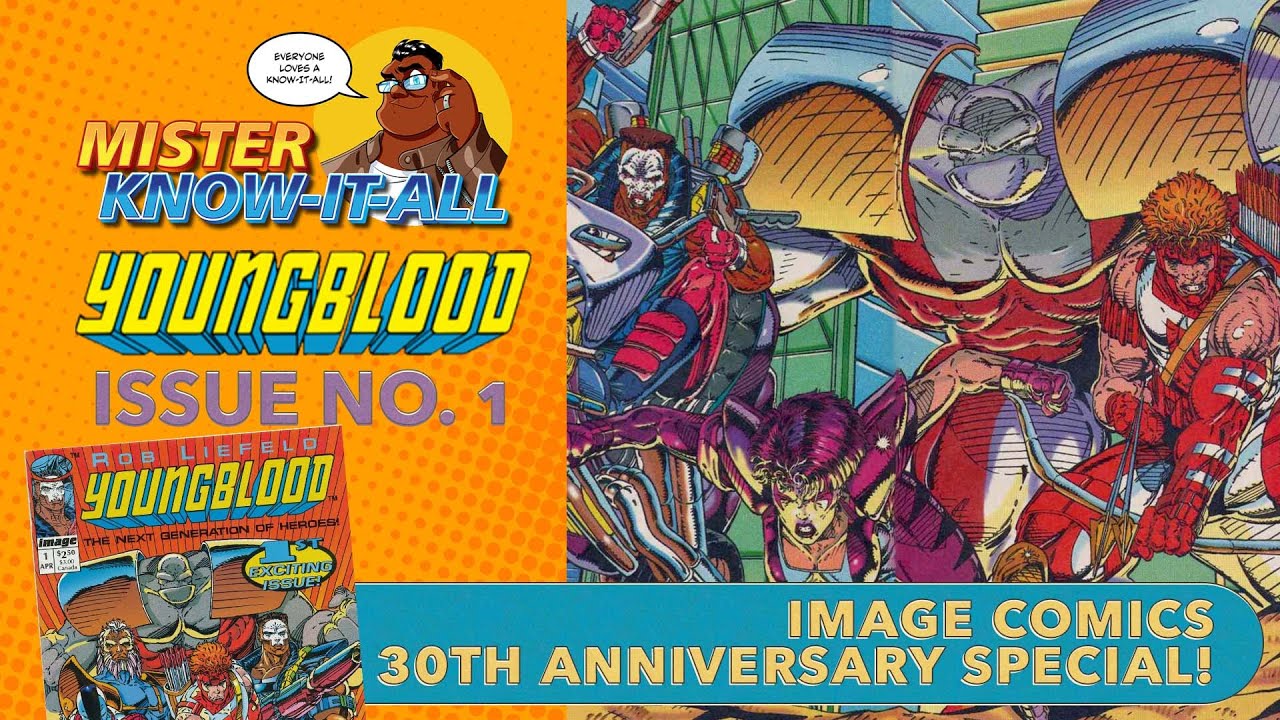
Youngblood #1 is what I consider to be a flashy book. There’s no substance here. And it’s still the place I want to start, because it’s the very first comic I ever opened with the Image Comics imprint on it.
Happy New Year, man. 2022. It turns out that this April is the 30th anniversary of Image Comics, so I wanted to go back to the beginning of Image’s publication history and tell some of the stories from the early days of the great experiment that was Image Comics.
Why am I doing this? Well, I had an uncle, and my uncle got me into Spider-Man comic books. Specifically it was the Sinister Six. My favorite artist at the time, and still close to my heart, is Erik Larsen. He went on to draw Savage Dragon at Image, but my first introduction to him was Spider-Man. Moving forward I began to read other comics, and eventually you get to Jim Lee and the X-Men, and you get to see all these different artists. Then all of a sudden one day those guys all disappear. Now I’m at the comic shop trying to figure out what’s going on, and I get introduced to Image Comics. April of 1992.
If you’re a comic fan you’ve clearly heard of Image, even if you didn’t live through the rise and fall of the comic book bust of the 90s and the paradigm shift that came out of it. So week to week I’m going to make you as knowledgeable as I am about this very niche and lost, if not legendary, even dare I say mythic in some cases, point in comic book lore and history. There’s more than a few videos about the actual beginnings of Image Comics and the creators, so I’m not going too much into that. We start at issue number one.
Two Front Covers
Youngblood #1 was first published in April of 1992 by a guy who was, at least at the time, one of the most high profile individuals in comics. I don’t know how many of you saw the Levi’s TV commercial back in the day. Rob Liefeld. Problematic or not, because obviously there’s been a little drama concerning him in the past.
True to the Image Comics brand, when you delve into this book they were trying to do a lot of different things, and first and foremost they were trying to change the way we saw comic books. Both sides featured a front cover. On one side was your front cover, and if you flipped it, the back side was a front cover too. Both sides had a story.
One side was called Youngblood Home Team and the other was Youngblood Away Team, and I think that was Rob Liefeld’s attempt at creating sort of an Avengers and West Coast Avengers. He wanted his cake and he wanted to eat it too, and by that I mean he wanted to be able to tell two different styles of story. It could also be that he had a ton of characters and took the opportunity to split them apart, because he couldn’t really cram them all into one.
There’s not a whole lot of deep storytelling, and you’ve got to remember the era. Artists wanted to be their own creators, and they wanted to write. Some were good at it. Some were good idea people. But at that point not everybody was tried, true and tested.
Home Team: A Pen, a Fountain and a Pager
What’s popularly known as side A is Youngblood Home Team, and it begins in Washington. One of our main characters, his name is Shaft, is walking in the mall with his girlfriend, and you see a thief grab a lady’s handbag. Problematic or not, because clearly the thief is represented as a Black guy, which, all right, stereotypical, whatever.
Somebody’s voicing over all of this, and I say voiceover because the captions are telling a story. Somebody’s watching Shaft and has set this whole thing up. They knew he’d be out with his girlfriend, and someone had hired an assassin to kill him. So Shaft, pretty awesomely, doesn’t have an arrow, and he real quick just whips out a pen and hurls it at this guy he’s barely caught a glance of. I think one of the previous panels is supposed to have something that tells you, oh, sniper. None of that. He throws a pen, hits the guy, the guy falls and clearly breaks his back on one of those wishing well type fountains like you have in the shopping malls.
The news crew’s there, everybody suddenly descends, and the guy’s like, SNN News, because they couldn’t use CNN at the time. Youngblood was supposed to be a high-profile team.
Fifteen Feet Tall in Shiny Jeans
I laugh because I’m thinking about the art style. Rob Liefeld was known for not being able to draw feet very well, so whenever possible he hid things. And his characters, if you look proportionately, were like 15 feet tall and for some reason always wore shiny, glossy jeans and pants. Women and guys alike had thick thighs, and when I say thick, I mean come on now.
Women had weird faces. Almost every woman had short hair, because Rob Liefeld couldn’t draw long hair. Now, he does draw long hair, but it’s not good, and it almost always looks the same. Everyone with short hair has some variation on two hairstyles: the one we see on Shaft as he’s running away from his girlfriend with her hair whipping in the wind, or the kind you see later on a character named Vogue.
The Roll Call
This whole half is really a roll call. For those of you playing at home, a roll call is where every character is being summoned to the headquarters, to the mission, to the briefing, to the whatever, and you see them for a split second, a panel, maybe two, doing something for the purpose of letting you know two things. One, where they are. And two, this is about as much character development as you’re going to get in this moment.
So Shaft gets a beep. I’m assuming it’s a page, because cell phones weren’t as prolific as they are today. His girlfriend’s there with her “you go get him, tiger” moment and her weird face looking all elongated and stretched.
Then we cut to a farm in Baltimore, somewhere in Maryland, in the countryside, and you meet Badrock. Oh yeah. The names were awesome in the 90s, man. They knew what they were doing. Badrock is a good old country boy, but he’s a big boy with stone-like skin, and he gets the beep. Oh, I gotta go, Mom.
You get another character, Diehard is his name, because that’s the kind of original names we had going on back then. Diehard is in what looks like some kind of a weird vault. It’s a very Jack Kirby-esque metal plate. It might be a bed, it might be medical something. It’s funny, there’s no perspective on that shot when you see him.
Then Chapel gets the call from headquarters. Chapel’s a smooth operating brother, and in the last panel you see him sit up in bed, because he’s there with a lady friend, we’ll call her. Funny enough, there’s no difference between Chapel and Shaft other than their hair, and don’t ask me why he named a white man Shaft. Chapel’s girl, this Black woman, has one heck of a weave, okay? Like I said, he could only do so many hairstyles. And of course Chapel’s in his outfit now, with his million pockets, literally looking like Black Cable, the little skull imprint on his face, he was so big and bad, and a big giant gun that is extremely unrealistic and probably could never be built ever, anywhere.
We briefly see Vogue, who apparently we’re supposed to believe doesn’t care about anything, because the caption’s like, it’s been five hours since I was paged. Okay. Clearly we know you’re a bad woman. We get it. You don’t follow your own rules. I totally understand.
The Four, and an Era That Only Knew How to Pose
Shaft arrives at headquarters, eventually the team comes together, and you get a nice classic team shot. Rob Liefeld was a big fan of these. Everything was a close-up, and proportions changed as the need descended.
The team is being sent after a group called the Four. Not a lot of original names going on here. The Four are your usual yahoos. You’ve got your gun-toting guy. You’ve got your big strong guy who literally looks like he’s cut right out of one of Rob Liefeld’s Juggernaut pictures from back in the day. Oh yeah, this guy’s channeling Cain Marko like nobody’s business. Then they free some other criminals, and these criminals are the same as everybody else, because back in the 90s characters knew how to do one thing, and that’s pose.
You talk about Yelena telling Black Widow she’s such a poser. The thing you do when you’re fighting, with the arm and the hair, the fighting pose. You’re a total poser. Dude, that whole era came from the 90s, and this comic book is just bleeding it all over the place.
Literally this whole thing is a setup for character. You don’t ever see them fight.
$4.50 to Join the Fan Club
There’s an advertisement in here for Rob Liefeld’s fan club. Enclosed is $3.50 plus one dollar shipping and handling, so a total of $4.50, the annual payment to be in Rob Liefeld’s fan club. Talk about a guy who had his head so far up his own butt.
I love Rob Liefeld, by the way. He created Deadpool. He created Cable and a bunch of other characters. He’s got Prophet, which is coming out in a movie soon.
Away Team: The B Side
Flip it over to what I’m calling the B side, Youngblood Away Team. This is a different set of characters. It’s Brahma, Riptide, Photon, Psi-Fire, Sentinel and, I think, someone poorly named Cougar. Whatever, because comics.
This starts out with a guy they’re calling Hassan Kussein. Again, 90s, very problematic. The Away Team is being dropped in the Middle East to stop this warlord guy, and they’ve got all the usual stuff.
And the dialogue. Again, Rob Liefeld’s not a writer, I’m sorry. You’ve got Cougar on one of the pages going, you know, I gotta admit, this gets me pumped. Everybody’s doing all the same stuff as the X-Men. You’ve got the big strong guy throwing the Wolverine-esque guy. You also have loose mention of the fact that some of these guys might be aliens, might be people from other worlds. They make short order of the people they’re fighting, and like I said, it’s all one big setup. You do get these awesome Liefeld robots.
Ultimately one of the characters narrows in on the bad guy. I want to say it’s Psi-Fire, who I’m assuming is a telepath, telekinetic, whatever. He narrows in on this Hassan Kussein guy and he fries his brain. That’s it. End of story.
Some of the kids aren’t happy. There’s a whole page where they’re like, oh dude, it’s so gross, I can’t believe you did that. Nobody had done these kinds of quirky things back then. It all feels very Family Guy right now. And then of course you know he got serious, because the color palette gets dark and all you see is dude’s eyes, and he’s like, all right, that’s it, clean-up crew, we’re gone.
It ends on this big giant USA Today newspaper that reads something like “Kussein’s Reign of Terror Ends in Suicide.” It’s all very political.
Next Up: Spawn #1
So there you go. Now you know, and if knowing is half the battle, then you’re halfway to being the know-it-all that I know you can be.
We’re going on to the next month of Image’s publication history, because unfortunately at this time they were slowly doing one issue at a time. The next issue we’re going to look at is Spawn #1. That’s right, May of 1992.
I just look forward to seeing you guys again face to face, as soon as I get cleared up of all this stuff.
If you were at the comic shop in April of 1992, tell me which side of Youngblood #1 you opened first. The conversation lives in the comments on the video above.