
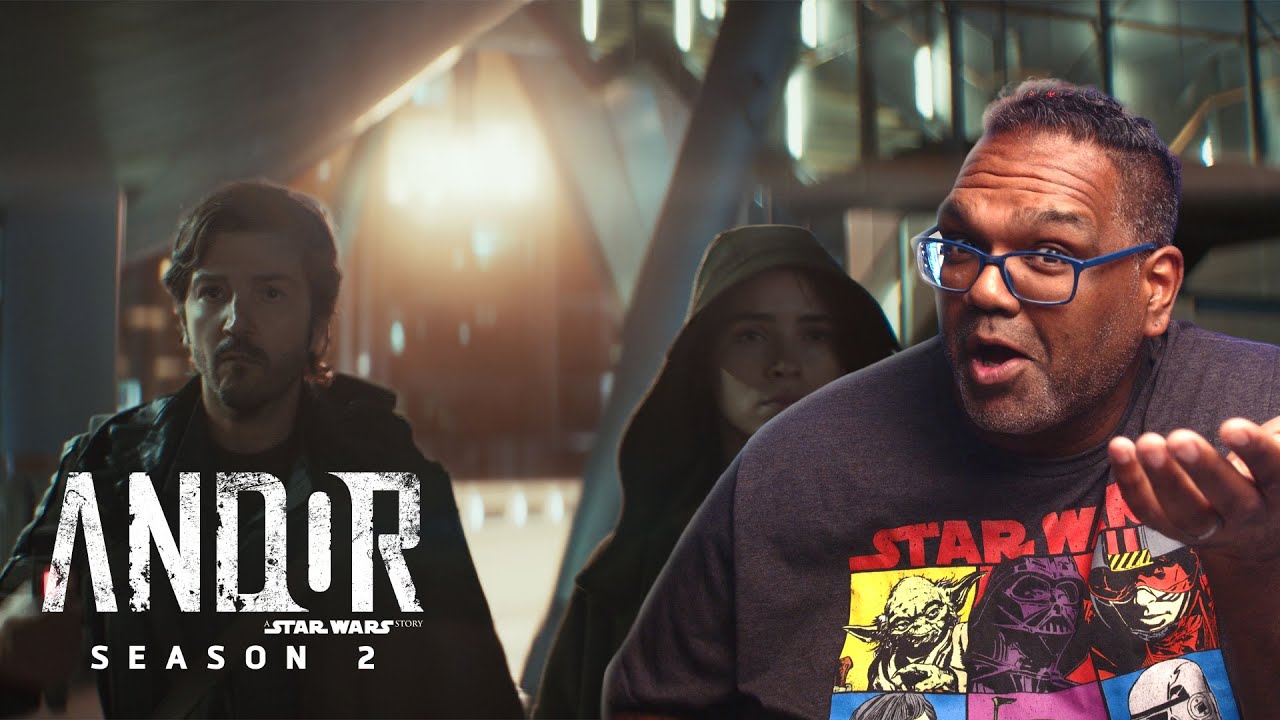
The Empire is setting a trap on Ghorman, and I don’t know how anybody can confuse this as anything but nefarious and evil. Episodes 4 through 6 of Andor Season 2 are the chilling precision of Imperial strategy, and they’re where you watch the seeds of rebellion get sown through some pretty calculated oppression.
These episodes slow the pace but deepen the intrigue. They’re focused on the Empire’s manipulative tactics on Ghorman and on how precarious the rebels’ position really is.
One Year Later
There’s a time jump, and we advance just as I thought we might. It doesn’t say two years later, because we’re no longer using Andor Season 1 as our metric. It says another year later, which brings us to three BBY, three years before the Battle of Yavin. We’re really narrowing down to that moment.
Cassian and Bix are embedded in the Rebellion now. I don’t think they weren’t before, but as it stands they’re between missions, they’ve gone back to Coruscant, and they’re staying in the equivalent of a safe house. Bix points out that they’ve basically been there before, and that if they’re going to keep coming back they should probably start having some things there, especially if people in the area are going to start seeing them and getting to know who they are. And she’s definitely having some issues.
The narrative shift here is the tightening of the grip the Empire has, the events escalating, and what I see as the desperation starting to build.
If you ever saw the Rebels animated series, and I know, we’re talking about an animated series compared to this thing, believe it or not it did an amazing job of solidifying some details about what was going on at the time. It’s kind of like Avatar: The Last Airbender in that respect. It starts out very cartoony and then very quickly turns into something a little more serious. If you haven’t seen it, I’d definitely recommend watching it, because it helped seed what I see Andor fulfilling, or actually giving us the promise of. So a lot of what we’re seeing in Andor is old ground, told through this lens.
The Ghorman Setup
As we saw at the end of last week’s mini movie, they’re setting Ghorman up. Cassian gets sent there under the alias Varian Skye, and he’s supposed to be a fashion designer. Remember, Ghorman’s the equivalent of Paris. Everyone there speaks this conglomeration of Italian, French and German, because at any given time the local language sounds very much inspired by these Eastern European stylings. Within the narrative George Lucas established, that whole idea of space Nazis, it makes sense on some level.
Luthen sends Cassian to investigate whether or not the Ghorman front is ready to be part of the greater Rebellion. Apparently Ghorman is one of the front lines of a lot of what’s going on. As we learned last week, they’ve got the kalkite the Empire needs for the lenses of the Death Star, which it’s just pushing as an energy thing.
So the Empire’s strategy becomes pretty clear. Allow the Ghorman resistance to gain momentum, only to crush it publicly and send a message to other potential rebels. Dedra is heading up the entire situation, and it’s a calculated approach that highlights the Empire’s psychological warfare tactics. A lot of this comes from the idea of the ISB and how they started.
Why Syril Exists
And who do they send? Syril. He’s talking to his mother, and you can clearly tell he’s being investigated by the local Ghorman group. They’re watching him. He sees them watching him. He sets a little trap on his door so he knows if anyone comes into his room, and they totally do. He finds listening devices, the whole nine yards.
Syril ends up infiltrating the Ghorman resistance. He poses as a sympathizer while feeding information to the ISB by way of his girlfriend, Dedra. His internal conflict, and I think the potential for wavering loyalties, adds complexity to his character. But at the same time, I don’t know that I believe it. I do, but I don’t. He’s definitely one of those people who believes he’s doing what’s right for the Empire.
There’s a moment when he goes back to Coruscant and gets brought before Partagaz with Dedra. As soon as Partagaz leaves, he looks at her and says, “Would it ruin the moment if I said this was the greatest day of my life?” And you can see she’s kind of like, wow, you’re pathetic. She’s not impressed in the least by that entire statement. But at the same time, she sort of idealizes his loyalty.
They keep pointing this kind of thing out, and I think they’re pointing it out for when it all goes downhill. Why do you introduce a character like Syril? Why does he exist? I feel like the only reason is so we can set up a true, genuine believer, a loyalist who believes the Empire is doing right and doing good. Though they’re not, contrary to what Salty will tell you. I’m just poking. And then we see his heart get broken, because he’s going to find out everything is actually much, much worse.
It’s funny, when the leader of the Ghorman front goes to talk to Syril, he says to him, I don’t even know if the Emperor knows the full extent of what’s happening out here, and in order to help protect the Empire we need to blah, blah, blah. And I’m just like, seriously, you don’t know if they know? I don’t know if he believes that. But I think on some level maybe Syril thinks that way.
Everybody will argue that the scene’s a whole cat and mouse thing. They think they’re playing him, but he’s really playing them. True. Here’s my prediction. He’s going to encounter bad things and question them, and Dedra’s going to have to be the one to tell him the reality, or maybe even Partagaz. Someone’s going to have to say something to him like, who do you think we are? Someone’s going to have to adjust his thought process. And when that worldview gets adjusted, it’s going to be over. It’s absolutely going to be over.
Bix and Doctor Gorst
Bix is an interesting dilemma at the moment. She keeps having nightmares, and at some points Cassian tries to help her through them. When Cassian goes on his mission to Ghorman, even Luthen shows up.
I don’t trust Luthen for anything, and you really shouldn’t. You start to realize Luthen is just as crazy, and frankly just as twisted, as Saw Gerrera. He finds her using drugs, and it’s, does this help you get rid of the nightmares? It only helps until you wake up, or something along those lines. And you’re like, ugh.
So Bix has to confront her trauma head on. Forget counseling, forget therapy. She gets revenge on Doctor Gorst. Literally, she straps him to the same machinery she was strapped down to, and she leaves him there. And there’s this wonderful moment. They push outside the window of his office, and as they’re slowly pulling back it’s dead silent, and you see him go from terrified to just screaming, and it’s done in silence. Very devastating. I loved seeing it.
It was so artfully done that it gave me Jojo Rabbit vibes. If you remember Jojo Rabbit, that was the Nazi Germany movie done by Taika Waititi. You start with this comical version of who this kid sees as Hitler, and you keep having more and more serious moments until finally you’re at this dramatic moment that mirrors an earlier one, where he sees his mother has died. This is like that. It’s so surreal, and you’re thinking, oh yeah, sci-fi, revenge, this and that. And then the reality of what’s happening hits. It’s a very mature Star Wars moment, and I really appreciated that.
As Victor DiGiovanni talked about in the comments last week, it’s more mature storytelling than I ever expected from Star Wars. There are people who are going to argue it’s mature because you’re fighting stuff, and because it’s evil and it’s terrible, like last week’s events with Bix. That isn’t what makes it mature. They’re trusting us as the audience to handle and measure this information. They’re giving us a prima facie, in-your-face version of what’s gone down, and you have to look at it, assess it, and take it for what it is.
When you trust your audience like this, you’re elevating. You’re telling them, okay, you’re grown up now. We’re not innocent anymore. We’re ready to tackle these topics head on, in a mature way that doesn’t talk down to us. I appreciate that in my storytelling. I genuinely do.
Mon Mothma and the Ground Dropping Out
Then we visit Mon Mothma. She’s too much. Now we’re getting into the machinations behind the scenes, and you find out the Emperor is making moves.
There’s a particular piece of legislation on the table, and you get these intercut moments where she’s talking to other senators, and the other senators are like, no, I’m not voting against Palpatine. You’re crazy. I’m not voting against the Emperor. No way. And she’s like, I thought we knew this stuff. What are we fighting for?
Imagine you took the Natalie Portman moment from the prequel trilogy, where she says this is how liberty dies, to resounding applause. That moment has so much political depth, and we see it used in modern politics all the time. Unpack that moment and this is what’s inside it. Mon Mothma chasing people down asking what’s going on, why are things falling apart. She’s very quickly seeing the ground beneath her start to drop out. Her personal sacrifices and her political maneuvering begin to illustrate this really high stakes dissent within the Empire’s core.
They’re Not Talking About Art
You find out that Luthen’s assistant had bugged Sculdun’s art collection, and Sculdun finds out that one of his art pieces is a forgery. So what does he do? He wants to go through everything and search everything, the whole nine yards. They’re positive he’s going to find this bug. So they have to go to this big gala event where he’s introducing a new piece of art, and she’s got to get to the piece that has the bug on it and take the bug out. They’re using everything at their disposal, some of their assets included.
Guess who’s there? Krennic. And you see Mon Mothma face Krennic.
It’s this cat and mouse that’s talking about artwork, and I say cat and mouse because they’re talking about what they’re not talking about. He’s using the artwork, he’s like, well, you know, I understand, and she’s like, oh, you mean like this, and this, and this. There’s this back and forth cattiness where you’re like, they’re not talking about art. I love that. It underscores how much she’s starting to realize events are moving much faster than she anticipated.
And that’s probably how this is all going to play out. We start with the first year, and they’re still in the periphery. Then we get into the second year, and the stakes are going higher.
“But They Will Burn Brightly”
Ghorman, a very big, notable group, is about to be made an example of, and they don’t even know it. It’s to the point that even Cassian, when he’s talking to them, is like, you guys, what are you doing? You’re going to get caught. And the guy says, I thought you were a revolutionary. And he’s like, yeah, of course I am, but I’m not ignorant.
At some point Cassian has to face the fact, with Luthen and these folks from Ghorman, that the Rebellion has to actually become a thing. It has to genuinely explode out of its shell. It has to stop being insurgency and militia and be official, an actual thing that’s opposing the Empire with a clear goal of bringing it down. Right now they’re just little pockets. Ghorman is the first major turn in that.
And he realizes Luthen didn’t send him there just to see what they’re about. Luthen’s like, you’ve got to help them stand up. And Cassian says, they’re going to lose. “They’re going to burn.” And Luthen says, “But they will burn brightly.”
Luthen is looking for that one thing that’s going to nudge it. He keeps pushing and pushing and pushing, because he knows eventually he’s going to knock down the Jenga tower, if you will. Only when something big and catastrophic happens to highlight what’s going on will people start to notice. That’s the journey we’re on, and I’m along for the ride. I really am.
You Have to Be Crazy
You see Saw Gerrera, and Forest Whitaker is so good as Saw Gerrera. It’s wonderful seeing him capture a younger version, which is so funny because he’s so much older, and you start to learn why Saw has bad lungs.
You see Wilmon, the young kid from before, the one who was in love with the girl at the farm. He’s been sent to teach them how to do a thing. It’s a very special setup, it’s going to release some gas, and the question is how you survive to that point. Saw is very aware of the whole thing. He asks him to train his guy. The kid’s like, I’m leaving tomorrow, I’m just training your guy and I’m out. And Saw’s like, you’re not leaving until I say so, until the work is done, until I get what I want.
God, I’ve loved the character of Saw Gerrera since we first saw him in Rebels, and then later on we see him realized in Rogue One and you’re like, man, amazing character.
When the time comes, Saw asks, is he ready? Is he ready to do it on his own? And it’s, yeah, absolutely. So Saw kills the dude. The dude, the kid lives. And he reveals the guy was leaking information to the Empire, and the Empire was going to be waiting for them at this other place Saw told him about as a misdirect. They’re going someplace else.
Saw’s actions serve as a contrast to the more measured strategy of the other rebels. They really do. There’s this great moment at their actual destination. The kid manages to get the thing done, he’s wearing a mask and a breather, and as soon as it happens, Saw steps forward and takes a deep breath of this stuff that’s supposed to burn you inside. The kid’s like, how are you doing this?
And Saw gives him this amazing speech. Crazy as can be, but amazing. It’s about the freedom that comes from being ready to fight this. You have to let it burn inside, and grab it, and hold it. That’s what it means to do this thing. They think we’re afraid, but you have to embrace it. So what does the kid do? He takes his breather off, inhales deeply, and begins to feel it. And Saw is like, yes, you are ready.
It’s psychotic. It’s insane. But Saw even says it. You have to be crazy to do this. You have to be insane. And I was like, okay, yeah. I totally get it. I’m down.
The Verdict
Andor Season 2, Episodes 4 through 6, is an 8 out of 10 on the Know-It-All Index. Absolutely an eight out of 10.
While the pacing is deliberate, the intricate plotting and the character development are laying a compelling foundation for what’s coming, the impending conflict, if you will. And I’m here for it. I’m seeing where the train is going and I’ve got to keep watching, because I want to know what’s going to happen.
I know the ratings aren’t that great right now for Andor. I feel like there are many people who are just disillusioned by Star Wars in general. I’m a fan, man. I’m here for it. Hopefully you will be too. Victor DiGiovanni, I know you said it last week, brother: people want a Star Wars, and this is the best Star Wars. It is. It’s the best Star Wars we’ve had in a long time and nobody’s watching it, and I’m okay with that.
Luckily there were no other seasons planned. This is it, and I think they kind of knew this was the end of the road for a lot of this stuff. Everyone’s saying it’s going to get cancelled. It’s done. We’re going to get this, and that’s it. There was no more Andor. This is supposed to end right at the doorstep of Rogue One, specifically when Cassian goes to meet the guy he eventually kills in the alley.
We’ll see where it goes, and I’m excited for it.
Your turn. What are your thoughts on the Empire’s strategy on Ghorman, and do you believe the rebels can outmaneuver these really calculated forms of oppression? The conversation lives in the comments on the video above.


