
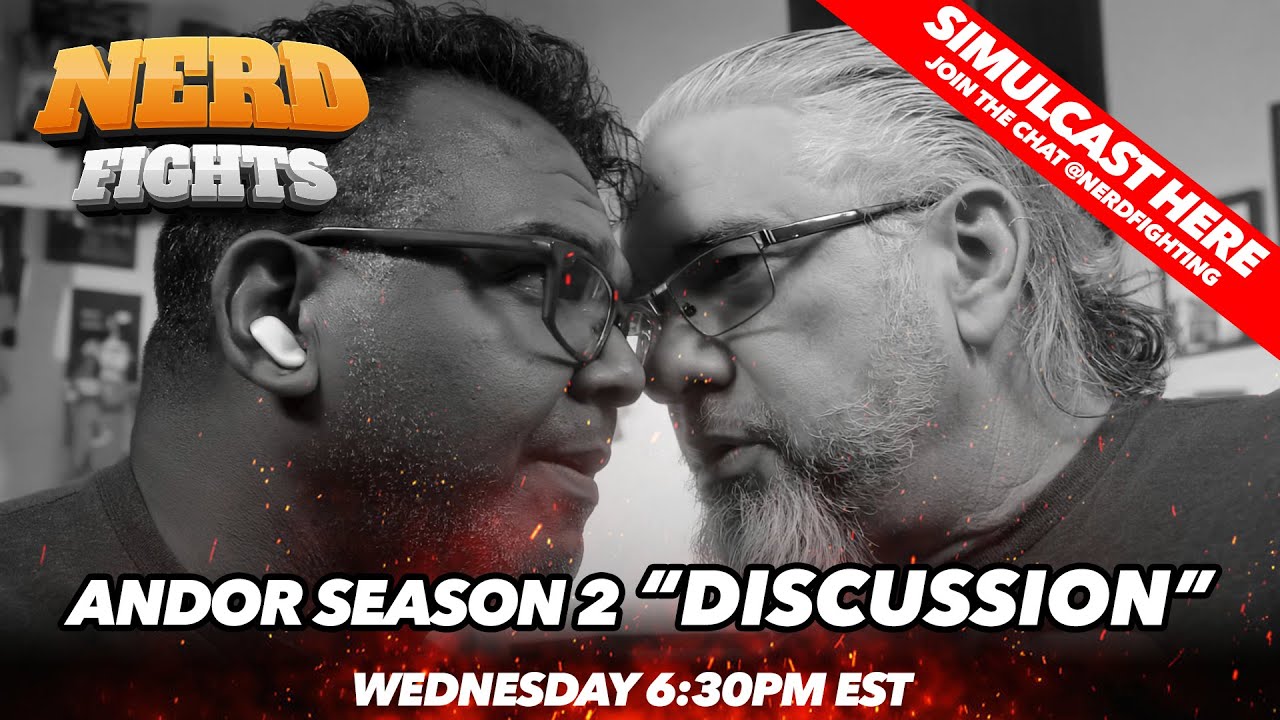
Salty’s position on the first half of Andor Season 2 is that he doesn’t see anything in this show that indicates the Empire is bad. He said it on Nerd Fights with a straight face, and he’d been saying it for a good fifteen minutes before I managed to get a microphone plugged in.
By the time I got there he’d already told Gonzo, who judges these things, that Andor looks really good but nothing happens, and that we’re halfway through and it’s all setup. He’d also gotten around to my review. He was nice about it. He said he knows I’m being sincere. His problem is that a lot of my love of the show so far is based on material that has nothing to do with the show. I’m talking about a massacre that’s going to happen, and he says there’s no indication of that on screen.
So let’s have a real conversation.
Salty’s Three Atrocities
He counted three things you could try to blame on the Empire in these six episodes, and he put the word atrocity in quotation marks.
Number one, some people got killed when Tarkin landed on Ghorman. Salty’s read of the dialogue is that those people are dead for the same reason a protester standing in the middle of the freeway is dead. They were standing on the landing pad trying to stop the ship. If you go to the airport, stand on the runway and a 747 squashes you, that’s not murder in his opinion. He went as far as Air Force One. You don’t block a high-ranking political official’s ship from landing. The answer he got back was that the planes on the runway usually aren’t coming to oppress your city, either.
Number two, what the Imperial officer tried to do to Bix in the third episode. Salty fully admits it was horrible and wrong. His point is that it’s a corrupt officer committing a crime, one bad apple, with no indication it was standard procedure. Gonzo agreed with him on that one, and said he doesn’t think the story was even implying otherwise.
Number three, the worst thing we saw and the one thing he says you can confirm was Imperial policy from the top: they were enforcing immigration law. And in his view they weren’t doing it in any way that seemed even the slightest bit out of order.
When You Plot the Destruction of a Planet
This is the biggest problem I’ve got, and I said it to him. “You try to run the table like you’re the only person with an opinion. The reason I even have a judge half the time is because all you try to do is talk through this thing as if somehow your answer is the only answer.”
Those three are minute. Nobody would use them to make the case. If all you’re going to do is focus on the first three episodes, I’m sorry, there’s an entire story here. You have Krennic plotting to mine a planet until it’s destroyed. You have the propaganda arm, those two guys in the nice suits, standing up in the middle of that meeting room.
Salty’s defense of the meeting is that Krennic never said let’s blow up the planet. Somebody at the table raised the possibility of complete destruction. Krennic said evacuation would be a better alternative than letting these people die, and his advisor told him the people have too much pride and chances are they won’t leave on their own. Then he told us a true story about a man named Harry Truman, not the president, who lived in a cabin at the base of Mount St. Helens. In 1980 they begged him to leave. He said, “This is my mountain. I ain’t leaving,” and he ended up under several billion tons of it. Salty wasn’t calling Krennic a nice guy. He was asking whether the man is wrong.
I don’t know about you, sir, but when you plot the destruction of a planet, that’s the answer. The second that came into play, good people would go, well, then maybe we don’t need the thing. But he’s like, no, because clearly the Emperor needs it for his energy project, which we, out of universe, know is the Death Star. And Gonzo piggybacked off that with the hole in the analogy. We begged that man to get off the mountain. The Empire didn’t even attempt to tell them to leave.
They built an armory, which they promised they wouldn’t do. And the protesters? They tell the literal story in the show. Tarkin decided he was going to land there no matter what. Tarkin didn’t care that the people were there. I don’t give a damn, I’ll land right there, boom, and crush them.
Go back to biblical times, since that’s context I know Salty knows. The reason Pilate was taking such great care when it came to the situation with Jesus is that they’d had the Maccabee uprising, and after that Pilate himself had several issues, to the point that Caesar was like, if you have problems one more time, I’m going to get rid of you. And by get rid of you, he didn’t mean fire him.
That’s this whole culture. The Ghorman, whether or not they’re pompous, whether they’re haughty, they’re absolutely at the end of a particular rope. That’s why when Cassian shows up to take a look around, he’s telling them you guys aren’t ready. Cassian’s still playing a long game. These people are at the end of theirs. They’re done, they’re so fed up. That’s the boiling pot.
And I’ll hand Salty this one on a silver platter. Then you have Luthen, and the guy says to him, “They’re going to burn,” and he goes, “And they will burn brightly.” Because he knows. Luthen’s not supposed to be better. He’s using these harsh tactics to make the people see. When a frog is sitting in water and you slowly turn it hot, it doesn’t try to get out. It gets comfortable. (Salty says it’s supposed to be a lobster.)
Where I’ll Meet Him
I’m not trying to argue the veracity of the show with him. What he and I have always argued about is something bigger, and I want to represent it respectfully because I do understand where he’s coming from. His belief is that starting with Rian Johnson’s The Last Jedi, there’s been an effort at Disney, on an institutional level, to deconstruct everything we as Star Wars fans would say is good about the franchise. Maybe the Jedi didn’t have the best intentions. Maybe the Sith are actually misunderstood. Maybe the Empire, blah, blah, blah.
I get that. I’m even willing to concede there might be a measure of it in Andor. But it’s definitely not to the extremity of The Last Jedi, and it’s definitely not to the extremity of The Acolyte.
For me, I don’t have a problem with putting a face on the Empire. I don’t have a problem with showing that the initial insurgency was messy. You’ve got to remember, once it became a thing, everything fell in rank and file. You had your generals, you had your officers, you had your people. Until that point, they were us in the Revolutionary War before George Washington showed up.
Salty thinks that’s the fundamental flaw, that Star Wars shouldn’t try to get serious and Andor is playing it too straight for a franchise whose roots are fantasy and space opera. And he brought the clip he’d sent me, where George Lucas flat out says that when he was writing the Rebellion, he used the Viet Cong as his model for their tactics. Which, Salty points out, would make the Empire us.
Speaking as a writer, and he’s writing too: I’ve used all kinds of things as examples. You sit there and say, okay, who can I think of that’s close enough to the way I want this thing to be? Then you find someone, and it has nothing to do with good or bad, right or wrong. You’re just saying, this is what they are.
Victor Dioani commented on this when we were talking it through, and I thought it was interesting. He said Andor is the mature Star Wars we don’t deserve. Think about how we got here. The first Star Wars was what it was, fantasy, entertaining, the whole nine yards. Then they brought in the second movie with a new director who had a different vision, and it took a darker, slightly more elevated, grown-up tone. Not that that’s better, just what it was. And George was like, this is not what I want at all. So he pulled it back and we got Ewoks, and it was a little overcompensation.
Groovy
Salty is working on what he calls a massive documentary about how the Jedi were the evil ones all along and the Sith being evil was the big lie. He may ask me to do some voice-over for it. I’m down, even though I’m going to disagree with some of it.
His case goes like this. Obi-Wan never tells Luke the truth in the first movie. He calls Anakin his good friend, then says Vader betrayed and murdered Luke’s father, and Salty doesn’t want to hear about a certain point of view. In the prequels it’s Palpatine and Anakin talking about peace while the Jedi send people on kill missions. And his theory is that Obi-Wan killed Owen and Beru himself to groom Luke, because Obi-Wan had motive and opportunity.
I feel like this is all circumstantial. That’s not enough to die on a hill with.
Then he said Palpatine is the legitimate emperor, that every one of his powers was legitimately given to him by the Senate and he did nothing illegally. I asked for the court reporter to read that one back. It doesn’t sound like Star Wars is the one with a problem defending the Empire. It sounds an awful lot like you are, sir.
At some point you keep doing this devil’s advocate thing and it stops being that. It’s like someone who does a joke to be ironic. For years I would say “well, that’s groovy” to be ironic. Pretty soon I just started calling things groovy. It stopped being ironic and became a thing that I say.
So I asked him the question underneath all of it: what do you want?
What he wants is for Star Wars to be more like Star Wars, the same way he wants Star Trek to be like Star Trek. Take the original trilogy in isolation and it’s your classic good versus evil. There’s no question who the good guy is and who the bad guy is, and no layers of subtlety about it. That’s why it’s called a space opera. Gonzo got him to say it plainly: he doesn’t like the gray areas. Gonzo does. His answer was that if you’re going to show how the Rebellion became the Rebel Alliance, it’s not going to be all rainbows and unicorns.
The Part He’s Right About
Salty will give Gonzo that. If you’re going to show the rise of the Rebellion, there are going to be some dirty deeds in there. What he says the show isn’t doing is showing the absolute oppressive evil that would cause good people to do dirty things. We hear people talk about the oppression of the Empire. We don’t see it. He wants to see what drove Saw Gerrera to be the radical he is. He wants to know why Luthen is so dedicated to the cause, what horrors he saw, and he thinks we should’ve seen that in episode one.
I’m kind of with him. There were a lot of people who knew the truth. Amidala wasn’t the only one who knew it when liberty dies to thunderous applause and all that. That’s one of the reasons Mon Mothma has been involved from the beginning. She realizes what’s happening, and she was hoping all she’d have to do was bankroll it and never actually get physically involved.
You want to know what I think about Saw and Luthen? I don’t think they saw anything. Maybe Saw did, because he’s further out on the rims. But I firmly believe these are just the conspiracy theorists who see the writing on the wall.
And this is where, for me, the allegory falls apart. They’ve lived in a perfect utopian Republic for over a thousand years. Anybody who could ever know what an oppressive government looks like is long gone. Nobody alive has seen one.
It’s funny, now that we’re talking this through. Salty’s right that the only way this should’ve gone down is what he described. Instead of trying to give us what some of our peers call “the message,” they should’ve showed us. That should’ve been the moment where people go, this is not how you’re supposed to treat people.
Gonzo called it the part we all agree on. The writer and the showrunners are leaning on the past movies, counting on us to walk in knowing the Empire’s bad, and he called that lazy.
Three-Hour Movies
Salty’s other complaint is the time jumps. The card says one year later again, and he’s asking whether that’s still one year later or another year later. Then we wake up with Cassian in bed with Bix and he felt like he’d missed a bunch of storytelling.
You did. It’s because they’re only giving us three-hour movies. We’re seeing a movie, and then a movie, and then a movie. That’s the nature of telling stories. You pick a snapshot of time.
He says that makes it worse, because it means Cassian Andor’s entire plot in a three-hour movie was that he steals a TIE fighter and hooks up with his old girlfriend. If it’s four movies building to the Battle of Yavin, groovy, as he says I would say, but then the guy the show is named after needs an arc in each one.
I’ve always said give a show three episodes, and I gave it the first three. They were rough. I feel like he was a bystander in his own show. Things are literally happening around him while he’s tied up. I did like that they’re establishing more and more of Mon Mothma’s motivations and the things pushing her. This guy isn’t normally part of the Rebellion, but he knows you had to move money, he’s having money issues, and now he’s a danger to us and we have to take out the threat. You start to see more of the machinations. Do I like the first three episodes? No. I wish they’d done more with them.
The second three, I feel like, were designed to show us a pivotal moment for the Empire. I think this is the moment they shift from being sort of peacekeepers who run a little bit tight to plotting something tyrannical. They’re plotting the actual destruction of a planet, and now you have Dedra, whose only job is to figure out the most efficient way to get us to the end. Dude’s already said he’s willing to accept that if it blows up, it blows up. Oh well. He makes a little face. Krennic is someone I love hating.
Then you get to the end of that three, and they decided to spend the time on Bix getting over her trauma, and all they really did was create a terrorist thing on Coruscant. It was sort of sloppy.
My prediction for where they’re going: remember that going into Rogue One, they’re an organized rebellion. They have wing groups. They have a base. We’re one breath away from A New Hope. So next week I think everyone starts coming together. If I’m not mistaken, we’re going to get Ackbar in one of these weeks. I bet you money they go to the Mon Calamari planet and show the Empire doing something there, because they’re probably going to need the water to cool the reactors. Ackbar and them stand up. The Ghorman are standing up. And Mon Mothma isn’t going to have a choice. She’s going to have to officially take a stand.
They’re also establishing something we already know, which is that everyone’s expendable. Most of the people who are the building blocks aren’t going to get to celebrate the success of their revolution. I think we’re going to see Luthen’s death before it’s all over. And we’ve still got to get K-2SO.
So they are building to something. I hope that by the end I’m going, oh, that was satisfying. No matter how you feel about Rogue One, everyone agrees on that moment. I don’t just mean the Darth Vader fight, or the Death Star coming over the horizon. You see the ship escape Vader, and the next moment is A New Hope. I hope we get to the end of this and it connects up the same way, where I can watch Season 1 of Andor again, go all the way to the end, and then probably watch Rogue One again because I’ll need the next episode.
The Krennic We Agree On
Salty threw the show one bone, and I’m with him on it. He wishes this was the Director Krennic in Rogue One. This guy is scary and imposing and carries weight and authority and gravitas, where the Rogue One version came off whiny. If he’d seen this Krennic at the beginning of that movie, he thinks the climax plays a lot better, because you’d believe you were looking at a ruthless killer and not some guy doing this because he’s afraid of Tarkin.
Agreed.
The Verdict
Andor Season 2, Episodes 1 through 6, is an eight and a half out of 10 for me, for all six we’ve seen so far.
The issue for me isn’t where it’s going, the way it is for Salty. I know where the story goes, and I’m willing to go with it.
Salty didn’t want to give a number until we get through the whole thing. As individual movies he’d rate them very low. As a series he has to see if it’s going somewhere, and right now he thinks it’s fizzle, fizzle, fizzle. Gonzo got a five out of him, and on Salty’s scale a five means that if the choice is watch paint dry or watch the movie, it’s a toss-up.
Gonzo calls it a seven and a half. He’s enjoying watching the rebels come together, as disorganized as the different sects still are, and he’s enjoying finding out how crazy Saw really is.
Your turn. Has Andor shown you enough of the Empire being evil on screen, or is Salty right that it’s leaning on movies you’ve already seen? Tell me which, and tell me the scene. The conversation lives in the comments on the video above, and the replays are on the Nerd Fights channel.


