
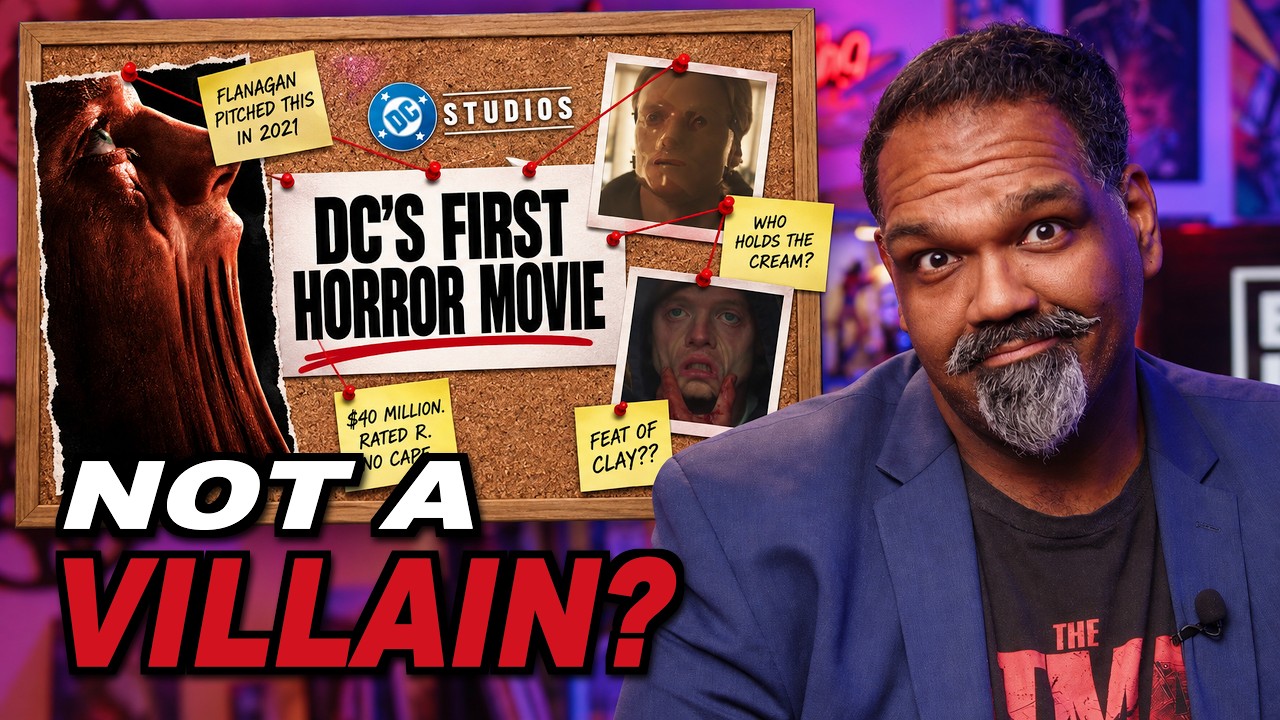
The first horror movie DC Studios ever made was pitched to a studio boss who no longer has the job, about a version of the character who died in 1986, by a writer who isn’t making it.
The Clayface pitch outlived everyone who said no to it.
Mike Flanagan said out loud in January of 2021 that he wanted a standalone Clayface film. His words were horror, thriller, tragedy. He said the thing that got him was Ron Perlman’s voice in the cartoon, in “Feat of Clay,” 30 years ago. He took it to DC that year. DC didn’t bite.
Two years later there’s a new DC, run by two new people, and he walks in and pitches it again. And this time the pitch has one more phrase in it. Not a villain.
They bought it. They greenlit it. And then, about five months later, Flanagan was gone. Other job, other studio, a different horror franchise with his name on it. A new writer rewrote it. A new director shot it, in Liverpool of all places, pretending to be Gotham.
So the thing that opens on the 23rd is a movie built on a four-year-old pitch that survived two regimes, one rewrite, and the departure of the man who wanted to make it. And I think the pitch is still in there. I think I can see it in the trailer.
How DEVELOPING Works
For anybody new: I don’t chase announcements the morning they drop. I hold a picture of what I think a thing actually is, I pin it to the corkboard with the evidence next to it and a date on it, and when the real thing shows up, we come back and find out how wrong I was.
Today the corkboard is Clayface, and the timing is on purpose. They’ve been talking for six months. A teaser in April. The boss on Threads the next day telling us where it sits. Comic-Con in July. A final trailer in September. And last week, a behind-the-scenes piece with Gunn and Reeves and the lead actor all on camera telling us what it is. Six months of the people who made it explaining it.
Next Tuesday the screening crowd walks into a theater in Atlanta, and I’m one of them. The day after that, every review drops at once. So this goes on the record a full week ahead of all of it. Not a frame of the film. Not a review. Just their words and the evidence, with a date on it. And on Wednesday the 21st, the minute I’m allowed to talk, the corkboard gets graded in public.
Is Batman in It? The Penguin Already Answered That
Here’s the question I keep seeing in every comment section and every headline, so let’s answer it once and get to the real one. Is Batman in it? No. Batman’s not in the cast. Batman’s not in the footage. The studio has been clear about it since the teaser.
And the reason that doesn’t scare me the way it scares the headlines is a show that came out two years ago.
The Penguin, September 2024. Eight episodes about Oz Cobb, Sofia Falcone and a kid named Vic, set in a Gotham where Batman is off the streets for a season, and the show never once needs him. It’s a crime story. It ends. Oz on top, Sofia in a cell, Vic in the river. Twenty-four Emmy nominations, nine wins, and Cristin Milioti took Lead Actress. The finale drew its biggest audience of the run. The showrunner, Lauren LeFranc, has said on the record it was “meant to be a limited series.”
Now put that next to the control group, which is Sony. Venom, Morbius, Madame Web, Kraven. Movies about Spider-Man villains with no Spider-Man, and every one of them treats the hole where the hero should be like a thing you step around and hope nobody looks down.
The Penguin did the opposite. The hole was the plot. Nobody’s coming, so Oz can rise. The absence had a job. And it kept the faith while doing it: Oz, Sofia, Francis, the Falcones and the Maronis, all from the page. It didn’t need the cape to make you care about the people. It needed the people.
A villain’s story works without the hero when the hero’s absence is a condition of the story instead of a hole in it. The Penguin earned Clayface the right to exist without Batman. It did not earn Matt Hagen your investment.
Gotham and Joker: Two Ways This Goes Wrong
I’ve also watched this exact setup fail twice, and I want to be careful about how I say it, because I’m allowed to not like a thing and I’m not allowed to just bash it.
Gotham, the Fox show, 2014. Bruno Heller’s pitch, in his words: “What if young James Gordon was the detective who investigated the murder of Bruce Wayne’s parents?” And in the same interview: “This is a world that’s going to become that familiar world of Batman, but it’s not there yet.”
Not there yet. Five seasons later, the show ends with Bruce Wayne in the cowl on a rooftop. The Gordon show became the Batman origin show. Every character stopped being a person and started being a name tag for who they’d turn into, and you could feel the show checking whether you’d noticed. What it changed into was the famous thing it promised it wasn’t about.
That’s one direction. Here’s the other. Joker, 2019. A billion dollars, a Gotham with no Batman, a villain’s story that ends, and it worked because it ended. Then the sequel. A reported budget somewhere around $200 million, a D CinemaScore, and Variety projected losses between $150 and $200 million. You can tell me the first movie still stands on its own. I’d tell you a story that proved it could end, and then didn’t, looks a little different afterward. It looks like it never meant it.
Two failures, two directions, same temptation. A story set before the famous thing, or beside it, has one structural temptation: to pay off with the famous thing instead of with itself. Gotham did it forward. Joker’s sequel did it backward. The Penguin didn’t do it at all.
Which Clayface Is This?
So which story did they buy? Here’s where most of the coverage has one thing wrong, and the reason it’s wrong is the interesting part.
Everybody keeps saying this is Matt Hagen, and the character is named Matt Hagen, so fine. But there are two Clayfaces that matter, and the movie is quietly using the wrong one’s biography.
Basil Karlo is the first one. Detective Comics #40, June 1940, Bill Finger and Bob Kane. He’s a washed-up horror actor who finds out they’re remaking his old movie without him, so he puts on the costume of a villain he once played and starts murdering the new cast in the order their characters die in the script. That’s Clayface in 1940: an actor with no powers who used to be somebody.
Matt Hagen is the second one. Detective Comics #298, December 1961. He isn’t an actor. He’s a treasure hunter who falls into a radioactive pool of protoplasm in a cave and comes out able to turn into anything. The catch is it wears off. He has to go back to the pool every couple of days or he’s a man again, and Batman beats him by finding the pool. Hagen dies in Crisis on Infinite Earths #12, March 1986, in a crowd scene, killed by a shadow demon next to a guy called the Bug-Eyed Bandit.
So the comics Hagen is a treasure hunter with a chemistry problem. The movie Hagen is an actor with a crime boss problem.
That’s not the comics. That’s “Feat of Clay,” 1992. The cartoon took the Hagen name and gave it the Karlo life. Matt Hagen is a movie star whose face got wrecked. A crooked businessman named Roland Daggett hands him a cream called Renuyu that fixes his face and lets him wear other people’s faces, and it’s temporary, and it’s addictive, and Daggett owns the supply, so Hagen does crimes for him to keep his face on. When he says no, Daggett’s men pour a vat of the stuff down his throat.
Look at the trailer again with that in your head. A rising actor gets disfigured by a Gotham crime boss. A fringe scientist with an experimental treatment gives him his face back. Dr. Corr tells him he has to learn to control it. And a cop gets told, “Matt Hagen can change his face.” That’s Daggett, Renuyu and the vat, with the pieces re-dealt. They handed the cream to a woman and gave her a name. And the thing that was a side effect in the cartoon, him needing more of it, is the whole second act now.
And honestly, good. Finger’s 1961 Hagen is a gimmick, the cartoon’s Hagen is a tragedy, and Flanagan told us in 2021 which one he was buying. “Feat of Clay” ends with a man who used to have a face, in a vat, as a monster, forever. That’s the whole point of it. It’s the saddest half hour that show ever made, and if you’re adapting that, you’re adapting a story that ends.
They’re adapting the cartoon, and the cartoon ends with a man in a vat. The question is whether the movie has the nerve to leave him there.
What DC Actually Paid For
Now look at what the production paid for, because every one of these choices is a tell.
Forty million dollars. That’s The Hollywood Reporter’s number, and their words were “stripped down.” Superman was reported north of $200 million. This is a fifth of that, with an R on it and no cape in it. That number is the whole personality of the movie. At $200 million you owe the studio a third act in the sky and a reason for the Justice League to show up. At $40 million you owe nobody. You can make a movie about one man’s face and let it be sad, because sad is cheap, and sad is what Flanagan does.
James Watkins directs. Eden Lake. Speak No Evil. He makes movies where ordinary people get cornered and the camera doesn’t flinch. You hire that for a monster movie when the monster is the last thing you want the audience looking at.
Tom Rhys Harries is Hagen. Gunn said they found him after “a long and incredibly exhaustive search,” which is what you say when you looked at every famous person first and didn’t cast one. You know him, if you know him, from White Lines and Suspicion. Handsome, Welsh, nobody’s movie star yet, and that’s the instrument. The character is a man who was almost famous and lost his face before he got there. Cast an actual star and the audience spends the movie mourning the star. Cast a guy on the way up and you’re watching the thing the character is watching. They cast the role’s own biography.
Naomi Ackie is Dr. Caitlin Corr. Whitney Houston in I Wanna Dance with Somebody, Mickey 17, Blink Twice. The Hollywood Reporter described the character as a fringe scientist and compared her to Elizabeth Holmes. You could read that as mad scientist. The Holmes comparison says founder: someone who believes the pitch harder than the data, who gets a desperate man to say yes because she already said yes to herself. Ackie plays conviction. You hire that to make the audience want the treatment to work.
Max Minghella is a Gotham police detective who is dating Caitlin Corr. So that’s the triangle. In most versions of this story the other man is the obstacle. Here the other man is the badge, the woman in the middle made the monster, and the monster can wear the other man’s face. The final trailer shows us Eddie Marsan’s face sliding off to reveal Hagen underneath: one corner of a love triangle that can become the other corner.
Sam Raimi did this exact movie in 1990. Darkman: scientist, mob boss, face destroyed, synthetic skin that only holds for 99 minutes, and he spends the back half wearing his enemies’ faces to get them. That’s the plot, beat for beat.
Every one of these is a one-off’s choice. The budget, the director, the unknown lead, the founder instead of the mad scientist, the triangle. None of them is how you build a brick in a wall. Everything they bought says one movie that ends.
“Very Connected”
Which brings me to the two facts fighting each other, and the movie has to pick one.
Fact one is everything above. Forty million dollars of one-off.
Fact two is the boss. James Gunn, at a DC Studios presentation IGN covered, on why this isn’t a Reeves movie: “Clayface is totally DCU.” And why: “It was very outside of the grounded, non-super metahuman characters in Matt’s world.” Fair. Reeves’s Gotham doesn’t have powers, a man made of clay is a power, so the character moved, and Reeves came with it. He’s a producer on this. Under everything I said about The Penguin, that’s the pedigree. The man who produced the proof of concept is standing behind the test case.
Then Gunn on Threads in April. Somebody asked if this is before or after Superman. “Before. It’s the first DCU film out of chronological order.” And separately, that it’s “very connected” to the wider story.
I’ve gone looking for what that means, and so far the connections are set dressing. A Ferris Air logo on Hagen’s airplane headrest in the final trailer, which ties back to Carol Ferris in Lanterns. A Janus Cosmetics ad in the background of a Lanterns episode in August, which is Black Mask’s company. That’s fine. That’s The Penguin’s kind of connection: a city that’s the same city.
The director said almost exactly that last week, to SFX: “You’re in a city called Gotham, so I guess you feel the shadow of the Bat inherently, because of the nature of where you are.” The shadow. Not the Bat. Nobody has said on the record whether Matt Hagen ever shows up again. I looked. Nothing either way.
And Reeves himself, in the behind-the-scenes piece: “It’s a horror thriller, but it’s also a revenge story.” Revenge stories end. The person gets their revenge or they don’t, and then it’s over.
So here’s the tension. Forty million dollars says let it end. “Very connected” says don’t. Those two facts cannot both be the movie, and the last two minutes decide which one it is. If the last reel points at a bat, a shadow on a rooftop, a file on a desk, a line about a man in a cowl, that’s Gotham the series, the famous thing pre-installed. If Hagen’s story ends on Hagen, that’s The Penguin. The last reel picks.
The Corkboard
This is the corkboard one week before I walk into that theater, and every pin on it gets graded.
The picture says: this is “Feat of Clay” at feature length. A tragedy about one man, wearing a Batman villain’s name so the studio would pay for it. Batman’s absence is a condition of the story, not a hole in it. And the story ends on its own man.
Watch for:
- A Roland Daggett, by that name or any other, because the cartoon needs the man who holds the cream.
- A clock on the treatment, something Hagen has to come back for.
- Corr believing it before it works.
- Hagen wearing a face we’ve already seen in the movie, because the trailer promised it with Marsan.
- An ending that closes. A man in a vat, or the movie’s version of one, and the credits.
This breaks it:
- Batman shows up. Any Batman, any frame.
- Clayface gets a hero beat, the moment you’re supposed to cheer the monster.
- The treatment is a one-time cure with no cost, no clock and no coming back, because then the addiction is gone and so is the one reason the cartoon worked.
- The last two minutes point at the famous thing. A tag, a file, a rooftop. Anything that tells you the next movie matters more than this one.
I want to say the hope out loud, because it’s the same sentence as the concern. I’m walking in next week wanting them to have had the nerve. If any of those land, on the 21st I’ll tell you to your face I read the evidence wrong, and the pin gets stamped.
There’s no Know-It-All Index on this one. There’s no movie yet, not for me, not until next Tuesday night, and I’m not going to put a number on six months of trailers and interviews and call it a score. The corkboard is the score.
The Pitch Kept Its Shape
DC spent two years telling us the universe was the product, a chapter with a name on it and a slate underneath it.
And the first time they go into the dark, the first time they go small, they go to a man who has no powers until somebody sells him some, in a city with no hero in it, in a story a different writer pitched to different bosses who said no. The pitch outlived the people who turned it down. Four years, two regimes, a rewrite, and a writer who walked. It kept its shape after everyone who touched it was gone.
That’s the most Clayface thing about it. And the one thing that could still break it is the studio deciding the shape has to keep going.
If The Penguin was your show, if the Gotham Matt Reeves built is the DC you keep going back to, the grime, the rain, the people instead of the capes, then Clayface is the movie to watch this month. Different universe, same street. My review is coming, and Mrs. Know-It-All is bringing her horror fan review right here on Know-It-All Nation.
The full board lives at knowitallnation.com/developing/clayface, every pin with the evidence under it, the outlet that broke it and the date it went up.
So tell me what breaks it. Not what you want: the one thing that, if it’s on screen, means I read this whole movie wrong. Put it in the comments on the video before the board gets graded on the 21st, and if you called it, you’re on the board.


