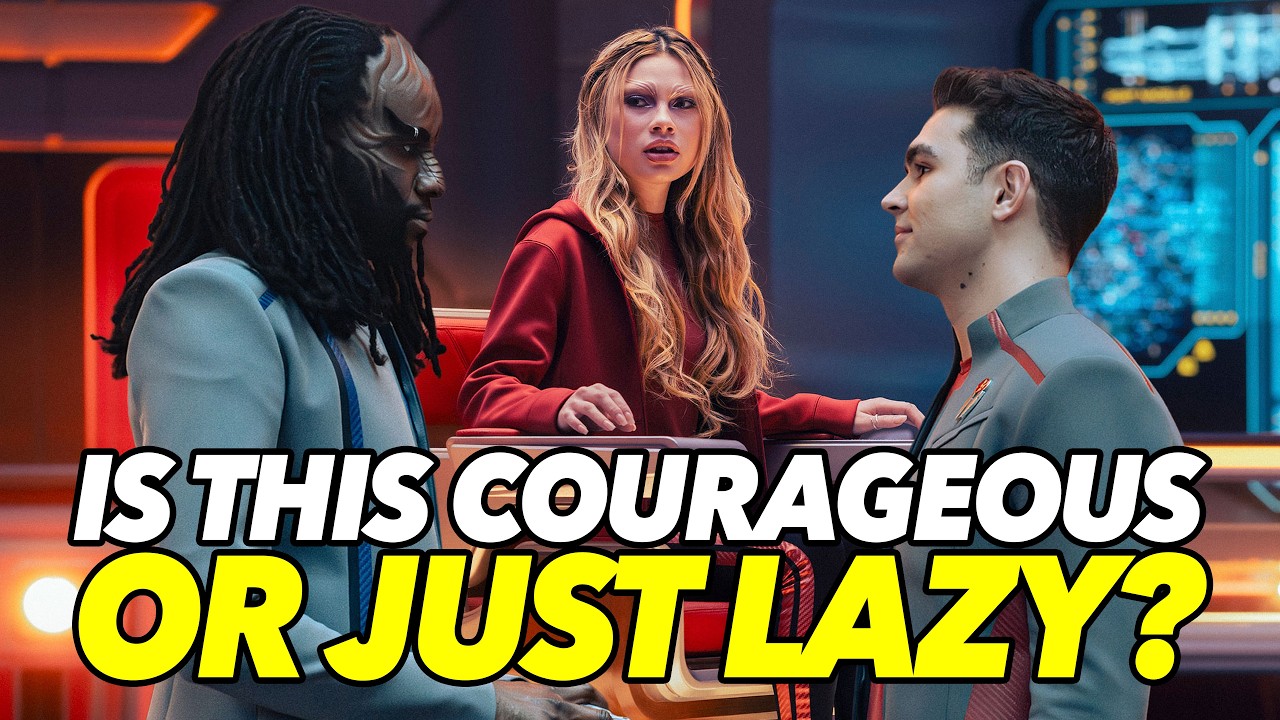
There’s a special kind of episode that looks dense on paper but feels strangely airless while you’re watching it. Portals. Royal succession. Pre-command pressure. A cadet committing fraud. Romantic tension still unresolved from a coma cliffhanger. All the ingredients are here. And somehow none of them are allowed to fully land.
Episode 7 is the hour where Starfleet Academy quietly reveals what it believes about leadership. And I don’t think it likes the answer.
Okay, let’s get some context. We open with a giant text card: mid-semester, a month later. Immediately, that threw me. Last week ended with T’Rina in a coma, Caleb emotionally wrecked, and the academy destabilized. At least, that’s what should have happened. That episode trusted fallout. It trusted discomfort. This week jumps ahead.
All Worlds Day, a new holiday. Cadets go home. We split the cast up. Genesis is pushed toward the pre-command track under the shadow of her Admiral father, or at least that’s what we’re led to believe. Darem is pulled through what looks like a violent abduction portal, which turns out to be a royal ritual. He’s a prince, and his succession timeline has been accelerated because of a health situation back home. Jay-Den follows him impulsively and ultimately becomes his co-sign, his best man. Caleb stays at the academy with Genesis, and they start a sort of holiday rebellion thing that escalates into something really serious.
Got it? Okay. That’s the grid. Now let’s slow down.
Command Rot at the Root
The most important storyline in this episode is Genesis. Not because it has the most spectacle. Because it has the most moral consequence.
She finds out that her letters of recommendation originally contained criticisms. She edited them before submission, and the edit ultimately helped put her on the path for the pre-command nomination. That’s already ethically gray. Then she finds out the criticisms still exist in the system.
And this is where the episode could have gone somewhere dangerous. Instead of confronting the insecurity, instead of asking whether she deserves command, instead of sitting in the discomfort of not measuring up, she escalates. She lies to Caleb to get his help breaking onto the bridge. She steals a programmable matter key that would give her access to all kinds of databases. I don’t mean metaphorically. I mean physically. She steals it. She admits to wanting to break into a secure database, again with Caleb’s help. She wants to override protocols and alter official records inside the command track pipeline.
That’s fraud, boys and girls. Inside Starfleet. This isn’t stealing exam answers. It’s manipulating the institutional memory that determines who leads ships.
So are we given the opportunity to live in the repercussions of those decisions? How do you think all those revelations are paced? Quick. The beats move fast. We get the discovery, the rationalization, Caleb nudging her, the infiltration, the system access, the change, the almost getaway. There is no still moment where she hesitates long enough for us to feel the moral weight of the choice. No extended silence. No held close-up where you see the doubt. It plays like escalation in a caper.
Then Reno catches them on the bridge. Later, Ake removes the nomination. Reno’s confrontation has energy, but it’s Ake who ultimately delivers the institutional consequence. And even that consequence is a contained, administrative, procedural act. Her nomination’s revoked. The scene moves on.
But if Genesis is willing to manipulate official records because she feels like she doesn’t belong, that’s way more than insecurity. That’s command rot at the root. So where’s the existential reckoning? Where is Ake pressing her not just on the rule break, but on the mindset? Where’s the conversation about whether someone who needs the system to lie for them is even fit to lead?
The episode does not sit there. It corrects and proceeds. And that’s where the caution shows.
The Spine That Wasn’t
Now, Darem. On paper, this should have been the spine. Let’s be real. Seriously.
Darem’s a prince. His fiancée’s father’s health accelerates the succession. He’s pulled home through a portal staged like an abduction, and that staging is pretty intense. Jay-Den runs in and saves him because there’s urgency. Then we contextualize it as a ritual. That’s not something crazy to Star Trek. It’s an arranged marriage. It’s political stability. It’s expectation. We’ve seen those things before.
That’s a full A plot. The tension between monarchy and Starfleet is rich territory: chosen identity versus inherited obligation. But the episode doesn’t really want to stay there long enough. The rhythm becomes predictable. Darem tension spikes. Cut. Genesis and Caleb at the academy doing their thing. Cut. The wedding preparations. Cut. Holiday hijinks. Cut. You can feel the rotation. Just when Darem’s internal conflict starts to build, we leave him. It never accumulates.
The Wedding Speech, Broken Down as an Editor
Now, the whole wedding speech thing. Let’s take a look at that for a second, because I need to break it down as an editor.
Jay-Den begins speaking about who Darem has become at Starfleet. He talks about growth, about the man he’s becoming. On paper, this is where the internal shift should happen. But the camera keeps cutting to the bride. And every time we cut to her, it’s a push-in. Not once. Multiple times. The framing tightens incrementally. The music begins to cue emotional change before the words earn it.
The push-ins are doing narrative signaling. It’s the episode saying, “Shh, watch her. She’s going to decide something.” If the performance between Jay-Den and Darem could carry that shift, you hold on them. You let the silence between the lines breathe. You let Darem’s face register realization. Instead, the edit underlines the outcome.
And here’s the uncomfortable question. If you can’t hold on the actor in that moment, that’s not just an editorial choice. That’s either performance not tracking, direction not trusting stillness, or rehearsal not locking the beat. Telegraphing is often a symptom, not the disease.
Then the bride annuls the marriage entirely. It’s an empowering concept, I guess. At least in concept. But I wasn’t surprised, because the camera had been preparing me for it the entire time. And when I’m prepared by staging instead of emotion, the reveal lands flat.
Nothing Cracks
Now stack that next to Genesis. Genesis commits fraud. Darem abandons a throne. Caleb is still bleeding trauma from T’Rina’s coma into bad judgment. These are all volatile ingredients. The right ingredients, I would argue. And yet none of them destabilize the hour.
Caleb’s trauma becomes texture rather than rupture. Darem’s monarchy becomes ceremony rather than fracture. Genesis’s fraud becomes administrative correction rather than moral crisis. Everything resolves into forward motion. Not a thing cracks.
And this is where I felt it personally. During the wedding speech, I leaned back. Not because it was bad, but because I knew where it was going. That’s the moment you lose tension: when you stop leaning in and start observing construction. I want to say boredom, but it’s not. I think it’s more like distrust. Yeah, that’s the better word. Distrust.
If Genesis can manipulate institutional records and the consequence is a temporary nomination loss, the academy feels like brand maintenance instead of a crucible. If Darem can walk away from the monarchy without sustained emotional fallout, monarchy feels like set dressing. And if trauma can convert into holiday flirtation energy within an episode, danger feels cosmetic.
That’s not a writing accident. That’s worldview management. And that’s why this episode feels cautious.
The Verdict
So, what is the Know-It-All Index for Starfleet Academy episode 7? It’s going to be 5 out of 10 for me. Because this episode was an opportunity to interrogate leadership at its root, and it blinked. It cut instead of holding. It corrected instead of confronting. It stabilized instead of destabilizing, which is what was supposed to happen. The ideas are strong, and the execution is really careful. And careful is not what this franchise built its mythology on. Careful was the last thing this episode needed to be after last week’s amazing episode.
What’s funny is that all the ingredients I mentioned last week, they gave us. Ake questioning herself. Everybody having to deal with and live with the aftermath. And then they just shoved it aside and kept going. Like, see all those things you’re feeling? Just tamp those down and move forward. That momentum really hurt this week’s episode.
This one is a disappointment for me. Not because I expected a whole lot different, honestly, but because last week’s episode was such a shining example of what this series could be if it just got out of its own way. I know they’ve already filmed season 2, and I’m here for it. We’ll see. There are three more episodes to go, and we’ll see whether they resolve anything or do anything big with it. I may save my thoughts until the very end and see where it all lands. Mainly because I’m a little gun-shy now.
Would love to hear your thoughts in the comments on the video. Tell me seriously: am I crazy? Did I get it wrong?
So there you go. Now you know. And if knowing’s half the battle, you’re halfway to being a know-it-all yourself.
Think the show earned more than a 5? Head to the video’s comment section and make your case.