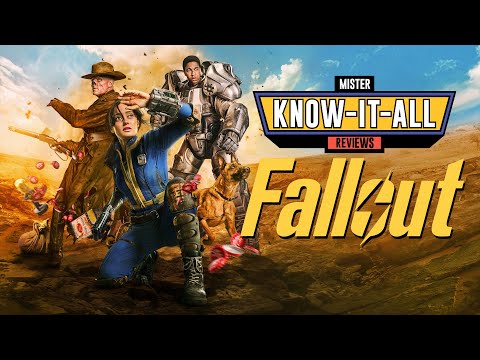
Yeah, I didn’t finish Fallout Season 2 feeling overly impressed. I finished it feeling exposed.
And that’s not a bad thing. Not in a “that was dark” way. In a “the show stopped protecting me” way.
Somewhere around the middle of the season, I realized I was no longer watching for payoffs. I was watching to see what the show was willing to let break. That was not a comfortable shift, because up until then I thought I knew what kind of story this was. I thought I knew the rules it was playing by. More importantly, I thought I knew where the guardrails were.
Season 2 takes those away quietly. No announcement. No thesis statement. Just a series of decisions that don’t get walked back. And I kept waiting for the correction that never came.
What’s up, my know-it-alls. Let’s talk about Season 2 of Fallout as a whole.
I want to be clear about something up front. I didn’t start the season convinced it was great. I didn’t even start it convinced it was smart. There are episodes here that tested my patience. There are stretches where I genuinely wondered if the show was mistaking restraint for depth. And there were at least two moments where I thought this might actually collapse under its own weight.
That’s what makes the landing so important, for me anyway, because this isn’t a season that wins you over by escalation. It wins by accumulation. That is a dangerous strategy in television. As a filmmaker, that’s the kind of choice that either earns trust or burns it completely. For a while, I wasn’t sure which way this was going.
Lucy Loses Her Narrative Protection
The first real warning sign for me was Lucy.
Lucy doesn’t become less moral this season. That’s the trap people are falling into when they talk about her arc. What she loses is narrative protection.
Early in the season she makes a decision that would be rewarded in almost any other show. She helps someone she shouldn’t. She believes a warning. She stays instead of running. The result is not growth. It’s damage. She ends up captured, publicly humiliated, crucified. And when she survives, the show refuses to give her a moment of reclaiming any kind of dignity. She’s injured. She’s dependent. She’s slower. She starts using painkillers, not as a spiral, but as maintenance.
That’s not a corruption arc. That’s consequence without transformation.
That bothered me a lot, because television usually teaches you that suffering is an investment. Endure this now, get strength later. It’s classic storytelling. Fallout Season 2 does not honor that contract. Lucy doesn’t get stronger. She gets narrower, more cautious, less certain. And crucially, the show does not frame that as tragedy or failure. It just lets it sit there.
That’s when I started to worry the season was confusing bleakness for honesty.
The Ghoul Reaches for Certainty
Then we get to the Ghoul.
Up until this point, the Ghoul’s violence had a kind of internal coherence. He was efficient, transactional, and he survived because he never expected the world to reward him. Then Hank offers him certainty. Not redemption. Not even forgiveness. Information. Confirmation that his family is alive, that something he lost actually survived intact.
And the Ghoul betrays Lucy.
That moment almost lost me, because from a writing standpoint that’s a cliche waiting to happen. Trauma-driven betrayal in exchange for hope. I’ve seen that scene fail a hundred times. For an episode, it feels like it might have here too.
Until the show lets the consequence land. Not with a speech. Not with any kind of real reflection. With time.
He’s skewered on a light post for two days. No montage, no clever cutting, just exposure, immobilization, degradation. His regeneration slows. His grip frays. By the time he gets free, what’s left isn’t a man who learned a lesson. It’s someone who almost lost the last thing keeping him human.
That’s when the pattern became impossible to ignore. Every time someone reaches for something fixed, something guaranteed, something stable, Fallout takes something else away. Lucy reaches for goodness and loses safety. The Ghoul reaches for certainty and nearly loses himself. That logic keeps repeating, again and again and again.
Maximus and the Bureaucracy Problem
Which brings us to the Brotherhood.
Maximus doesn’t destabilize the Brotherhood because he’s incompetent. He destabilizes it because he acts inside the system as if moral intent should matter. There’s a moment where he prevents a massacre. It’s the right call. It’s also the moment where the internal fractures finally surface.
From a structural standpoint, this is risky writing. You’re letting the protagonist do the correct thing and still lose institutional support. No ally. No consolidation. Just collapse.
As a filmmaker, I clocked what they were doing here. They’re letting bureaucracy replace spectacle. Meetings instead of battles. Process instead of heroics. That’s bold, and it’s boring if you don’t trust your audience.
So for a few episodes, I wasn’t sure I trusted the show. Because there’s a real danger here. Accumulation without release can turn into exhaustion. Pressure without payoff can feel like withholding. There were moments I expected relief that never came, scenes that felt like they were setting up reversals that simply didn’t exist. And I didn’t like that.
The Pivot: It Was Never About Release
Then I realized something really uncomfortable. The show wasn’t failing to give me release. It was removing my expectation of control.
That’s the pivot.
The season isn’t about escalation. It’s about what happens when systems protect themselves instead of people. Shady Sands doesn’t fall because of a villain. It falls because order mattered more than consequence. The Brotherhood fractures because preservation becomes indistinguishable from self-interest. Vault-Tec never disappears. It just stops pretending to be benevolent.
Once that clicked, the pacing problems stopped reading as mistakes and started reading as pressure. There are no protected spaces. No untouchable factions. No moral exemptions, not even narrative ones.
That doesn’t mean nothing matters, and I think that’s a place you can get confused easily. It means things matter because they can be lost without ceremony.
Risk Is Not Nihilism
This is where I want to draw a hard line, because this is where some criticism misses the mark.
Saying “if the world is this unstable, nothing matters” feels emotionally true, but it isn’t structurally true. In Fallout, instability is the condition that gives actions weight. If outcomes were preserved, if factions were safe, if morality guaranteed reward, choices would be cosmetic.
What Season 2 commits to is risk. And risk is not the same thing as nihilism.
Now, does this approach scare me going forward? Yes. Let me be straight about it. Because accumulation is fragile. Because exhaustion is real. Because Season 3 cannot rely on subtraction alone. They built too many walls for that. There has to be release eventually. Not comfort. Not victory. Meaning.
The Verdict
I didn’t arrive at this verdict easily.
I didn’t love this season because it was fun. I didn’t love it because it was faithful in the way people usually mean that word. I loved it because it stopped flattering me. It made me misread it. It made me wait for payoffs that never came. It made me sit with decisions I couldn’t fix. And by the end, I realized the resistance I felt wasn’t boredom. It was loss of control.
That’s Fallout.
So what’s the Know-It-All Index for Season 2 as a whole? After weighing where it frustrated me, where it nearly lost me, and where it earned my trust anyway, I’m giving it a 10 out of 10 on the Know-It-All Index.
I need to be precise about what that means, because I feel like people are going to say “what?” This isn’t a 10 because the season is comfortable or clean or perfectly balanced. It isn’t. It’s a 10 because it commits to a structure that could have collapsed, refuses to protect itself when it gets uncomfortable, and still manages to hold together.
I don’t want a safer version of this season. I don’t want it smoothed out. I don’t want the guardrails back. For what it’s attempting, and the nerve it takes to attempt it at this scale, this lands at a 10.
Now you know, and if knowing is half the battle, you’re halfway to being a know-it-all yourself.
If you disagree, I want to hear why. Not insults, not slogans. Tell me where you think the structure failed or where the pressure collapsed. The conversation lives in the comments on the video above.