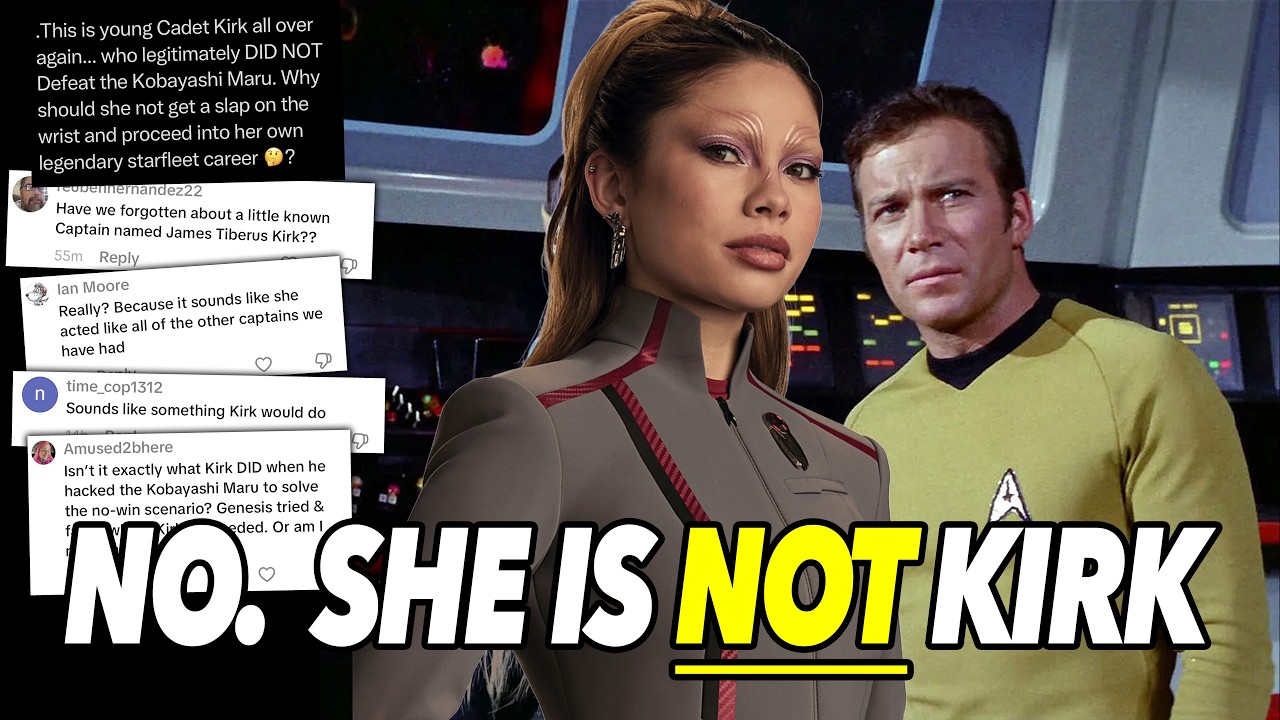
I’ve seen this comment over and over: “This is a young cadet Kirk all over again.”
No, it isn’t. I think it’s a bad characterization. And if we’re going to compare the two, I think we need to actually compare what happened, not just the vibes.
This video is a direct response to the comments saying Genesis is basically Kirk with the Kobayashi Maru, that what Genesis did is exactly what Kirk did, just messier. That shows a fundamental lack of understanding. Let’s slow it down, because if you actually look at what each of them touched inside Starfleet’s systems, the comparison falls apart fast.
What Kirk Actually Touched
“I reprogrammed the simulation so it was possible to rescue the ship.” “He cheated.” “I changed the conditions of the test.”
Kirk changed a training simulation. The Kobayashi Maru is ultimately a test. It exists inside the Academy specifically to measure how cadets react to a no-win scenario. It’s a contained program designed for evaluation.
He didn’t access personnel files. He didn’t alter mission records. He definitely didn’t break into a commissioned vessel. He didn’t activate propulsion systems, and he definitely didn’t attempt to erase evidence of prior fraud. He changed the rules of the test, and Starfleet then decided whether that counted as ingenuity or cheating. That’s really a debate about evaluation philosophy more than anything.
What Genesis Actually Touched
Genesis, on the other hand, didn’t change a test. She falsified recommendation letters to get into the Academy. That’s admissions fraud. Then, when she realized the lie could cost her command eligibility, she tried to erase the evidence.
And she didn’t do that in a classroom. She and Caleb accessed the bridge of a commissioned vessel. They powered up the impulse engines, which is already a problem, and then they brought the warp core online.
That’s not symbolic rebellion. That’s activating a matter-antimatter reactor for a personal coverup. In Star Trek, warp power isn’t casual. It’s the heart of the starship. You don’t bring that online quietly. You don’t do that without system logs firing. You don’t do that without triggering internal oversight. If two cadets can power up a warp core to erase records, that’s not a “bold future captain” moment. That’s a security failure.
Kirk bent the rules of a scenario. Genesis attempted to rewrite her own institutional history. Those are not the same. They are definitely not the same category of action. One challenges a test. The other compromises trust. And in Starfleet, trust is the currency of command.
“But she didn’t finish the fraud.” Well, that’s not how institutional systems work. Attempted fraud inside secure systems is still a breach. Powering up propulsion to do it is still a breach. The fact that she was stopped does not erase what she was willing to do. Intent matters in command assessment. Starfleet doesn’t evaluate outcome. It evaluates judgment, definitely judgment under pressure.
What Historical Precedent Says
Here’s the uncomfortable question: in earlier Trek eras, what happens when cadets lie and compromise safety?
Look at the TNG episode “The First Duty.” Even without a fleetwide catastrophe, the coverup is treated as the real crime. “The first duty of every Starfleet officer is to the truth. Whether it’s scientific truth, or historical truth, or personal truth.” Genesis’s entire candidacy was built on a lie. Then she escalated that lie by compromising a ship. If we’re being honest, in a stricter era of Starfleet, that likely ends in expulsion or a full academic reset.
Instead, in this episode, she receives probation and loses the early command track. That’s not a slap on the wrist, but it’s lighter than historical precedent would suggest.
The Production Reality
So let’s talk production reality for a second. Genesis is a lead. You don’t permanently detonate your lead at episode 7. The show wants a redemption arc. It wants growth, not removal. So the institutional spectacle is lessened, minimized if you will. We don’t get a full inquiry panel like they did in “The First Duty.” We don’t get a fleetwide security scandal. We get character consequence.
Now, that is a storytelling choice, but I think we should be honest about it. It’s a tonal softening of what is, inside Trek logic, a serious systems breach.
So no, this is not young Kirk all over again. Kirk altered a test. Genesis falsified her admission, attempted to erase institutional records, and powered up warp systems to do it. That’s way more severe, and it speaks directly to her fitness for command. The fact that Ake pulls her recommendation is the most Starfleet part of the ruling, because ultimately command is about trust. When fear threatens ambition, what you choose tells the institution who you are.
That’s the difference. So there you go. Now you know. And if knowing’s half the battle, you’re halfway to being a Know-It-All yourself.
Look, agree with me or not, I just wanted to address this because so many people were getting dismissive, acting like it’s just what Kirk did. It’s really not, and I think you’ll understand that the longer you look at it. Just because you like the character doesn’t mean the comments characterized what happened the right way. I have a feeling I’m going to want to talk more about this, so let’s keep the discussion going.
Would love to hear your thoughts in the comments on the video, whatever platform you’re watching on. Never forget: everyone loves a Know-It-All.