
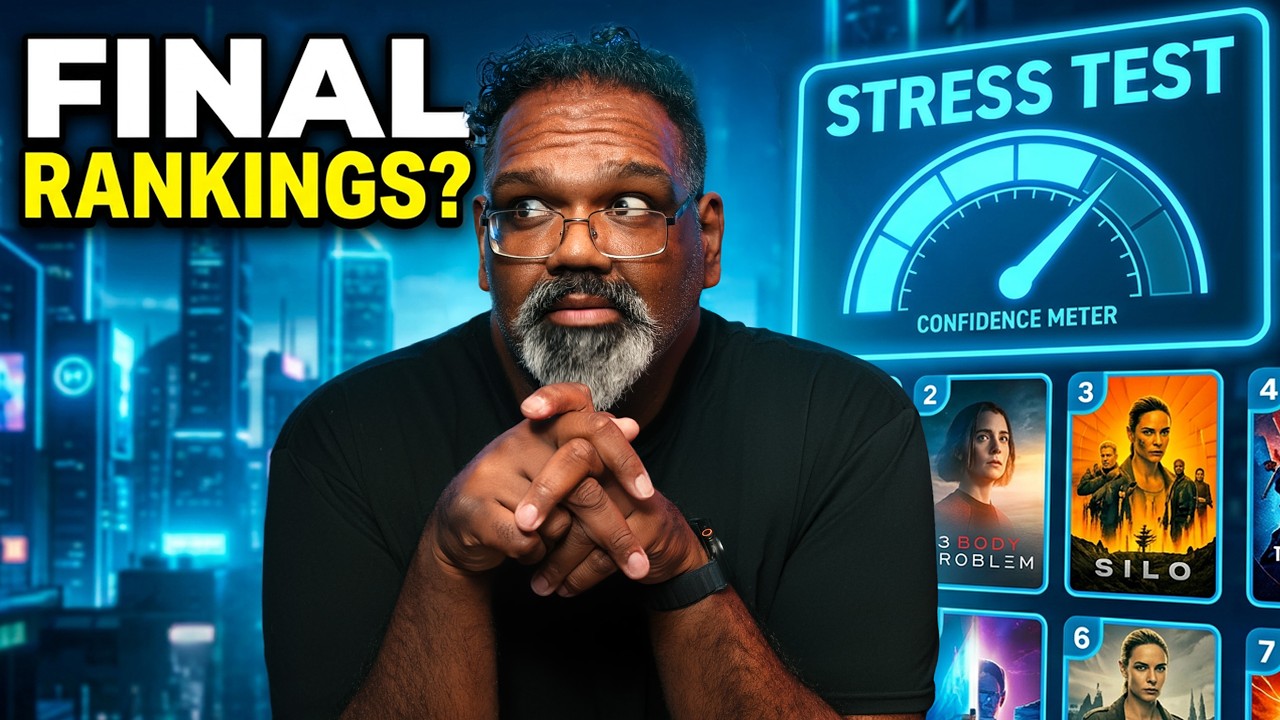
2026 is turning into a sci-fi stress test.
I don’t mean that in a cute marketing way. Space.com just put nine shows on the board, and when you look at them together, it stops feeling like a watch list and starts feeling like a franchise confidence exam. At a certain point, asking “which one looks cool” isn’t enough anymore. A lot of them look cool. The real question is: which one actually has a reason to exist right now?
And that’s where this gets fun. I didn’t make the list. Space.com did. I’m just here to run it up against the Know-It-All Index.
The Confidence Test
So here’s the board Space.com updated for 2026, and it’s frankly ridiculous: Spider-Noir, Star City, Silo season 3, Star Trek: Strange New Worlds season 4, Lanterns, Vision Quest, 3 Body Problem season 2, Blade Runner 2099, and Neuromancer. That’s not a casual “what should I watch next” queue. That’s Apple, Netflix, Paramount, DC, Marvel, and Amazon all stepping into the same year, desperately trying to prove they aren’t just pushing expensive content sludge with a recognizable logo slapped on it.
So today we’re doing a special edition of the Know-It-All Index. I’m not here to review all nine shows. Instead, we’re doing the Know-It-All Sci-Fi Confidence Index. For this version, I’m not asking which title has the biggest fandom or the most recognizable brand. That’d be boring, and honestly it’d probably make the list worse. Instead, I’m judging them on a few strict criteria:
Does it know what it is? Is the pitch clean? Does the creative team understand the assignment? And can it actually justify the attention it’s asking for in a really crowded year?
That’s the game. Scored 1 to 10, half points available. No fake science, no corporate spreadsheet nonsense, just pure franchise confidence. Let’s rank all nine.
9. Neuromancer (6.5/10)
Before anybody accuses me of walking into William Gibson’s house and kicking over his typewriter, calm down. Neuromancer is a foundational cyberpunk text that built the language modern sci-fi still speaks today. But I think that’s going to be a double-edged sword. Apple has the budget and a serious cast, but the show has a brutal assignment: it has to make the blueprint feel new again. You’re adapting the exact thing that influenced everything audiences already associate with cyberpunk. The danger isn’t that people will think it’s too weird. It’s that they’ll watch it and say, “Wait, haven’t I already seen this?”
Importance isn’t the same thing as confidence, and Neuromancer’s biggest enemy is its own massive influence.
8. Vision Quest (6.5/10)
This one’s dripping with brand power. Paul Bettany is back as Vision, James Spader returns as Ultron, and the ties to WandaVision and the wider MCU are going to be really obvious. There’s a universe where this thing is weird, sad, strange, and highly compelling.
But big brand doesn’t equal an easy entry point. If I pitch you “White Vision reconnects with his memories while exploring MCU artificial intelligences,” die-hard fans are hooked, and everyone else is blinking like I just assigned them homework. Marvel has accidentally trained casual viewers to ask “what do I need to remember?” before they ask “what’s the story?” Once a show feels like a continuity filing cabinet, people emotionally unsubscribe. I like Vision, but as a confidence play, this pitch is just too muddy.
7. Blade Runner 2099 (7/10)
Here’s where the prestige alarm starts blaring. Blade Runner is an all-time influential brand carrying heavy atmosphere, moral dread, and that iconic neon rain. On paper, throwing Michelle Yeoh and Hunter Schafer onto Prime Video to continue the 2049 storyline sounds brilliantly expensive.
But the name is almost a trap. When you say Blade Runner, people expect cinema. They expect every single frame to make other sci-fi shows look like they were lit in a dentist’s office. That’s a brutal standard for television. And right now, the public pitch feels a little foggy, and not in a cool, atmospheric way. More in a “what’s the actual week-to-week hook” way. The title has massive weight, but weight can easily turn into gravity.
6. Star Trek: Strange New Worlds Season 4 (7/10)
I know I’m going to catch heat for this, because I genuinely love Strange New Worlds. It has one of the cleanest identities in modern Trek: Captain Pike, the Enterprise, classic episodic adventures, modern execution. Identity isn’t the issue here. The problem is the runway.
The show is actively promoting its future while simultaneously looking like it’s packing up shop. Season 5 is already confirmed as a shortened six-episode final season. So when marketing tells us we’re getting “closer to where it all began,” I get the excitement, but I’m also wondering: are we building toward something great, or just watching the track run out? Star Trek knows what this show is, but the franchise confidence surrounding it feels shaky right now. I want season 4 to be amazing. But love isn’t confidence.
(If you want more of my thoughts on what Strange New Worlds is actually selling us, I did a whole video on exactly that earlier in the week over on the channel.)
5. 3 Body Problem Season 2 (8/10)
This is the biggest hard sci-fi swing on the board. The story itself is excellent: a massive tale of alien threat, civilization panic, physics, and humanity trying to process an unfathomable problem. My only hesitation isn’t the plot, it’s the platform. Netflix has trained us to be nervous. Whenever you start an ambitious sci-fi show there, part of your brain wonders if it’ll be taken behind the barn and canceled after one season.
However, getting seasons two and three changes the game completely. It proves this massive story actually has the runway it needs to stick the landing. You can’t do 3 Body Problem politely or small, and Netflix is finally showing real commitment. Strong story, big swing, totally earned confidence.
4. Star City (8/10)
Star City fascinates me. It isn’t just “For All Mankind, but more.” It completely flips the board to the Soviet side of the alternate-history space race. We’re getting the cosmonauts, the KGB secrecy, the immense pressure behind the Iron Curtain. What makes this a fantastic dramatic engine is the parallelism: we get to watch a version of Russia that achieves the success and power America enjoyed in the parent show, and we get to see if that success makes them just as complacent. It’s a brilliant way to explore ambition and propaganda from the other side of the mirror.
The spin-off angle is incredibly clear, and the creative confidence is highly visible. It isn’t the loudest show on the list, but it easily has one of the strongest reasons to exist. It’s on my list: For All Mankind first, then running right into Star City.
3. Lanterns (8.5/10)
Lanterns has a really steep hill to climb. The Green Lantern brand comes with heavy on-screen baggage, and fans have nitpicked everything from the muted color palettes to Hal Jordan’s suit. But the reason it ranks this high is the undeniably brilliant pitch: True Detective with space cops. Hal Jordan and John Stewart investigating an Earth-bound murder that cracks open a galactic conspiracy.
It works because it finally gives the Lanterns a shape audiences instantly understand. You don’t need to memorize the lore of Oa before episode one. You just follow the case. Add James Gunn acting as the Kevin Feige of this new DC universe, and my benefit of the doubt remains intact. It has baggage, sure. It also has the cleanest pitch of the year.
2. Silo Season 3 (9/10)
Silo is exactly the kind of sci-fi clarity that major franchises would kill for. It’s a brilliantly physical, easy-to-understand premise: humanity lives underground in a sealed system, the outside world is deadly, and the rules keeping them alive are deeply suspicious. People have called this “grown-up Fallout,” which I think is a mischaracterization, especially if you actually watch the show.
The Silo itself acts as a storytelling machine. The setting establishes the premise, the premise creates the conflict, and the conflict is exactly why audiences keep coming back. Watching characters slowly realize their reality is a lie hits incredibly hard. It stays in your memory and actively creates a reason for you to return. That isn’t just hype. That’s a finely tuned prestige engine.
1. Spider-Noir (9.5/10)
Spider-Noir was spectacular, and I don’t just mean “pretty good for a weird Marvel side project.” I mean they completely understood the assignment. While a lot of the shows on this list are still selling us on promise, Spider-Noir showed its work.
The pitch was always perfect: Nicolas Cage doing a 1930s detective-noir Spider-Man. But it wins the confidence index because it treated the concept as a genuine stylistic commitment, not a cheap gimmick. A lesser version would have just leaned on the novelty of Cage’s voice. Instead, they walked into the alley, pulled the fedora down, lit the shadows gorgeously, and let Nicolas Cage absolutely shine. It had a razor-sharp reason to exist, and it flawlessly justified it. That’s huge.
The Final Board
So let’s look at the final board. Neuromancer gets a 6.5 because it’s fighting its own legacy. Vision Quest gets a 6.5 because it has a muddy doorway for casuals. Blade Runner 2099 gets a 7 because it’s crushing under prestige gravity. Strange New Worlds season 4 gets a 7 because the identity is strong but the runway is weak. 3 Body Problem season 2 gets an 8 for its massive scale and finally securing its runway. Star City gets an 8 for a brilliant spin-off perspective. Lanterns gets an 8.5 for having the perfect True-Detective-in-space pitch. Silo season 3 gets a 9 for being the cleanest sci-fi engine on TV. And Spider-Noir takes the win with a 9.5 for the flawless execution of a wild concept.
Every one of these shows answers the “why should I watch” question differently. Silo answers with clarity. Lanterns answers with pitch. Blade Runner answers with prestige. But this is a true confidence test, and Spider-Noir takes the crown because it perfectly bridged the gap between having a hook and executing the tone. That’s the definitive difference between interest and confidence. Interest says, “I want to see if this works.” Confidence says, “This knows exactly what it is.”
So there you go. Now you know. And if knowing’s half the battle, you’re halfway to being a know-it-all yourself.
Now I want to know where you land. Which 2026 sci-fi project are you actually confident in? Not just excited for, confident in. Drop your ranking in the comments on the video above, and don’t just tell me what you like. Tell me what you trust. And never forget: everyone loves a know-it-all.


