
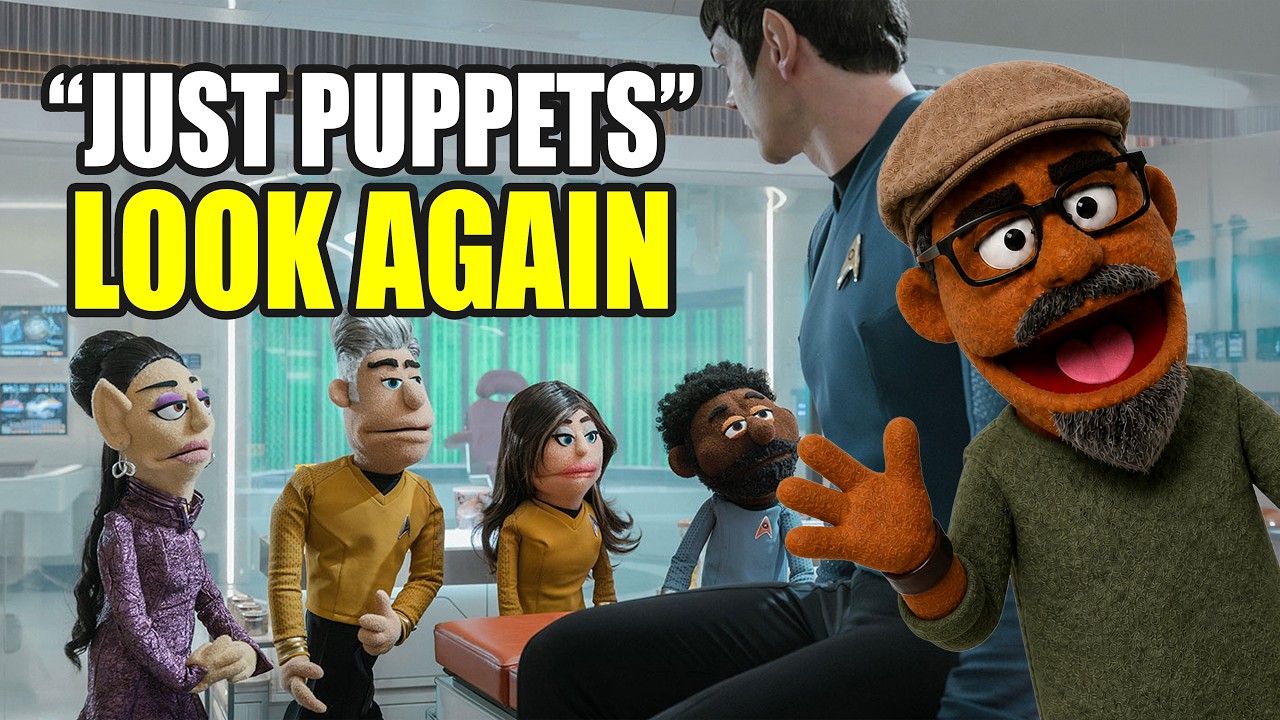
Six months. That is what the showrunner says they spent building this thing, and it bought the most important episode of this era of Star Trek. Six months of work on one episode, running alongside everything else the show still had to shoot, with a whole crew hired that this production did not have before.
Which is insane, because from the outside the answer is a joke. It is a bit. The crew turns into puppets.
It took me until the last ten minutes to figure out what it was actually for, and once I saw it, I could not stop seeing it. Everybody is arguing about whether they should have done this. I want to know why they would bother.
I Am the Mark
Before anything else, I have to put something on the table, because if I do not say it, it will sit underneath everything else I say today.
I love puppets. Not as a bit. As an art form. I wanted to be a puppeteer when I was a kid. I had a puppet growing up. I own a professional-grade one right now, and the only reason you did not just watch me use it is that it looks close enough to Ernie that I would rather not have that conversation with somebody’s legal department.
So you know what that makes me? I am the exact person this episode was built for, and nobody involved knew I existed. I am not neutral. I am the mark. Which means me telling you I liked it is worth nothing, and it should not be worth anything. If the argument only works because I felt something, it is not an argument, and I would rather find that out on camera than pretend otherwise.
(I have more on the puppet thing than belongs in here. It is in this week’s sidebar video for members. If that is your thing, I hope you will join me over there.)
Here is the part I would rather skip. When this was announced, I was not charitable about it either. My honest first reaction was the same one you probably had: what are they doing? I have been at this long enough to know that reaction is usually laziness wearing a costume, and it really was. When I watched it, first forty minutes, I said “this is stupid” out loud more than once. Somewhere in the back half, for me anyway, it flipped, and I went, “okay, that is actually kind of clever,” and the premise was still ridiculous. Then the last ten minutes happened, and I sat back and went, “oh.”
I am going to ask you to hold the end of that. I went through the whole thing, and I want to walk you the way I walked it.
The Money Was the First Thing That Got Me
The part that got me first had nothing to do with the story. It was the money.
These are not Amazon puppets. Be specific with me here, because the word “puppet” is doing damage and people are picturing a sock. What is on screen is full Muppet-grade construction. The end credit card reads “Puppets by Jim Henson Creature Shop.” Not The Jim Henson Company, not Jim Henson Studios, not The Jim Henson Workshop, all three of which I have watched go out in print this week. It is the Creature Shop. And TrekCore reported they did not just build these, they operated them.
I have a friend who works at the Puppetry Center here in Atlanta. He restores old Sesame Street and Muppet puppets. He builds costumes for Macy’s parades. He is one of the foremost mascot suit builders working, and he is classically Henson-trained, which means a specific process that shop has been running for decades, and it produces a very specific-looking object. You can spot it across a room.
Nobody has published a budget for this. I went looking, actually looking, and there is nothing out there, so I cannot tell you what it cost. What I can tell you is what my friend charges, and a completed puppet or mascot suit runs somewhere between six and ten thousand dollars depending on the internals: working arms, hand ability, wiring, whatever. Now go count the puppets in this episode. And that is just what is sitting on the shelf when you show up.
Here is the problem with counting puppets. The puppets are not the expensive part.
The Part You Cannot See Is the Floor
The thing that made me sit forward is the floor.
When you shoot puppets on a standing set, the performer has to physically be somewhere. Normally you do that with a recessed set, which means either you cut the floor open and carve a clear path for the puppeteer to move through, or you rebuild the floor sections and lift the whole thing onto risers. I am not telling you that is what they did here, because nobody has said, and I am not going to invent it for you. That is how this is normally accomplished, and there is no cheap version of it on a standing set, on an ongoing series, that still has to shoot every other episode.
Which is why the six months does not surprise me. Henry Alonso Myers said easily more than six months of work, and that they had to staff an entire crew of puppeteers on top of the crew they already had. Goldsman said that alongside every normal prep meeting for every episode, there was always a separate puppet meeting.
And that is where the word everybody keeps using falls apart on me.
“Gimmick” Is the Wrong Word
A gimmick is a hook. A hook exists to go get you an audience you have not got.
Strange New Worlds has five more episodes after this one, and then a final season that is only six, and then it is finished. Goldsman called that last season a six-episode goodbye that walks these people to their known future. There is nobody left to hook. Whatever this is, the word does not describe it, because the motive it names stopped existing a while ago.
Which is also why the dare does not bother me. Anson Mount has said the whole thing started as a dare the cast threw at the writers, and if you have spent any time on a set, you know exactly why that is true. Somebody hands you a word you have to work into an episode. Somebody bets you cannot. That is what a crew does to stay awake in month four. The dare is how it started. Six months is what happened afterward, and only one of those things is on screen.
So the money is not chasing an audience, and it is not an accident. Which left me with the other easy answer: that it is a stunt, a swing for the sake of swinging. I could not make that one work either.
This Franchise Has Always Gone Here
Star Trek has done this since the very beginning, and it is not close.
The original series has an episode called “Shore Leave,” where the crew lands on a planet that manifests whatever they are thinking about, and one of the things it manifests is a giant white rabbit. “Oh, my paws and whiskers, I shall be late.” That is a man in a rabbit suit, and the show does not wink at you. It plays it dead straight as an actual enormous rabbit, Alice in Wonderland and everything. And this franchise absorbed it without a scratch. Bring it up now and what you get back is, “well, that was the era.” Right. And you accepted it not because the effect holds up, because it does not. You accepted it because the episode was about something, and the rabbit was how you got there.
Data got two dreams, and they were not a stunt then either. “Birthright” in 1993, where his father shows up as a blacksmith hammering a bird’s wing, then “Phantasms” eight months later, the cellular peptide cake with mint frosting. Same writer both times, Brannon Braga, and the second one was directed by Patrick Stewart. That is a production putting real money and its lead actor behind the idea that the inside of a character’s head is a location worth building.
That is the well-known one. Go back further, because the deepest cut here is also the oldest. The very first Star Trek anybody ever shot, before Kirk existed, is “The Cage,” and it is Talosians putting Pike inside illusions built out of his own wants and running him through them in order: duty, homesickness, desire. They reused that footage in “The Menagerie” in 1966, and that two-parter won the Hugo the next year. And what the illusion is unpacking in “The Menagerie” is Spock. It is Spock’s career-ending loyalty to Pike, delivered entirely as a story inside a story. The first Hugo this franchise ever won was for using an interior projection to say something about Spock. That is not an argument. It is just a pretty funny thing to be true.
And Discovery did it to the exact same character seven years ago. If memory serves, Spock’s mind is scrambled, and it is a Talosian projection again that puts him back together.
The one I went looking for and did not expect is Enterprise. 2002, an episode called “Vanishing Point.” Hoshi gets transported off a planet during a storm, starts going invisible, then intangible, and watches the crew move on without her. At the end you find out the whole hour happened in 8.3 seconds inside the pattern buffer. A transporter accident. You catching me? That turns out to have been an entire interior event, twenty-four years ago, and you are not going to find one person mentioning it this week.
So if you want to say you do not want this level of absurdity in your Star Trek, that is a real position and I have got no argument for it. That is taste, and taste is allowed. But the franchise has always gone here.
The Loaded Frame
And the tradition has exactly one rule, and it has nothing to do with how silly the frame is.
The frame has to have something in it.
Break the format and put nothing inside it, and you have made a stunt. Break it and load it, and you have made what I have started calling a loaded frame, which is the only kind worth doing. That is the actual test. That is the only test. And it is the test I could not get this episode to fail.
But I am the craft guy, which means I had to find out what was in there.
Spock’s College Years
What is in there is Spock, and it has been in there all season.
Strange New Worlds is going to go down as Spock’s college years. That is the frame I keep landing on. The experimentation era. The stretch where you break it off with the fiancé back home because you want to know what else is out there, and you try things, and some of them are embarrassing, and eventually you come back around recognizable.
This season has been waking him back up. Walking him back, if you will. Three times. Not three in a row, three separate times.
Episode 1: watch him in the conference room. He is colder, more analytical than we have seen him, to the point where people are cracking jokes around him and he does not get them and does not pretend to. I will be straight with you, nobody wrote about that. I went and read the premiere coverage, and Spock effectively is not in it. That is my read, not a reported one, and I would rather tell you which it is than let you assume.
Episode 2, the horror episode, is the one you can point at. T’Pring shows up as an apparition and goes straight at his Vulcan identity, ties him down in sick bay, starts taking his ears off. And get the direction right, because everybody inverts it. She is not making him more Vulcan. She is making him more human. The way out is a meditative logic exercise, so he escapes using the most Vulcan tool he owns. And in the episode itself, the cutting is something he is doing to himself. That is a character being told in horror movie grammar. The thing eating him is inside the house.
Now the one that does not fit, and I am naming it on purpose. Episode 4. Spock is barely in it, and his one real beat is dismissing La’An’s concern about the probe, in an episode that is entirely about how the dismissed instinct was correct. I sat that one out, and I will tell you why. It was fine. It just did not leave me with much to say that was not me defending an alien world built to mimic an Earth institution on a premise that was contrived the second you looked at it. Fine for what it was. I am not going to spend fifteen minutes defending a lazy premise, so I moved on.
I cover every one of these the day it airs. The other half of that arrangement is that when I have got nothing, I do not show up and say it anyway, which is exactly why I am not going to turn around now and pretend episode 4 supports me. If you only ever show people the episodes that fit, you are not describing a pattern. You are building one.
The Guy Who Loves Playing Spock
So that is two. The third one is the reason I wanted to talk to you today, and to explain why it hit me the way it did, I have to tell you about a conversation I had at a convention.
I met Ethan Peck there. My wife swooned. That is her business. But we got a real conversation out of it, and what stuck with me is the difference between him and Anson Mount. Mount is an actor’s actor: this is a job, I do it as well as I can, I love the work. Peck is something else. Peck loves Star Trek, and loves playing Spock, in a way you can hear across a table.
So when he says at CCXP in Mexico this spring that they are working to turn this more emotional Spock into the more computational, analytical Spock you know from The Original Series, I do not hear a press line. I hear the guy. He got four years to play the fun version, and now he gets to turn the corner into the one everybody has been waiting on.
And the show knows exactly where that corner leads, which is the part I think gets lost. Goldsman said in July that by the time we get to “Amok Time,” Spock and T’Pring’s relationship is not where we left it. Then he said every coloring book has lines, and the lines of ours are where we end up. “Amok Time” aired in 1967. It has been sitting at the end of this the whole time like a wall, and everything they do with those two between now and then is them deciding how she gets from here to there.
That is the part that reframes the whole season for me. This is not a show doing a bit. It is a show spending its last year putting a character back where it found him, one episode at a time. And this is the one where it finishes.
The Last Ten Minutes
He wakes up. Spock wakes up in his own quarters, and T’Pring is there to meet him, and she is not a puppet, and she never was. There was a transporter accident, but what it damaged was his shuttle and some buoys. That is it. Everybody turning into felt happened inside his head while he was unconscious.
Here is my first reaction, and it is the thing I need to be careful with. My gut went, “oh, that makes so much sense, now the insanity makes sense,” and I felt every problem I had with that hour evaporate. That is a dangerous sentence and I know it, because a twist that shows up at minute 50 and retroactively excuses everything in front of it is a cheat. That is the definition of one. And there is a real complaint out there that the show runs out of things to do with the puppets well before the hour is up, and the reveal does not make that complaint go away.
So let me say it more carefully than my gut said it. The dream does not forgive the silly hour. It tells you what the silly hour was in service to.
Stay with me, because this is the part that moved me. Look at what he does in there. Somebody tells him flat out that this situation cannot be met with logic, that the hijinks are not the obstacle, they are the solution. Spock says, “I know what to do.” And what he does is take the captain’s chair and shut off life support to knock the boarding party unconscious. That is a cold, ruthless, completely Vulcan calculation. He does not abandon logic to win in there. He needed the chaos in order to use it.
Then he wakes up and tells her that in that state, she taught him how to face anxiety and accept illogical things. And she tells him that is a relief, because that is exactly why she came aboard in the first place. That is literally what she was there to help him with. And in the same conversation he is asked whether he still wants to go back to a life of logic, and he says, “Very much so. Little can make one crave order and logic more than being surrounded by puppets.”
Both of those, minutes apart. He learned to sit with the illogical, and he wants order more than he did before. That is not a contradiction. That is a man who has proved to himself he can survive the chaos and picks logic anyway, which is a completely different thing from hiding behind it.
And I know what some of you are already typing. He is Spock, he was always going to end up there, canon says so. Sure. But canon tells you where he lands. It does not tell you he chose it.
That is the corner, and they put it inside a puppet show.
What the Six Months Was For
Which finally answers the thing I could not work out at the top.
They hired a crew they did not have. They built puppets that cost what a used car costs, one at a time. Somebody almost certainly cut into a standing set that has to keep shooting. And they spent all of it so that one man could work something out in his sleep and wake up knowing who he wants to be.
That ratio is insane, and it is the whole answer. Nobody spends that to land a joke, because there is no audience left to sell the joke to. You spend it because the silly frame is the only place you can put a quiet decision that big without the show turning into a lecture about it.
That is what it was for. A loaded frame. And it is the oldest trick this franchise has.
The thing that almost cost me this episode was not the puppets. It was a habit I had fallen into without noticing, which is asking whether a show was allowed to do a thing instead of asking what the thing did. That question feels like criticism. It is not. It is a permission slip, and it will stop you at the door of every interesting episode ever made.
There you go. Now you know. And if knowing is half the battle, you are halfway to being a know-it-all yourself.
The Verdict
Two numbers went into this, and they did not agree, so I am going to show you both.
As production, I would say it is a 9, and I will not be argued down. The build, the performance, the staging, the logistics of getting a puppeteer crew inside a standing set on a show that still has to make its schedule, and doing it well enough that a lifelong puppet guy sat there counting gags instead of seams.
As an hour of story, it is probably closer to a 7. It sags in the middle, and that reveal is carrying more than a reveal should have to. I said so before I said anything nice about it at all, and I am not rounding up because I had a good time.
So where it actually lands is 8 out of 10 on the Know-It-All Index. They cut the floor open for a character beat. That is crazy.
Your turn, and give me the real answer in the comments on the video above: what is the format break you wrote off before you watched it and were wrong about? The musical, the animated one, noir. It does not matter which show or which franchise. Tell me the one you were wrong about. I will go first.


