Last week I got one wrong. I am going to say it out loud. I sat right here and had a problem with what this show did to Kirk, and it was not the writing. It was me. I love that character. I have loved him since I was a kid, and I let that love sit down in the chair where the argument was supposed to be.
A bunch of you called me out on it. You came into the comments with actual evidence, which I respect, from the episode, from the canon, from the production, and you moved me. Not because you were loud. Because you were right. And the embarrassing part is that what you were telling me is what I had already been saying on this channel for weeks: these episodes are the events that are making them into these people. I argued that, and then the second it was Kirk’s turn, I forgot it.
So this week they did it again. They took the silliest premise on the board and they pointed it at somebody. This time I did not flinch.
This is Star Trek: Strange New Worlds, season 4, episode 9, “Once La’an a Time.” It is the fantasy one. It is the sequel to the storybook episode from season one, “The Elysian Kingdom,” except this time the kingdom is a real planet you can fly to. There is a dragon. There is a wizard. There are doppelgangers, because of course there are. And if you have been anywhere near Star Trek discourse this year, you already know the word waiting for it.
Gimmicky.
The Word Has the Shape Backwards
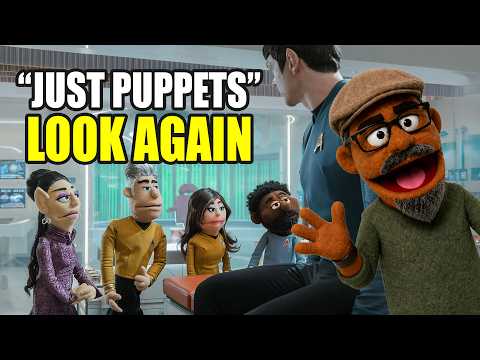
That has been the word all season. Puppets, gimmicky. The soap opera, gimmicky. The noir one, gimmicky. Klingon Bonnie Tyler, gimmicky. Now a fairytale planet with a princess on it, which is going to read to a lot of people like the show finally ran out of ideas in its second to last season.
Something about that word has bothered me for months and I could not figure out what it was. I think I can now. I think the people using it have the shape of Star Trek backwards in their heads, and I think this episode is the cleanest proof we have got.
Do this with me. Pull up the original series. The actual thing, the one everybody is defending when they say “this is not real Star Trek.” Start counting. The Enterprise finds a planet that is, for no reason anybody can explain, 1930s Chicago gangsters. They find an obelisk that throws people back through time. They meet a super being in a ruffled shirt who is essentially a spoiled child with the power of a god, and they have to play along with him for an hour. They go down to a planet that manufactures whatever you are thinking about, so a man gets chased by a knight and another one finds his college rival waiting in a field. There is an energy creature out in the middle of nothing that eats a ship. There is a planet where the adults all died and the only survivors are children. And that is before you get to The Next Generation, where a godlike being drops the entire senior staff into Sherwood Forest and makes Picard play Robin Hood in tights.
Those are not the weird ones. That is the show.
If you sorted the original series by how fantastical the premise is, the earnest hard military science fiction hour is the outlier. It is the exception. It is the one they did between the gangster planet and the Greek god. The internet is not stupid for liking serious Star Trek. Serious Star Trek is great. But what the people running this show are doing is the format itself. That is the whole method.
Akiva Goldsman has said this out loud more than once. His framing is that the different worlds are really different genres, and they use genre as a lens for the storytelling. Henry Alonso Myers says they try to see every episode as its own little movie. You can call that damage control after a bad week online, but it is a stated method, plain as day, and it is the same method that was running in 1967.
Nobody Says That About a Shortcut
The reason I trust it is that I have watched what it costs them.
Anson Mount has said the parts he likes are the ones where he reads the script and thinks, “oh no, how am I going to do this.” Ethan Peck has said he was genuinely intimidated by the puppet episode, that he was worried about playing it truthfully when he did not know what he was walking into on set.
Nobody says that about a shortcut. You say that about the hard version of the job.
And it is not a new job either. Think about what it must have felt like to be Shatner or Nimoy or any of them. You are standing on a plywood set in colored tights looking at a papier-mache puppet, and somebody is telling you to sell the most ridiculous moment imaginable like your life depends on it. That was the assignment every week. Say what you will about this cast, but they are carrying sixty years of that and holding their own in a big, bad way.
The complaint says this season lost the plot and started reaching for costumes. The complaint has it exactly backwards. This is the season where the show stopped reaching, went back to the original operating manual, and started running the oldest play in it.
Once you see it that way, the question stops being “why are they doing this” and becomes “why now, and why on her.”
The Only Person Without an Ending
Think about the two episodes everybody loves this season that were not controversial. Scotty’s episode. Spock’s episode. Think about why they actually worked. We were watching somebody turn into a person we have already met. We know where Scotty ends up. We know where Spock ends up. We have known since 1966. So when you see the night the engineer becomes the engineer, what you are feeling is the pleasure of a circle closing. It is destiny getting filled in. It is great, and it is completely safe, because the ending was written sixty years ago.
La’an does not have that. And I do not mean that as a fan observation. The people making the show have said it. Goldsman, talking about what he has to solve in the final season, laid it out plainly: Spock and Uhura have futures that are already locked because the original series locked them. La’an and Ortegas do not. There is no canon waiting for them. Somebody in that room has to decide what happens to those two from scratch.
Now sit with that. They got ten episodes this year and six next year. Goldsman has said the outliers are getting fewer and fewer as they move toward saying goodbye, that they are trending toward a much more singular kind of show. Paul Wesley has said the final season is very serious and very contained.
Which means the fantastical episode, the thing I just spent five minutes telling you is the actual spine of Star Trek, is on its way out. And one of the last ones they had, they spent on her.
The Fairy Tale Is the Treatment
Watch what they actually do with it, because the setup is not subtle.
Before any of the magic starts, Pike finds La’an in the gym working out her aggression and asks her about a pattern. Not one incident. Incidents, plural. And rather than write her up, he goes to M’Benga and asks for a second opinion, which is a captain quietly moving a discipline problem over into the medical column. Her commanding officer has clocked something she has not admitted to herself yet.
That is the gate she walks through. So the fairy tale is not an escape she stumbles into. The fairy tale is the treatment.
The way it pays off is the best scene in the episode, and it is two women standing still. You have got our La’an and you have got the princess, the Elysian version of her, and they ask each other the same question from opposite ends of it. Do you feel this love and emotion I am feeling all the time? Do you feel angry and ready to kill all the time? Neither one of them has an answer. And then they stop fighting and they hold each other.
For those of you playing at home, the second I saw that scene I went somewhere else entirely. Season one, episode 10. The finale. “A Quality of Mercy.” Pike takes the crystal and jumps forward seven years to 2266, into a version of events where he dodges the accident coming for him. And in that future he runs into La’an, and she is not the woman we know. She is a commander on the Farragut. In command, gold instead of security red. Healthy, warm, whole. When she sees him, she hugs him, and Pike says out loud, “I do not remember her being much of a hugger.”
That aired four years ago, two episodes after the storybook. They showed us the healed version of that woman once, in a hug, and then had a character point at the hug so we would notice it. And now the sequel to the storybook is the hour where she learns how to put her arms around somebody.
I did not sit down with a wiki to find that. I was watching a scene and my brain went, that is the one, that is the woman from the Pike future. That happened in real time on the couch, unprompted. When that happens, that is not me being generous to a television show. That is a piece of seeding planted four years ago doing its job on the exact viewer it was aimed at.
This is the show building an ending for the only person on that bridge who does not have one, and using the oldest tool in the box to do it, because the oldest tool in the box is the one that gets inside somebody.
It also answers something that has been sitting in the back of my head for years. You ever wonder how that 1960s crew handled the completely absurd with so much grace? Gangsters, gods, a planet that reads your mind, and Kirk and Spock and McCoy just roll their sleeves up. Where did that come from? That boldness to walk into the absurd without flinching, that unflappability, is way more than how things were written. It is the entire resume. They got that way because they survived the ridiculous over and over until the ridiculous stopped being able to break them.
What It Cost to Build
There is a version of this argument that is just a fan defending something he liked. So look at what it cost to build.
Season one’s “The Elysian Kingdom” was a bottle show. I do not say that as an insult, I say it as a fact about the budget. They dressed the standing sets, put the cast in costumes, and the whole thing lived on the ship. The reviews at the time said the same thing: charming, and hurt by being so obviously the cheap one.
This time they got money, and you can see every dollar of it. The kingdom is a floating planet, which is going to warm the heart of every flat earther watching, and God bless them. It is a beautiful image. They went out to a real forest and married it to a rendered world past the tree line, and that seam holds, which is harder than it looks.
But the small one is where you can tell who knows what they are doing. When Queen Neve sends them into the tapestries, everybody watching goes, ooh, that is magic, that is gorgeous. I went, oh, that is a transporter effect. Because that is all it is. It is an overlay with a mask that shrinks in a particular way, then the camera moves, and then you reveal the second version of the tapestry that was always sitting there. They almost certainly built the tapestry twice. The energy on top is what sells the transformation.
Understand that I am not taking anything away from them by saying that. That is the compliment. They had the money to go over the top and they did not. They took an effect Star Trek has been doing since 1966, pointed it at a painting, and it reads as sorcery. Restraint like that is a choice somebody made in a room. Same with the dragon: Neve’s dragon form is gorgeous and it is not on screen for eleven minutes showing off. Same with the wizard. Same with the whole thing.
A Hat on a Hat
Then there is the acting, and this is the one I have real standing on.
Every one of these actors is playing their own character meeting a fantasy version of their own character, and that is so much harder than it looks. In Star Trek terms it is a doppelganger episode. In acting terms it is a hat on a hat.
Years ago I got hired to replace the narrator on the British version of MythBusters, mid run, because the guy who did it had throat surgery. Ten month gig. Somewhere in one of those scripts, in the directions, it said “do your best American accent,” except the voice I was doing was already a character. I am an American doing an English read. So now I have to be an Englishman who is trying very hard to sound American, which means thinking in two layers at once and letting the audience hear the seam on purpose. That is the single hardest note I have ever been handed.
That is what Anson Mount is doing in this episode. That is what Ethan Peck is doing. Both of them. And Mount in particular is doing it while making it look like nothing.
Christina Chong, meanwhile, spent this season taking horse riding lessons, doing fight rehearsals, and looking at digital mockups of puppets, all at the same time. The sword fight she has with herself in this episode is what those fight rehearsals bought. Rebecca Romijn is back as the Huntress, Ortegas is back as the Knight, and they brought the musical cues back from season one, which is the kind of thing you only do if you actually care about the thing you are sequelizing.
And the dog is real. It is my favorite detail in this whole production. Runa the princess’s dog is Christina Chong’s actual dog. Her name is Runa Ewok. My wife and I met her at a convention in Tennessee where Chong had brought her along.
Nobody smuggles their own dog into a cynical episode.
The One Note
I have got one complaint and I am honestly not sure where I land on it.
They hand wave the connection back to the season one episode. They do the work to tell you why this fantasy world relates to the one that nebula entity built inside the ship for a dying little girl, and I sat there going, I do not think you needed that. You could have taken this exact script, made it a brand new fantasy premise, connected it to season one thematically and nowhere else, and I would have been just as happy. Maybe happier. And the thing they reached back to grab was not even the crown jewel. It was the cheap one everybody liked.
So I do not fully know why the rope had to be tied that tight. I am still turning it over. It is the only note I have got, and it is a note about a seam, not about the episode.
The Verdict
Strange New Worlds “Once La’an a Time” lands at a 9 out of 10 on the Know-It-All Index. This is the oldest play in Star Trek, run clean by a cast carrying sixty years of doing exactly this. It gets spent on the one character on the bridge whose ending nobody has written, and it pays off a hug from four years ago on the way there. The craft holds all the way down to a transporter effect pointed at a painting. One seam it did not need to tie is the only thing standing between this and a 10.
This episode is about a woman who lost her ability to feel anything but the fight, who could not see it, whose captain had to see it for her. And we spent all week calling it a gimmick.
We are her. Forty, fifty, sixty years old, arms folded, deciding Star Trek is serious science fiction and completely unable to remember the eight year old who could not breathe when Trelane showed up.
Go find that kid. They are still there.
Drop a comment on the video above. If you think I am wrong about this season, come tell me and bring the receipts, because you people moved me on Kirk last week and you can do it again. And if this episode did to you what it did to me, tell me which one broke you open first: “Shore Leave,” Trelane, the gangster planet, or Robin Hood in TNG.