
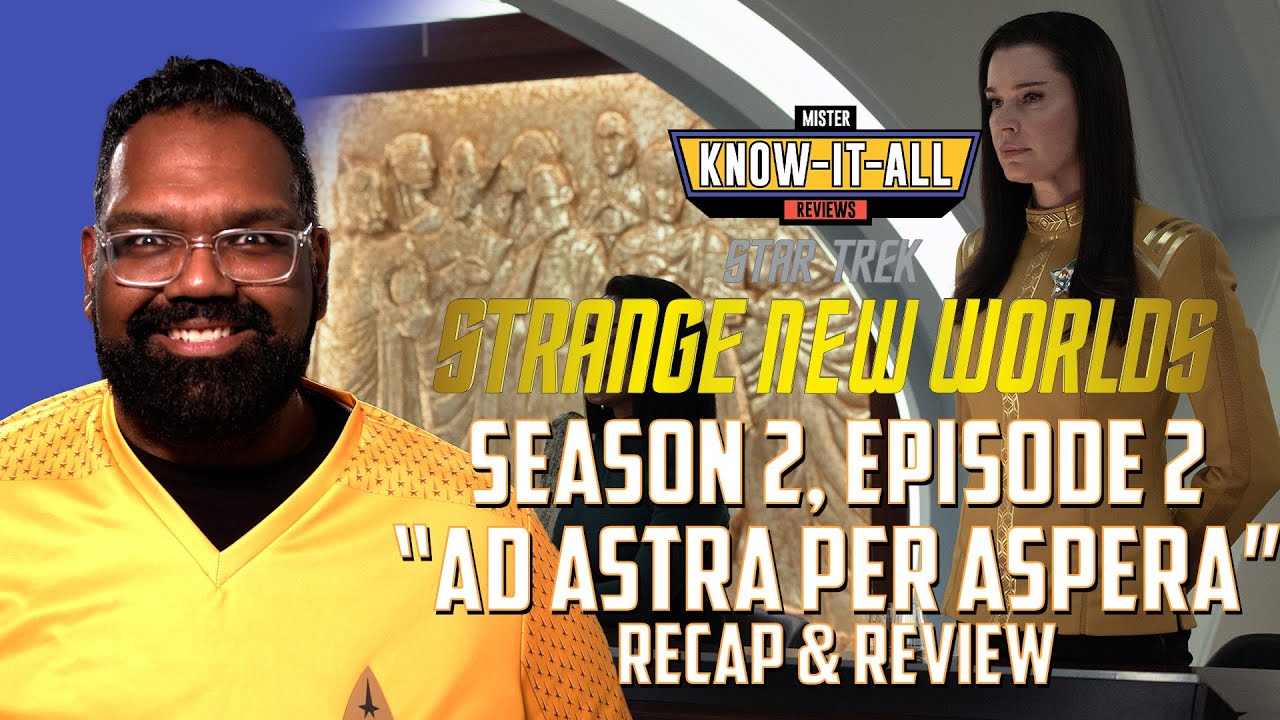
Strange New Worlds just did a courtroom drama, and it’s literally the episode we’ve been waiting for: the trial of Una Chin-Riley.
I tell you what, man, I dig this show so much. As I’ve said before, it’s showing us the TOS world, the Star Trek universe we’re used to, in a different font and a different style. It’s still very much steeped in that show, and this hour is full of the reasons why.
This is Star Trek: Strange New Worlds, season 2, episode 2, “Ad Astra Per Aspera.”
A Little Girl Who Glows
The episode starts with a memory. It’s a little girl, and we all clearly believe it’s Una. She’s dealing with an injury of some kind. It could be an infection, it could be a broken bone, you can’t really tell. Her parents are sitting there whispering about whether to get her to a doctor and what to do with her. Then she starts to glow, the same way Una did last season when her body was healing that disease the ship had been infected by. That was when La’an found out, when they had to get the antibodies from her body. It’s one of those moments where you sit there and go, oh, wow.
Then you flash forward to Pike. Last week I said he was on leave. That’s wrong. He’d taken leave to go track down an attorney for Una. It seems like a little more time has passed than the three days they originally talked about, and you find out he went to the Vaultera Nebula. It’s a hostile environment, but the Illyrians who live there have genetically modified themselves to breathe it. Pike has to walk around with a breathing apparatus on. I almost feel like they should have given him more of a filtration system, something that recycled the bad air, but apparently it really is an oxygen tank on his hip.
So he’s in your average waiting room, just chilling with his little breather on, and the receptionist is on the phone saying he’s not leaving and she doesn’t know what to do. She tells him she’s really sorry, the counselor is going to be busy. He says that’s okay, I’ll wait. I’ve got all day. Then his air starts beeping, and she goes, “Looks like maybe you don’t.” And he’s like, that’s what you think. Sure enough, he lets himself pass out, and the girl freaks out.
He wakes up in Neera’s office, and there’s this cool little thing with the puffs of air. Neera walks up and tells him he doesn’t need the breathing apparatus anymore, he’s going to be okay. That’s all we needed, explanation-wise. I’m in. Somebody took the time to work out the actual logistics of that scenario, and they saved us from the scene where he wakes up going oh my God, how am I alive, oh look, I can breathe in here. When you’ve been watching bad storytelling, which has happened in recent days with different things, and all of a sudden you find good storytelling, you notice. It’s legit.
The Galaxy Is a Neighborhood
Pike really challenges her. He calls her the best civil rights attorney in the galaxy.
The old Star Trek, meaning TOS, did a really good job of making the galaxy feel like a neighborhood. Small. Yes, you had your big space things, and obviously they’re on a five-year mission and all that good stuff. But the thing that really got me was that at any given time it could be, oh, we’ve got to go over here and deal with this, we’ve got to go to that place. Politics happened. It all felt close.
So I love that the galaxy is small enough to have a civil rights attorney people know by name. It’s world building I didn’t realize we didn’t have. It’s always been a Federation attorney, this person or that person, and almost never someone outside Starfleet. Having a non-Starfleet litigator, or counsel if you will, I thought was brilliant, and well worth the world building they put into it.
One of my friends was watching along on Discord and said it’s all very, very dry courtroom drama. I feel him on that, I do. But I’m digging the nuance of it. I remember TOS, and the times they were in court and had court martials were dry there too. Heck, just watch the trial of Khan in “Space Seed.” It’s all law. And you’ve got to remember we’re a culture that’s been watching courtroom dramas for a long, long time. There’s a difference between a good one and a bad one. Looking at you, She-Hulk.
When Pike gives Neera the file for the trial, it’s on a square, colorful data disk that harkens right back to the ones from the old series. Same exact kind of computer panel too, so when somebody slides it into the slot, it’s going into a slanted gray screen. It’s an honor and a respect to TOS and the heritage of the series. I feel like these are the design elements they would’ve done in the 60s if they’d had the technology, because it stays that faithful to what was originally created. Big ups to them for that. Some of my colleague channels would call it a thumbs up or a thumbs down. I’m not a big fan of those, but I get why they do it. So yes, thumbs up from me for design that feels like original Star Trek.
They Turn Down the Deal
Neera finally comes to visit Una. At the very beginning the prosecution makes an offer: Una is dishonorably discharged and that’s it, everybody moves on. She’s still a free Federation citizen, she just can’t be in Starfleet. On its face it looks like a good plan. The truth is it isn’t fair and it isn’t right, and they reject it.
So Pike’s in his kitchen cooking, and Captain Batel, his girlfriend, kicks the door down. Not really, but she stalks in. They just rejected our offer. You have no idea the strings I pulled. And it really isn’t a bad deal, considering they could’ve charged her with sedition and some other things. Which, now that it’s going into her boss’s hands, is exactly where it goes. It does get nasty.
There’s a point where Neera tells Una, “We’re going to do this my way this time.” So there’s that implication that they have history, and you get what the history is further down the episode.
Neera stages out of the Enterprise. La’an shows her to her quarters, which are actually Una’s, and there’s a picture in there that confirms the little girl from the beginning. This is Una, this is her family. Neera asks for a copy of Federation law, and La’an says no problem, I’ll find you one as soon as I can. Then she kind of implies she’s going to leave and she doesn’t. She says she wants to help, and that she thinks the evidence may have been gathered illegally. Neera asks how she knows. She says she needs to research more. Okay, fine, go figure it out and let me know. La’an is doing her best to help. Everybody is, where they can.
Spock’s Outburst and Uhura’s No
Then you get to see the prosecution’s boss. Not Batel, her boss, who’s a Vulcan and an admiral: Pasalk. He’s in the lounge sitting across from Spock. Ortegas and M’Benga are at another table, and Ortegas is doing this great imitation, like Seth Green in The Italian Job. Oh hello, of course, Mr. Spock, this is naturally only logical. It’s wonderful. And M’Benga tells her she clearly doesn’t have much experience with Vulcans, because there’s a lot of tension at that table. She’s like, what are you seeing that I don’t see?
In that moment Spock stands up, calmly steps aside, composes himself, walks over to them and says, “I’m sorry you had to witness my outburst.” They both tell him they won’t say anything, it’s all good. I’m just sitting there like, wow. He explains that this is one of his father’s former colleagues, and one of the few people who really just infuriates him.
It’s what I enjoyed in last week’s episode too. You get to see Spock before he’s who he will be, and you get these shades of it, which here is him saying something very uncharacteristic in a very calm tone. It’s great. I love it. It’s more of that road for Ethan Peck, the road toward who Spock is going to be.
Then there’s a moment on the bridge where Uhura’s at her station, and I loved that she’s there. La’an shows up and says she needs some things, she’s helping with the case, and she’s also going to need any personal logs that mention Una. And Uhura says, yeah, I can’t do that. Remember, Uhura was a cadet. Now she’s a full-blown ensign and a ship’s communications officer. She tells her she can’t break the rules like this, and she stands firm.
Everyone on this show breaks rules left and right. What I love is that Spock’s on his journey to become the Spock we’re going to know, and Uhura’s on hers. This is the one who’ll eventually be Lieutenant Commander and Commander, who’s the focal point for communications, who understands how to reinterpret languages and everything else. I really love seeing the beginnings of who that character is going to be. I love them already, frankly. The level of groundwork they’re putting into this series is brilliant.
A lot of people are scared they’re going to rewrite this, that and whatever else. I’m very much of the mindset that this eventually becomes the show. I believe we’re going to see Kirk, and we’ll roll, historically speaking, into another version of it. I’m totally down for that.
The Trial of the Century
The Enterprise has the court case up on the screen in the observation lounge. And oh my God, everyone’s wearing dress uniforms, and the dress uniforms harken back to the old series. They’ve got the gold trimming, more advanced and running along the whole thing, and the big, gaudy, glass-looking medals. All of it fits how the original series presented things. It’s like the green wraparound that Pike wears, the relaxed uniform for captains, and the red motion picture style uniform they revised for the last episode of last season, “A Quality of Mercy.” I really enjoyed seeing those little flourishes.
You get citings of the Eugenics Wars too, and why the Federation doesn’t do these things. I don’t fault them. I do think they need to grow, and I do think the arguments against them are right, but I don’t fault them. They came out of a horrific war where genetically modified super soldiers tried to take over the world. Neera literally says so in her opening statement: from the ashes of the Eugenics Wars, you built a utopia.
I think that’s brilliant, and I’m okay with it. We’re hanging our hat on the fact that the future Gene Roddenberry built is real. It’s utopia, it’s genuine. But it’s also built on trying to protect ourselves from the past, and sometimes you put walls up and build borders where they’re unnecessary, out of fear. The message here is clear, and I really do appreciate it.
The first witness is Admiral April. As a former captain of the Enterprise he’s inspired a lot of people, and he was Una’s sponsor to Starfleet. He starts to compliment her, and the prosecution cuts him off. That’s not the question. Would you have sponsored her application had you known? He has to admit: no. No further questions.
Then Neera gets up and jumps down his throat. It was an uncomfortable exchange because it felt very cold. It felt like an indictment of Starfleet and of the Federation and its laws. Which it is. But she’s a very intelligent attorney. I’m telling you, she’s very Sherlock Holmesian, and at the very end, like a heist film, they loop back around and show you her methodology, where she was going and how she got there, and you go, oh yeah, that makes total sense.
Right after it they warn her. This isn’t a hearing for Admiral April. It’s a hearing for Una, so you’d better defend her and stop getting off topic. It’s legit, the way they keep her in line.
What La’an Was Carrying
Between scenes La’an brings Neera the law, which is this big giant book. Neera asks whether she ever tracked down who’s responsible, and it comes out that she couldn’t. And this is the first sign of Neera being a detective. She looks at her and says, your name’s Noonien-Singh. Are you related? Yeah. I figured as much.
La’an had been angry, and she’d put it in her personal log, and she feels like it’s her fault that someone found out. Neera tells her she doesn’t understand: to access personal logs, to subpoena them, is a massive process. You didn’t do this. Nobody got your logs. That’s when you see what La’an’s been going through.
Then you find out La’an bears the genetic modifications of Khan. You can go freaking out that she’s like Khan, but any geneticist will tell you that when you introduce other DNA over decades and generations, it waters down. Maybe she’s got slightly more durable muscle. Maybe her cells sustain her longer than most people’s, so she lives to 120 where most live to 100. At the end of the day, she isn’t Khan.
And Neera tells her this wonderful thing. Other people put it on you that you were bad because of this. You had no choice in it. You were born this way. What you do with it is your choice.
That really resonated with me, because I’m six foot seven in a world where a lot of people who are large become bullies in school, usually after being ridiculed or bullied themselves. I never did. I’ve got this giant body. I could throw people around and bust down walls. I choose not to. I choose to be a normal, reasonable, rational person. We’re the ones who make those things happen. That’s huge.
God, it was such a big moment for La’an. It really was.
Unto the Stars, With Difficulty
Una is finally called to the stand, and Neera questions her in a way I love, because it all builds to the final judgment. She asks how she grew up, and you find out Una was raised on a Federation colony of Illyrians and humans who’d been welcomed into the Federation provisionally. They had to deny their genetic practices.
The Federation’s law looks at any genetic modification and sees Khan. That isn’t what the Illyrians are doing. It’s part of their culture. There are ceremonies for it. They do it to give their children a chance to go out into the world and be durable enough to survive it. So to be suddenly told to stop would be very much like people of a particular faith, Jewish or otherwise, being told you can’t be this way, you can’t celebrate, do it in silence or else. That’s fascism. That’s Nazi Germany. I love that they pointed those things out, because the Federation means well. What they endured is scary to them, and they don’t want to leave the opening for someone who isn’t the peace-loving Illyrians to come through it.
Then you get the truth. Violence broke out over a child who was discovered to be Illyrian, and that child was killed. That child was Neera’s cousin. You find out Neera is Una’s childhood best friend. There may or may not be more there, and other people may want to find more in the relationship, but I think that alone is special enough and powerful enough.
Neera asks her why she joined Starfleet, and she says, “Ad astra per aspera,” which basically translates to unto the stars, with difficulty. The idea being that in the stars she’d find salvation of some kind. It blew my mind. That’s so much tea. That’s deep, man. She believed in it. Starfleet called to her: its mission, the desire to see the stars, to explore, to be better.
When she was younger there was an uprising, and eventually the population split into Illyrians and non-Illyrians. She and her family turned their backs on everybody, went to the non-Illyrian side and hid. Not every Illyrian can. Some modifications are too visible. But her family could hide who they were, to give her the opportunity to do great things and move forward in her life.
“When Did Captain Pike Know?”
When both sides are done, the Vulcan prosecutor, the head guy, gets up. Since my co-counsel didn’t ask the question, he says, I’m going to ask it directly. When did Captain Pike know?
You find out Captain Pike knew four months before this. And he begins to paint the picture of a conspiracy to hide an Illyrian. Dude, he sounds so much like one of those people who hunted Jews for the Holocaust. It was bad. I’m listening to him going, God, bro, you’re a Vulcan and you sound rough. You see even Pike is like, oh man. Everybody knows it looks bad.
He sums it up by saying this is the law, and the law is cold, it’s dispassionate, the law is logical. As much as you want to lean on your emotions, you’re here to abide by it.
The Heist Reveal
Then Neera gives a closing that’s amazing. She takes the law book La’an gave her, puts it next to Captain Batel, and asks her to read Starfleet regulation 8154, which has a three-point criteria for someone requesting asylum. As Batel reads it, they cut back through the episode. This is the heist moment, where the heist movie shows you how everything really went down, or the Sherlock Holmes moment where the evidence lines up. She outlines it straight through, you see Una’s testimony cut in, and sure enough it’s the equivalent of a woman asking for asylum. It’s wonderfully poignant.
When the tribunal comes back, they say they’re not going to change the law. That goes to answer a lot of people’s questions about canon. What about the future, when you find out in Deep Space Nine that Julian Bashir is genetically modified? Those things are fine. They’re still the way they are. They’re canon, if you will. What the tribunal says is, we’re going to judge this on its merits, this moment right here. She’s exonerated of all charges, and she gets to return to her ship and her command.
Neera is just stupid amazing. When Una transports back to the Enterprise and everyone’s there, she tells Neera thank you so much, I know we didn’t change the law. And Neera says this is a start. Then she leaves. I thought it was brilliant.
Then everybody leaves except Pike, and Pike hugs her. Anson Mount plays it in such a way that you can tell there’s a breath Pike was holding that he didn’t realize he was holding. He hugs her so tight that even she’s shocked. It’s really nice.
The Verdict
Strange New Worlds “Ad Astra Per Aspera” is a 9 out of 10 on the Know-It-All Index. Honestly, it’s a nine because I know we have higher heights to get to, and it’s a solid nine for me.
I was very impressed. I was impressed by the courtroom drama. I was impressed by the continuity that keeps TOS as the inspiration and point of origin for all of this, and they’re honoring that legacy in a way I really appreciate. I also love the story.
Some people are saying it’s politicized. You know what? I’d love to have that conversation.
Let’s talk about the politics within Star Trek in the comments on the video above. If all you’re going to do is bash stuff, do me a favor, I don’t need the comment. Tell me you liked the approach or you didn’t, and give me good reasons. And tell me how you’re seeing Spock and Uhura grow into the characters we know. Know-It-All Nation has always been right there for that kind of conversation.


