Seven days ago this show put a dagger into James T. Kirk’s gut, and the reason it happened is that something aboard the Griffin reached into La’An Noonien-Singh and found the thing she’s most afraid of in the world: turning into her ancestor. Kirk nearly died on the transporter pad. Pike left it out of the official report to spare her, and the episode ended on a ghost in a window shushing her, telling her to keep it quiet.
This week, that exact same inheritance is the punchline. She takes over a gang of goons on a pleasure planet, spends the back half of the episode threatening to kill everybody, and it’s played for laughs.
I’m not here to tell you this is a bad episode, because it isn’t. I laughed out loud more than once. But somewhere between last Thursday and this Thursday, something came loose in this show, and it took me two passes and a whole page of notes to work out what it was, because it wasn’t where I thought it was going to be.
This is Star Trek: Strange New Worlds, season 4, episode 3, “Human Best Friend.” Same day it drops, like always, and we’re going full spoilers.
The Note That Was Wrong
My first note on this episode. I’ve got the timestamps sitting right there on the page, was that the comedy wasn’t landing. To be fair, that note was wrong. I went back through a second time, and the jokes mostly land. Foley’s funny. The karaoke’s funny. I laughed in the same two places both times, which is usually how I know it’s the writing and not my mood.
Which left me somewhere worse, honestly, because something was still off, and now I didn’t have a name for it. The comedy was never the risk. A comedy episode is exactly as legitimate a swing as the horror episode was last week, and I gave the horror episode a 9. So the question I ended up chasing all day isn’t whether this was funny enough. It’s why an episode where the jokes work still feels like it’s wrestling the show it lives in.
Where I finally landed: this is a Lower Decks episode made in live action. But I want to walk you there the way I got there, because if I just hand it to you, it doesn’t mean much.
First, let me clear the table, because there are two conversations about to happen around this episode, and neither one of them is the event. The first is whether it was funny enough, and like most things, that’s taste, and I’m not interested. The second is the season-long fight about whether all this genre-hopping is the achievement or the problem, and that one’s going to get loud, because this is the purest test case the season’s produced. I’m not interested in that either, it’s an argument about a network’s release strategy dressed up as an argument about filmmaking.
And there’s a third conversation I’m not having, and it’s got nothing to do with this episode in particular. You’ve probably noticed I don’t do lore, not the deep stuff, the canon threading, what a thing means for the universe forty years down the line. That’s not the job here. The job here is how it got made.
One thing I do need to correct before we go further, because it’s going to be everywhere by tomorrow morning. You’re going to hear that this episode does half a comedy and then bails into a bomb-countdown thriller for the third act. It doesn’t. There’s a bomb, technically. There’s even a countdown, technically. And at no point did I feel one ounce of thriller. It’s got shades of Adam West running down a pier with a big round cartoon bomb, looking for somewhere to put it. The comedy tone never lifts, not for a second, not even for the ticking clock.
Hold onto that, because it isn’t a nitpick. Honestly, it’s the whole diagnosis.
Who Made This
The first thing I did once I knew the jokes weren’t the problem was go look at who made this.
Let me introduce you to Kathryn Lyn. She wrote this episode, and if that name isn’t ringing for you, it should. She wrote “wej Duj” for Lower Decks, season 2, episode 9, which got nominated for a Hugo Award. And she co-wrote “Those Old Scientists,” the Strange New Worlds / Lower Decks crossover, which I put up as the best live-action comedy Star Trek’s made this century. This isn’t a random staff assignment. This is the person you hire when you want funny Star Trek, and she’s got the receipts.
Yana Gorskaya directed it, and Gorskaya’s an editor first, which matters more than anything else I’m going to say today. She cut most of Taika Waititi’s filmography. What We Do in the Shadows, Hunt for the Wilderpeople, Thor: Ragnarok, Jojo Rabbit. Then she moved into the chair and directed 22 episodes of What We Do in the Shadows, the series, across six seasons, including “Jackie Daytona,” including the finale, and picked up six Emmy nominations doing it.
So look at what’s actually happening here. Last week, this show handed a horror episode to a working horror director and got out of her way, and I said on this channel that was the real story of that week. This week, they handed the comedy episode to a Lower Decks writer and the person who built the visual grammar of the best comedy on television in the edit bay.
That’s twice. That’s a hiring strategy. And I don’t think anybody else is tracking it as one.
I want to be very clear before I go anywhere else: nobody in that sentence did bad work. Everything from here is about what happens when you hire two brilliant people and don’t give either of them an anchor.
Drawn Rhythm
Here’s the thing I couldn’t stop noticing, and it took me a while to put words to it: I can see this episode animated. Not as an insult. If you told me tomorrow that the script had been boarded for Lower Decks, I’d believe you instantly, and I’d probably watch it twice.
The rhythm of it is drawn rhythm. The beats hit on exact frames. The physical business goes further than bodies go. The reactions hold a half second longer than a live-action reaction holds. It’s vaudeville, genuinely, structurally vaudeville, and there’s nothing wrong with vaudeville.
The place I felt it hardest is the La’An material. That whole sequence where she takes over the gang, that’s a cartoon. And I don’t mean that as a slam; I mean it as a diagnosis. That scene’s perfect in animation. Put Mariner in it, and it sings, because Mariner taking over a gang of idiots is Tuesday for Mariner. Put Tendi in it, and it sings even harder, because Tendi’s whole Orion-pirate lineage is a thing the show lets her pick up and put down whenever the joke needs it.
Both of those characters have an elastic relationship with a violent inheritance. That’s design. La’An does not. La’An’s inheritance is the least elastic thing in this entire franchise.
And Gorskaya has actually said out loud why this happens, which is the part that stopped me. Talking about Shadows, she said the documentary element is what grounds the broad stuff, that calling attention to the camera and the camera operators is what makes the format feel real, and that’s what makes the jokes land harder. Her words. Her whole comic grammar is built on having something underneath it holding it down. Shadows had the mockumentary camera doing that job. Lower Decks had animation doing that job, because animation gives you permission for free.
This episode has neither. And to be fair, it isn’t a mockumentary and never pretends to be, there’s no doc camera anywhere in it. But the beats are Shadows beats. I felt them. The rhythm came over, and the thing that grounds the rhythm stayed home.
Why Nobody Caught It
That’s the question I actually wanted answered, and I couldn’t tell whether the friction came from the writer or the director. So I went and pulled last week’s credits to compare. That’s where it clicked.
“The Griffin Incident” was directed by Axelle Carolyn, an outside genre specialist, and written by Robbie Thompson. And Robbie Thompson’s the piece I’d been missing. Seventeen episodes of Supernatural across five seasons, and look at which ones he’s known for: “Bitten,” told entirely from the victim’s point of view. “Fan Fiction,” the 200th episode, a full musical, he wrote the lyrics. “Baby,” shot entirely from inside the Impala. That’s a writer whose actual specialty is taking a wild formal swing and landing it without ever breaking the show it’s inside.
So last week: one specialist steering out, one writer holding the house style down. This week: two specialists both steering the same direction, away from the house, and nobody holding anything.
That’s not a talent problem. That’s a problem in the room. And it explains everything, including the bomb, because if there’s no counterweight to the comedy, the comedy just keeps going until it’s touched everything in the episode, and a countdown that’s been soaked in that tone for forty minutes can’t generate one second of tension. That’s why I told you to hold onto it.
And it explains La’An, which brings me back to where we started.
The La’An Problem
I want to steelman this, because there are two good arguments against what I’m about to say, and I’d rather make them myself than read them later.
The first: Pike buried it. That’s true. He left it out of the report specifically so she wouldn’t carry that burden, and there’s a real in-story reason nobody’s standing around going, “hey, remember the stabbing?” Fine. But that explains why the crew doesn’t bring it up. It doesn’t explain why the episode goes looking for a laugh in the exact place the wound is. Those are two different layers. One’s a plot device. One’s a choice. Somebody made that choice in the room.
The second argument’s better. Shore-leave episodes are where characters get to not be themselves. That’s the entire function of the trope going back sixty years. Everybody cuts loose, that’s the point, and me complaining that La’An’s acting out of character is me not understanding the assignment.
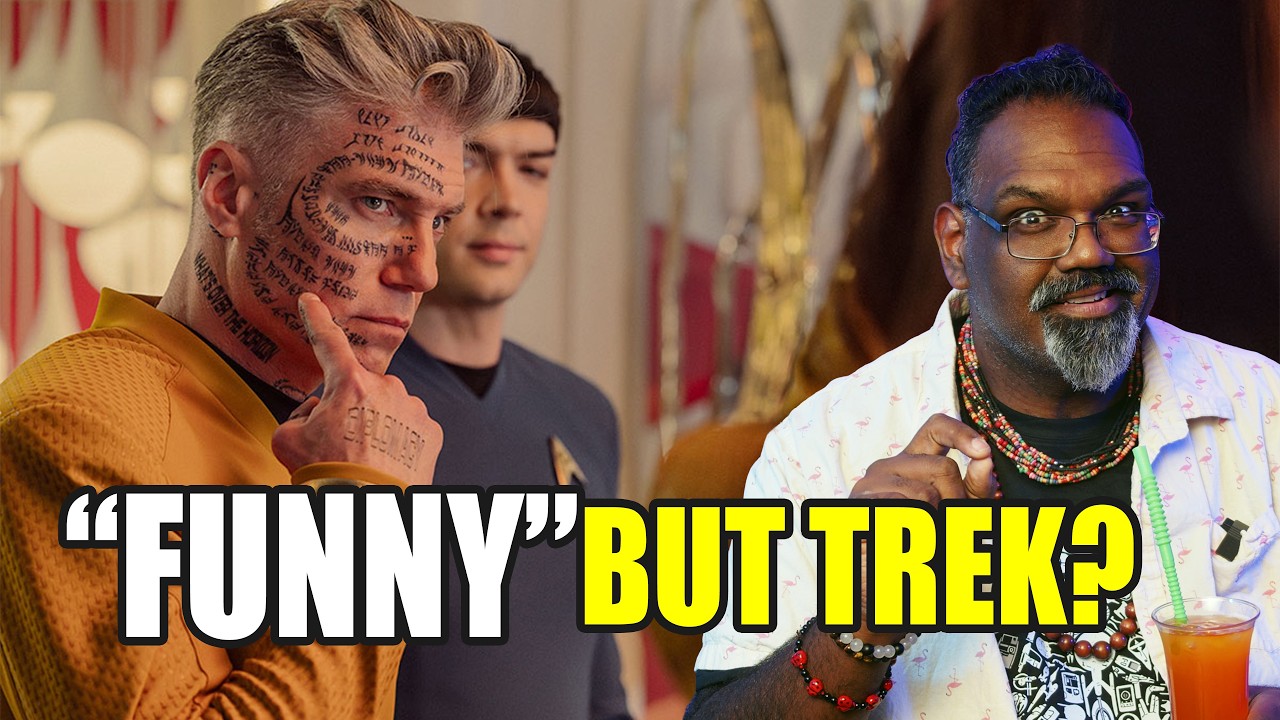
And honestly, if the episode had just let her get drunk and be a mess, I’d have zero notes. Pike gets a face tattoo, and I’ll defend that with my life in about four minutes. But that’s not what it does. It doesn’t just let her cut loose. It reaches specifically for the augment thing. It builds the gag out of her conquering, commanding, threatening violence, and it plays her genetic inheritance for comedy seven days after that same inheritance nearly made her a murderer. The joke is about the exact thing that was the trauma. That’s the part I can’t get past.
And the tell that this is a choice, and not just how episodic television works, is sitting right there in the same episode, because this show absolutely does track continuity when it wants to. Ortegas and Scotty butt heads in the premiere. I clocked it in episode one and said something was coming. Episode 2 doesn’t touch it, because episode 2 is busy being a haunted house. And then this episode pays it off. Three episodes, one thread held.
So the machinery exists. It just wasn’t pointed at La’An. Which is also, incidentally, my Kirk problem, and it’s smaller than people are going to make it. I don’t mind Kirk being here. What’s strange is that a woman put a knife in this man a week ago, and the episode doesn’t carry any of it. He’s just… around. Does this man not have a ship of his own to go to?
(I’ve got more thoughts on Ortegas and Scotty and what that through-line actually means. I go a good bit deeper in this week’s sidebar video for members. If that’s your thing, I hope you’ll join me over there.)
The Small Stuff
Once I had that, I couldn’t stop seeing it in the small stuff.
The air on the planet is intoxicating, literally, mechanically, in the script, so nobody has to make a decision. The inhibitions question is solved by the atmosphere. The judgment question is solved by the air you breathe. Every guardrail is handled by the environment instead of by a person. We skip the arrival, we skip the descent, and we wake up straight into the amnesia. The bomb’s a big round prop with a fuse and zero threat. The vacation promo runs the terms-of-service-zipping-by joke, which was hacky in 2014. The gang hideout is crates on a back lot. None of it costs anybody anything, which is why the countdown couldn’t land, which is why the comedy had nothing to push against, which is the same problem I’ve been describing from three different directions.
Here’s the part that actually bugs me, and it’s a compliment in an ugly sweater: you can see the effort. Somebody thought hard about how to get a crew of disciplined Starfleet officers to behave like this without breaking a single one of them, and the intoxicating atmosphere is a genuinely clean solution to that problem. It works. I just watched it work. I can also see them thinking of it.
My first pass at this was just that The Hangover is a dated reference, which is true, and I’ve decided it’s the least interesting thing wrong with it, because dated I can forgive. Trek’s been borrowing other people’s movies since 1968. What actually got under my skin is that the whole frame comes off. You can lift it out, and the episode underneath keeps running.
So let me tell you the cut I would have made. You don’t need The Hangover. Show them arrive. Show the first drink, the first bad idea, the influence taking hold. Take us all the way to the point where the lights go out, and then let them wake up with nothing. Now I know what happened and they don’t, and everything after that is dramatic irony instead of a mystery box, which means the comedy comes from watching them reconstruct a night I already got to enjoy. You’d earn the amnesia, the characters would stay legible the whole way through, and you wouldn’t have to spend a third of your runtime discovering information you could have shown me in three minutes of people making bad choices.
That’s my actual answer to why the middle drags. It’s not pacing. It’s that reconstruction-as-plot has to burn screen time finding out what a straight chronological open just hands you.
Honest Edges
They cut both directions, because most of the episode is genuinely good, and I want to be specific about why.
Every character gets a moment, and the moments aren’t random, they’re each an extension of who that person’s been. Pike, the most controlled and most burdened man in Starfleet, a guy who knows precisely how his story ends, completely cuts loose and comes back with a full face tattoo. That’s not a random gag. That’s the one man on the ship with the most reason to want a night off, taking it. Una singing ’80s power ballads in the original Klingon is a heritage joke that goes back to Star Trek VI in 1991, and it’s never going to stop being funny to me. Spock spends the whole episode convinced he’s hallucinating and stays the straight man throughout, he’s on his path, man, he is on his path. And Uhura’s running the party and turning away Ortegas and Scotty for being fuddy-duddies, which is a fallen version of the woman who used to be the one who needed telling to relax.
And here’s the thing nobody’s going to mention: they set that up in the previously on. The recap for this episode pulls specific early-days footage of Uhura being the stiff one, twenty minutes before the joke lands. That’s an authored recap. Somebody sat in a bay and chose those shots to load a punchline in the third act, and I’d bet money on who. That’s your editor directing, which is exactly why nothing I’ve said today is about competence. That woman was fully awake in that edit. Nobody was holding the tone. Those are very different problems.
And Dave Foley, who I loved, watch what he’s actually doing. This is a man who spent Kids in the Hall being the unhinged one, then spent five seasons on NewsRadio as Dave Nelson, the straight man in a building full of lunatics, a role Paul Simms wrote specifically for him. And this performance is both at once. He’s a lunatic running an intoxication resort, and then he sits down across from Ortegas and has a completely level conversation about how he used to be exactly like her. Both registers, same scene. There are actual layers in there.
Before the verdict, one thing to watch for, and I’m staying vague on purpose: pay attention to how this episode leaves Ortegas and Scotty relative to one another. That’s not a reset. That’s a placement.
The Verdict
I want to be careful with this number, because there’s a version of this review where I’m a lot angrier than I actually am. I laughed. The performances are good. Foley’s great. The Klingon karaoke is a gift. Pike’s tattoo made me genuinely happy, and there isn’t one person in these credits who did bad work.
But the frame around all of it was borrowed, from something that was already dated five years ago, and it cost a character something she couldn’t afford to lose, seven days after we watched her nearly kill a man.
“Human Best Friend” gets a 7 out of 10 on the Know-It-All Index. It’s a good episode, not a great one. And most of what’s missing isn’t on the screen. It’s in the room.
Last Thursday, the name Noonien-Singh was the worst thing that could happen to her. This Thursday, it was a bit. That’s not a tonal swing. That’s an empty chair in the room, and La’An is the one who paid for it.
Drop a comment on the video above: did the La’An material cross a line, or am I carrying last week too hard? I genuinely go back and forth on it. I cover every episode the day it airs, same lens every time, a filmmaker reading the choices.


