
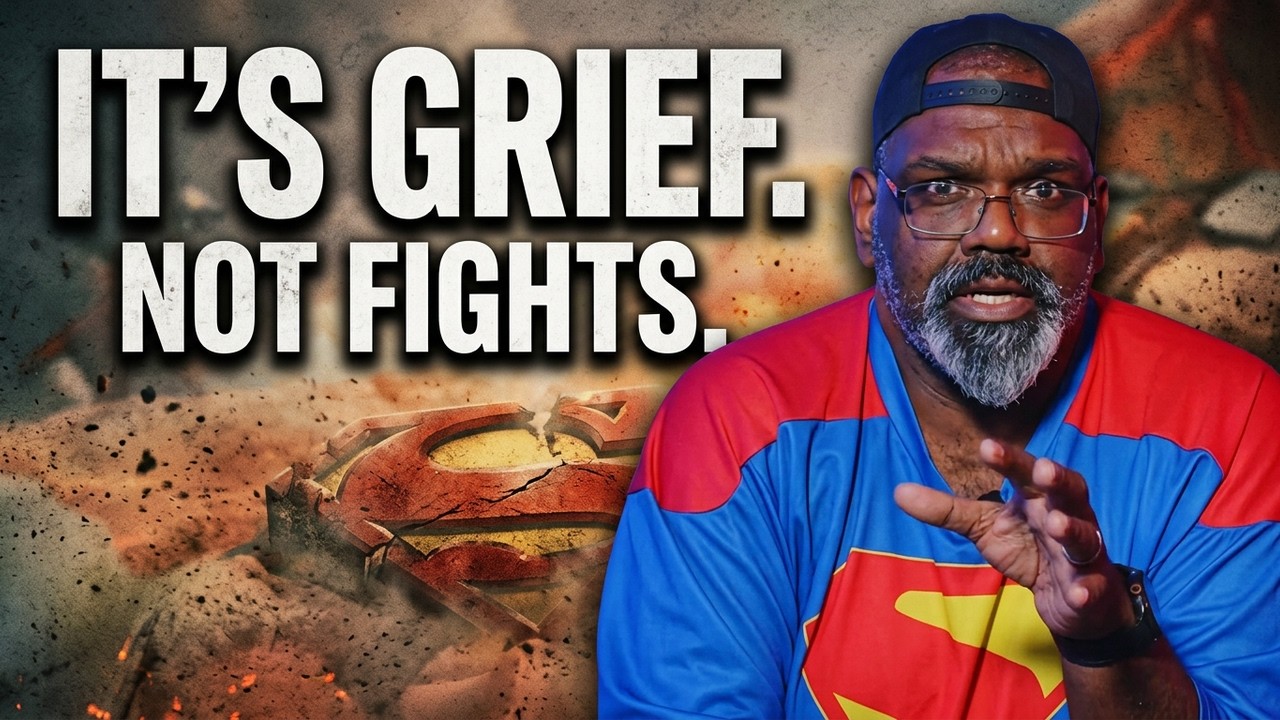
Everybody keeps saying that Supergirl has a weak villain.
Good. Krem should be weak. He’s not Darth Vader. He’s not Killmonger. He’s not some grand ideological shadow version of Kara Zor-El. He’s a small, vicious man who does a monstrous thing, runs from it, and gives everybody else’s pain somewhere to go.
That’s not a defense of him as a character. That’s the point of him as a target. Because the real fight in Supergirl isn’t Kara versus Krem. It’s Kara versus what happens when grief finally finds a body.
That’s why the movie worked for me. I saw it twice. My wife and I had a great time. Both theaters were full. Both audiences clapped. But this is also where the movie creates its own fracture, because Supergirl understands Kara’s grief better than a lot of the critics do, and I’m not sure its ending understands the moral debt that grief creates.
And that’s the movie: emotionally right and morally unstable at the exact same time.
Fair warning before we go any further: I’m talking spoilers. I don’t do non-spoiler reviews. I don’t really do traditional reviews at all. I analyze things, and with Supergirl there’s a lot here to analyze. If you haven’t seen the movie yet, bookmark this and come back.
A Target, Not a Villain
I went into Supergirl without a clipboard. I knew the source material. I knew the reputation of Woman of Tomorrow. But I wasn’t sitting there waiting to punish the movie every time it changed a panel, collapsed a planet, or moved a character beat. That’s not how I watch movies. A movie has to work as a movie, and on that level, Supergirl worked for me. Not because it’s flawless. It’s not, I promise. It’s got real problems. But the loudest criticisms around this movie are not the most interesting ones.
The interesting criticism isn’t “Krem is a weak villain.” No joke. The interesting criticism is: if Krem is only a target, why does the ending suddenly make him the center of Kara’s morality?
Because Krem’s not deep. He kills Ruthye’s family. He poisons Krypto. He runs. He keeps making everything worse, because that’s what a cruel little man does when the world gives him power. And honestly, that weakness almost makes him more useful. A grand villain, a Lex Luthor if you will, would make this cleaner. A grand villain turns the movie into hero versus evil. Krem makes it uglier than that, because sometimes the person who ends up carrying all your rage isn’t impressive enough to deserve it. Sometimes grief latches onto someone pathetic.
That’s what makes him work as a target. Ruthye looks at him and sees the man who destroyed her life. Kara looks at him and sees something more dangerous. She sees the thing she never had: someone to blame.
Ruthye’s pain has a direction. There’s a name, a face, a body, a man she can chase across space and say, “You did this.” Kara doesn’t get that. Krypton’s gone. Argo’s poisoned. Her people are dead. Her home is gone. And even when she finds Clark, even when she finds Earth, even when there’s a family in front of her, she’s still carrying the end of the world inside her body. There’s no one to punch.
That’s probably the most important thing going on in this movie. Kara is not just helping Ruthye get revenge. She’s staring at a version of trauma that got to be simple. Not easy. Simple. Ruthye’s pain has an address. Kara’s pain is everywhere.
So when Kara tells Ruthye that revenge won’t help her, won’t heal her, she’s saying the right thing. But the movie keeps asking the harder question: does Kara actually believe that? Or does she believe it only because she’s never had the chance to test it?
That’s the movie I was watching. Not “can Supergirl beat the bad guy.” Can Kara survive the moment when the bad guy finally gives her grief somewhere to land?
Comic Panel Logic
This is also why I don’t buy every version of the “bad script” complaint. Some of the movie’s jumps worked for me because the movie moves like a comic. Not always smoothly, and definitely not always perfectly, but deliberately enough that I could track the rhythm.
The Red Planet bar fight is a great example. Kara still has power stored in her cells. She spends it hard. She throws a guy through a wall. She burns through what she has. Then the movie doesn’t stop to explain a power chart to you. It expects you to read the gap.
That’s comic panel logic. Action, white space, consequence. In a comic, the gutter between panels is part of the storytelling. Your brain supplies the motion, the time, the impact. Supergirl keeps trying to bring that rhythm into live action. That’s not going to work for everybody, I get it, and there are definitely places where the movie could use more connective tissue. But choppy and panel-driven are not automatically the same thing. The question is whether the gap creates momentum or confusion. Most of the time, I felt momentum.
The Grime Is a Choice
I think the craft of this movie is stronger than the drive-by criticism makes it sound.
The production design isn’t just dirty space. It’s a choice to make Kara’s world feel physical before it feels iconic. The ships have weight. The taverns feel crowded and low-ceilinged. The aliens feel touched by makeup, costume, prosthetics, and a lot of creature work. The grime isn’t decoration. It keeps Kara from floating above the world like a clean symbol dropped into a dirty set.
Why does that matter? For the performance. If Kara is supposed to be off-balance, angry, exhausted, and not fully herself yet, then a polished universe would fight that character arc. The movie wants her surroundings to scrape against her.
That’s why some of the darkness worked for me. The question with low light is not “is the scene bright.” The question is: can I still read the geography, the faces, the emotional beats? In the tavern material, I could. It wasn’t mood soup. It had atmosphere, but I still understood where Kara was, what she was reacting to, and how the space was closing in on her.
The action works the same way. When Kara’s angry, the violence gets less graceful. The impacts feel ugly. The blocking gets more desperate. She’s not always moving like a superhero striking a pose. She’s moving like somebody who has normalized getting hurt. That’s an important difference. A weaker version of this movie would make every fight a power fantasy. This one keeps letting Kara look breakable.
That’s not girl-boss filmmaking. That’s action character filmmaking.
The Moral Machine
Now, the movie does make huge changes from Woman of Tomorrow, and I’m not going to back away from that. I just think that alone is not the problem. Adaptation requires damage, bottom line. You absolutely cannot take an episodic cosmic odyssey, put every planet and every incident into a two-hour movie, and assume the shape is going to survive. So I understand why the movie compresses. I understand why Ruthye’s loss is boiled down. I even understand why Krem becomes more of a singular threat and less of the abstract character he is in the book, and why the movie cuts the parts of the comic that would require more time, more explanation, more emotional runway than a feature can afford. That’s the job.
The problem is not that Supergirl changes the plot. The problem is that it changes the moral machine.
In the comic, the revenge story has a very clean reversal. Ruthye wants to kill. Supergirl teaches her not to. And at the end of it, Supergirl reaches the edge herself, and Ruthye has to pull her back. That’s not just a plot beat. That’s the story closing its own argument. The student becomes the witness. The person being saved becomes the person who saves.
The movie doesn’t do that, or rather, it doesn’t choose to. It’s not interested in doing that at all. The movie has Kara stop Ruthye from killing Krem, and then Kara ultimately kills Krem herself. That’s not a small adaptation change. That’s the whole moral weight moving from one place to another. Kara tells Ruthye not to let revenge define her. Then Kara takes the revenge herself.
That can mean a lot of things. It can be protective. It can be tragic. It can even be, as everyone’s calling out, hypocritical. It can be Kara taking the sin onto herself so Ruthye doesn’t have to carry it. It can be Kara proving she’s not Superman. It can be Kara failing the lesson at the exact moment Ruthye is learning it.
The problem is not that the moment has no meaning. The problem is that it has too many meanings, and the movie doesn’t choose hard enough.
Because emotionally, the beat plays. You hurt the dog, you die. Very simple. The audience understands that. I heard someone call it John Wick logic, and Supergirl can’t live only on John Wick logic. John Wick is a revenge fantasy. Supergirl is supposed to be carrying something more complicated. So if Kara kills Krem, the movie has to make us feel the cost, not just the satisfaction. The cost.
And that’s where the ending gets unstable. The movie lets Ruthye reject revenge, lets Kara commit revenge, then moves forward before the moral bruise has time to darken. That doesn’t break the movie for me, but it does leave a mark.
Not Clark in a Skirt
The reason it doesn’t break the movie is that Kara is not finished becoming Supergirl. That’s the key. She does not start this movie as the icon. She starts messy, angry, drunk, disconnected, restless. She’s not Clark in a skirt, and the movie is smart enough not to pretend she is. Clark lost a world he never really knew. Kara lost a world she had to survive losing. That difference really matters.
So when Kara makes a morally messy choice, I can read that as part of the character, not a betrayal of the whole movie. She’s better than where she started. She’s trying. But she’s not clean yet. That’s a real character place.
The problem is not the mess. The problem is that the movie sometimes acts like the mess is resolved before it actually is. And that’s where the script softens its own best idea. It tells us too often that Kara is good. People keep saying it to her. You’re good. You’re going to be good. You’re better than this. Strive to be good. I get the intention, but after a while the movie starts underlining a sentence it should have trusted the drama to prove.
This is why the cheap criticism doesn’t work for me. Kara being messy is not a flaw. That is by design. She drinks, she fights dirty and ugly, she makes bad calls, she gets beaten down and keeps dragging herself forward. It’s not a failure of the character. That is the character.
And this is not a girl-boss movie. I’m sorry, but if your definition of a girl-boss movie is “a refugee from a dying world getting the hell beat out of her while wrestling with whether she can still be good,” then the phrase has officially lost all meaning. Female action heroes are not the problem. Alien worked. Terminator absolutely works. Kill Bill, same thing. Underworld became a franchise because Kate Beckinsale walked into frame and everybody got it. The issue is never whether a woman can lead an action movie. The issue is whether the movie gives her a dramatic engine strong enough to carry the action forward. Supergirl does, mostly. Its flaw is that the movie doesn’t always know how much moral weight her mess creates.
The other real flaw, honestly, is visual balance. I liked the tactile approach. I really liked that space wasn’t clean. But Supergirl is a dangerous character to bury too far in grime. The brightness, the hope, the iconography, all of that is important. And if the whole movie is scuffed, smoky, and exhausted, then the arrival of the symbol needs to hit like oxygen. Sometimes it does. Sometimes the movie waits a little too long. That’s the trade-off. If the story is about Kara becoming the icon, then delaying the icon made sense. But when you delay the icon, you’d better make the becoming powerful enough to justify that weight. Supergirl gets close. Close enough for me. But the gap is real.
The Verdict
So what’s the Know-It-All Index for Supergirl? I’m not even going to bury it: 8 out of 10. That’s not a mercy score, and it’s not me grading on a curve.
The movie works because it understands Kara’s grief better than a lot of the conversation around it. Krem’s not the soul of the movie. He’s the target. He’s the small, pathetic body Kara’s enormous pain finally gets to stand in front of, and that makes him more interesting than the “weak villain” criticism allows.
But the smartest criticism is real. By letting Kara do what Ruthye is told not to do, the movie changes the moral shape of the story. That doesn’t automatically make the choice wrong, but it does create a debt, and I’m not convinced the movie pays that debt in full. Kara killing Krem makes emotional sense from inside her pain. You hurt the dog, you hurt the girl, you become the face of everything she’s never gotten to avenge. I get why that lands. But Supergirl can’t just land emotionally. It has to survive morally, and that’s where it gets unstable.
Milly Alcock works. Krypto works. The tactile universe works. The comic-panel rhythm worked for me. The action has character behind it. Kara’s grief has a real shape. But the movie tells when it should trust, it pushes the grunge right up to the edge of the iconography, and Krem being weak is useful right up until the ending asks him to carry more moral weight than he was ever built for.
That’s what keeps the movie from greatness. It doesn’t keep it from being good. The worst version of Supergirl would have been clean, safe, bright, frictionless, and ultimately forgettable. It would have just been Superman 2.0. This isn’t that. The movie is messy. It’s wounded. Sometimes blunt, sometimes sharper than people are giving it credit for, and sometimes not quite sharp enough to survive the choices it makes.
That’s still enough to get it to an eight for me.
Now I want to know where you land. Did Supergirl work for you on its own terms? Did the ending break it? Or are people reviewing the villain this movie never actually had? Drop your own Know-It-All Index in the comments on the video above. And never forget: everyone loves a know-it-all.


