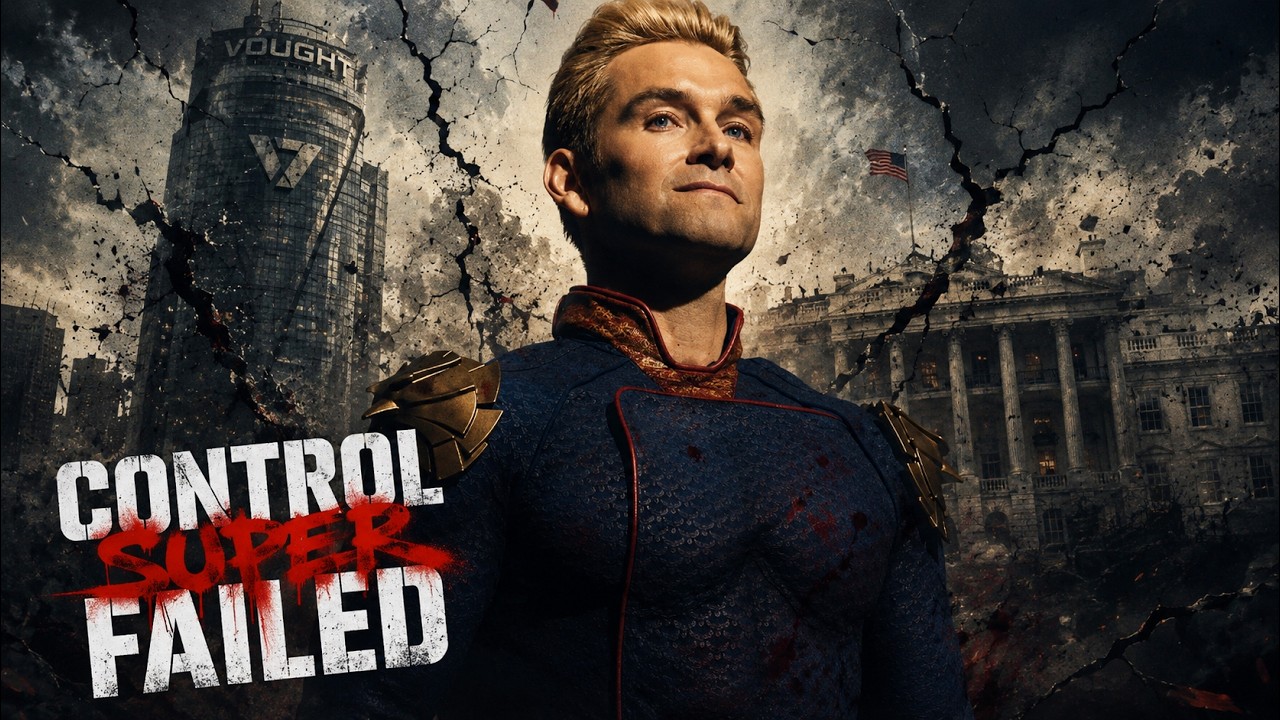
The Boys didn’t just get messier over time. It started collapsing in the same shape as its world.
And I think that’s the part people are still struggling to articulate when they talk about the later seasons. By season 4, you could feel the audience turning a little. The show peaked at season 3. The writing fell apart. Homelander stopped being interesting. The satire got too broad. And look, some of that criticism is fair. The pacing strains. The satire absolutely gets blunter in places. Some transitions feel really compressed. Some scenes needed another draft. Those are real issues.
But I also think people were diagnosing the wrong disease. Because The Boys isn’t really a story about corruption appearing. It’s a story about restraint failing. And once I started looking at the later seasons through that lens, honestly, the whole show started feeling different to me. Not cleaner, trust me. Not “secretly perfect” different. Different.
This isn’t really a traditional review. My analyses never are. Honestly, I avoided talking about The Boys publicly for years. Not because I disliked it. Clearly, I watched the whole thing. But this channel has always leaned more family-friendly overall, and let’s just be honest, The Boys is aggressively adult television. Absurdly adult in ways. There are scenes in this show where, if somebody walked into the room at the wrong moment, you’d have to pause the TV and explain yourself as a person. I know I have walked into that trap at least twice.
So even though I followed the series from the beginning, I never really dug into it publicly. But now that the show is over, and now that I’ve had time to sit with the finale for over a week, I think I finally figured out why this thing survived as long as it did.
The Show That Should Have Collapsed
Because the show absolutely should have collapsed under its own escalation at some point. Most shows like this do. You start with shock, then you need bigger shock, and then bigger shock than that, and eventually the entire thing turns into self-parody because it can’t emotionally sustain the escalation anymore. And honestly, there are moments where The Boys gets really close to that line. Dangerously close.
But somehow the emotional spine keeps surviving underneath the chaos. And I think that’s the key to the entire show. Once you stop looking at The Boys as a satire about superheroes, or a deconstruction, and start looking at it as a story about systems losing the ability to restrain what they created, the later seasons start making way more sense.
Again, not flawless sense. By any stretch of the imagination. That’s important, so keep it in mind. I’m not doing the thing where every flaw magically becomes secret genius because I liked the ending. No. Some pacing genuinely gets weaker later on. Some satire does realistically become way too broad. Some scenes lose the observational sharpness the earlier seasons had. That stuff is all real.
But I also think something more interesting starts happening at the exact same time: the show’s form starts destabilizing alongside its world. And honestly, I don’t know how much of that is intentional versus accidental anymore either. That’s the uncomfortable middle this show ends up living in.
Collapsing Inward
Go back and watch season 1 again. The world still feels socially functional. There are busy streets, corporate spaces, newsrooms, crowds, public environments, people constantly moving through systems. The show still breathes outward.
Then you look at the later seasons and everything starts collapsing inward. More interiors. More confrontations in rooms. More isolated staging. Less public life. Less environmental texture. The crowds become smaller and smaller, theaters or auditoriums, and the world ultimately starts turning into emotional pressure chambers.
Yeah, some of that is probably production compression. You can absolutely feel the scale tightening financially in places. But what’s fascinating is that the thematic collapse and the formal collapse start overlapping in ways that are sometimes damaging and sometimes weirdly revealing too. The show itself starts feeling unstable in the same way the world on screen feels unstable.
And if I’m being real with you, that tension is more interesting to me than pretending the later seasons were either secretly flawless or complete trash. Neither explanation fully accounts for what’s actually happening on screen.
Homelander Was Never Better Early. He Was Contained.
I think Homelander is the clearest example of that entire evolution. I keep hearing people say season 1 and 2 Homelander was better. The more I think about it, I don’t actually think that’s true. I think early Homelander was contained. And that’s different.
The monster is already there in season 1, believe me. The system around him just still functions enough to disguise it. Corporate oversight, PR management, public expectations, political caution. He still has walls around him. And Anthony Starr, God love him, performs him that way. That’s the thing I don’t think people fully appreciate when they go back and watch those early seasons. Starr was doing amazing work. Homelander doesn’t dominate rooms yet. He studies them. He watches reactions, measures silence, controls eye contact carefully, uses smiles performatively. There’s calculation in the stillness.
Then the restraint starts disappearing. And once that happens, the performance changes too. He stops navigating rooms and just starts overwhelming them. The physicality gets larger. The volatility gets louder. The emotional instability stops hiding behind corporate polish. And the framing changes him. He’s less corporate satire, more existential dread. By the end, Homelander barely even feels like a political metaphor anymore. He feels mythological. The best way I can put it: the logical endpoint of a society that kept building systems it no longer knew how to control.
And honestly, I think that’s why some people disconnected from the later seasons emotionally. Early on, The Boys still carries the illusion that the world can stabilize itself. The later seasons lose that illusion completely. But at the beginning, the Boys’ mission is literally about just that.
Emotional Debt
Yet through all that instability, the emotional continuity survives. And apparently that was intended, or at the very least intentional. Kripke said that before they broke season 5, they went back through the series looking for unresolved emotional debt. Not just plot threads. Emotional debt. And once I read that, the finale suddenly clicked into place for me. Because The Boys constantly revisits damage. Not lore, not mythology. Genuinely, damage.
Annie and The Deep: that isn’t just a callback from the writing. It’s years of humiliation, trauma, rage, recovery, and powerlessness finally colliding with consequence. And what makes that dynamic work for me is that the show never pretends Annie’s damage disappears cleanly. Watch her evolution and it’s clear the confrontation doesn’t magically heal her either. It just restores her agency inside a relationship that spent years defined by powerlessness. That’s way more emotionally mature than a simple revenge fantasy.
And realistically, The Deep destroying himself instead of being traditionally defeated matters too. That’s really important, because self-destruction is basically the governing logic of half the series. Homelander destroys himself. Butcher destroys himself. Vought destroys itself. The corruption becomes self-consuming eventually.
And I think A-Train may honestly be the smartest emotional writing the show ever did. The series understands something really uncomfortable: weakness is harder to forgive than villainy sometimes. A-Train keeps knowing better, and I think that’s what makes him frustrating. He’s not purely monstrous. He’s compromised, cowardly, self-preserving. And the show delays absolution long enough for recognition to actually matter. It lets shame accumulate. That’s smarter than most redemption arcs on television.
Inevitability Is Not Predictability
Honestly, I think modern audiences sometimes confuse inevitability with predictability. Like if the audience emotionally sees something coming, that somehow weakens it. I completely disagree. Sometimes inevitability is the payoff. The audience should feel the emotional collision building long before it arrives. That’s momentum. That’s emotional gravity.
Huey eventually having to stop Butcher? Feels inevitable. Annie eventually confronting The Deep? Inevitable. Homelander eventually collapsing under himself? Feels inevitable. But inevitable doesn’t mean emotionally empty. Usually the opposite, actually.
And I think that’s why the finale worked for me despite all the instability surrounding it. Not because the show remained perfectly controlled. It didn’t. But because underneath all the structural wobbling, the emotional follow-through survived.
That’s ultimately why the ending stayed with me. Not because it shocked me (I wasn’t surprised), and not because it reinvented television (trust me, it absolutely didn’t). But because underneath all the gore, the satire, the cynicism, and the chaos, the show remembered the people. And weirdly enough, that’s become rare.
The Verdict
So there you go. Now you know it. Knowledge is half the battle, and you’re halfway to being a know-it-all yourself. The Know-It-All Index for The Boys: the show got indulgent, the pacing buckled sometimes, certain satire got too broad for its own good, and there are absolutely moments where the show feels one rewrite away from collapsing into self-parody. But underneath all the noise, The Boys remembered what mattered. And that’s why the ending lingers with me way more than I expected it to.
Not because Homelander destroyed the system. He didn’t. The system survived him. It absorbed him, studied him, learned from him, which is precisely what real-life corporations and Hollywood do. They learn the wrong lessons. And it looks exactly like that’s what Vought is about to do. But that’s a whole different video.
For me, season 5 is probably around a 7 out of 10. The finale itself is closer to an 8.5. And the series overall, I think, is a solid 8 out of 10 on the Know-It-All Index.
What did you think about the series finale of The Boys? What about the overall series itself? This is one that begs discussion, because there are so many bad takes and disingenuous opportunities out there for people to latch onto. The conversation lives in the comments on the video above. Never forget: everyone loves a know-it-all.