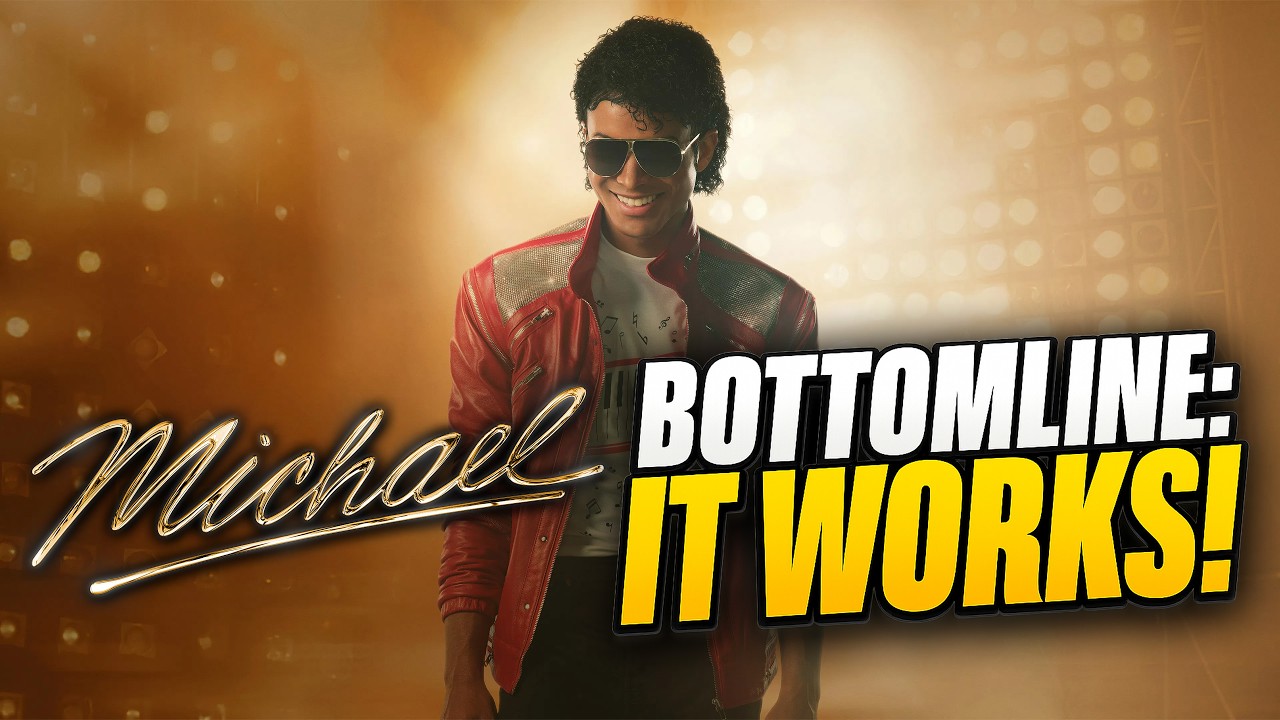
I was moved by Michael in a way that I don’t fully trust.
That’s the review right there, because I could see what it was doing. I could see the guardrails. I could see where the images were being protected. I could see the movie choosing the Michael Jackson it wanted to resurrect. And still, when Jaafar Jackson started performing, my critical brain lost the argument for a few minutes.
Because Michael is safe. Very safe. It’s not investigative. It’s not confrontational. It’s not interested in dragging Michael Jackson into the court of public opinion and re-litigating the whole life. It wants the music, the movement, the ache, the spectacle, the memory. And memory doesn’t need permission from your judgment. It just shows up.
The Michael Jackson It’s Willing to Resurrect
Today we’re talking about Michael, the Antoine Fuqua-directed biopic starring Jaafar Jackson as Michael Jackson. The movie follows Michael from the Jackson 5 years through his rise into solo stardom, and it stops before the later controversies that consumed so much of the conversation around him.
That’s not a neutral choice. I want to make sure that’s clear. That’s the movie telling you what kind of Michael Jackson story it’s willing to tell, and what kind it’s not.
So let me be honest up front. If you wanted the hardest possible version of the biopic, this isn’t it. If you wanted the movie to force the allegations, the lawsuits, the accusations, and the darkest public questions into the center of the story, this movie’s going to feel evasive. Maybe it is. I don’t think we have to pretend otherwise.
But I also don’t think that ends the conversation, because this movie isn’t trying to be a final moral accounting. It’s trying to recreate the feeling of Michael Jackson before every conversation about him became impossible. And that’s where it gets me. That’s also where I get suspicious of it.
Because nostalgia isn’t innocent. Nostalgia can preserve something real. It can also launder discomfort. And Michael walks directly into that danger. The movie says: remember this? Remember the kid? Remember the voice? Remember the glove, the body, the moonwalk? Remember what it was like when the room stopped because Michael Jackson was on television?
If you grew up with that feeling, the movie doesn’t have to work as hard to reach you. It already has a key.
That’s why my reaction to the movie isn’t clean. Part of me admires the craft. Part of me distrusts the protection. Part of me can’t deny the hit. That’s the triangle.
The Jaafar Jackson Trial
And Jaafar Jackson’s really the reason the triangle holds, because the movie lives or dies on one question: can anyone stand inside the outline of Michael Jackson without looking ridiculous?
That’s a brutal assignment. Michael Jackson’s body is part of the archive. The movement is the text. If Jaafar is wrong, the movie’s dead.
And he’s not wrong. He doesn’t become Michael Jackson. Nobody could. But he gets close enough for the movie to start breathing.
The movie understands it has to manufacture that belief. It gives him the stage-like evidence. It lets the crowd react before we do. It cuts around familiar movements long enough for anticipation to start working. Then it gives us the body. The pose. The release. And when it lands, it lands on the body before it lands in the brain.
That’s what happened to me. I got goosebumps. I don’t want to over-intellectualize that. I also don’t want to excuse it, because goosebumps can be honest, and they can also be easy. They can mean the movie found truth. They can mean the movie found the button. With Michael, I think realistically, it’s both.
That’s why the performance recreations matter. Now, I understand the argument against them. We already have the footage. We have the concerts. We literally have the videos. We have the real Michael. So why watch an actor rebuild moments we can already pull up ourselves?
Because the movie isn’t only recreating history. It’s asking whether this version of Michael deserves our belief. Every performance is a trial. Not a moral trial, mind you. A cinematic one. Can Jaafar hold the frame? Can the staging hold the illusion? Can the sound mix trigger memory without turning the scene into karaoke? Can the cut make us anticipate something we already know is coming? Can the movie make imitation feel like presence?
And more often than not, yes. It absolutely can.
That’s why the safer parts of the movie still worked on me. Look, I knew I was being guided. I knew the movie was choosing the clean path. And still, when the music took over, I leaned forward. That’s the uncomfortable truth of the experience: the movie’s protection isn’t separate from its power. The protection is part of the power. It keeps the image stable enough for the old feeling to come back. Maybe that’s dishonest. Maybe that’s necessary. Maybe it’s both.
The Booth Is the Better Movie
But the best parts of Michael live right there, and for me, the strongest material is in the studio. The stage scenes are the resurrection. That’s fine. The booth scenes, those are the womb.
When Michael is alone behind the glass, singing into the microphone with the track coming through the headphones faintly, the movie finally stops trying to prove the icon and starts watching the person. That image stayed with me, because to us the song is enormous. It belongs to everybody. It plays in cars, at weddings, at parties, in stores, in arenas. It becomes public property. But at the beginning, it’s one person alone in the room. One person with headphones on. One person trying to push feeling through a microphone. He’s alone, making something that’ll belong to everyone.
And that’s the movie. Or at least that’s the better movie hiding inside this one. The glass matters. The isolation matters. The thin sound in the headphones matters. The fact that the world will eventually scream this music back at him. Right there, that’s the crux of the whole thing. But in that moment, there’s no world. Just the voice. The room. The need to be heard.
That’s where the movie finds a real idea. Michael Jackson became a language for millions of people while seeming almost unable to live normally inside language himself. The music connects him to everyone. The making of it isolates him completely.
That’s a movie. And I wish Michael trusted that movie more.
Joseph Carries the Darkness
Because there’s a more dangerous version of this film sitting just under the surface. Not a version that becomes a courtroom drama. A version that understands the same machine that made Michael extraordinary also damaged him. The family machine, the industry machine, the fame machine, the perfection machine, the nostalgia machine. That’s the movie I kept seeing in flashes, and then the film would pull back. It would touch the bruise, then protect the icon.
The clearest example is Joseph Jackson. Joseph isn’t just a harsh father in this movie. He’s where the movie stores the darkness. He enters like pressure: a command, a glare, a threat, a lesson. And that works. You feel the fear. You feel the discipline. You feel childhood turning into labor.
But the more I watched it, the more I felt the function. Joseph became the container. The film can point at him and say, there, that’s where the damage comes from. That gives the story a clean wound. Maybe too clean. Because if Joseph carries the darkness, Michael can stay in the light.
And it’s effective. That’s the problem. It lets the movie acknowledge pain without letting that pain fully infect the music. It lets the film admit Michael was formed under pressure without really sitting in the uglier implication that the pressure may be inseparable from the thing we’re celebrating.
That’s where the movie gets cautious. It wants the wound. It doesn’t want the infection. It wants the cost. It doesn’t want the mess. And I get it, because the mess would change the movie. Let’s be real. The mess would make the celebration harder. The mess would make goosebumps less comfortable.
And maybe they should be less comfortable.
A Shrine With Cracks in It
That’s where I keep landing. I don’t think Michael needed to be a courtroom. I really don’t. Please know that. A courtroom isn’t the only place the truth can happen. A stage can tell the truth. A booth can tell the truth. A body moving through light can tell the truth, and a crowd losing its mind can tell the truth.
But a love letter can also lie. Sometimes by framing. Sometimes by stopping early. Sometimes by putting the darkness in one corner of the room and lighting the rest like a shrine.
That’s Michael. It’s a shrine with cracks in it. And some of those cracks are more interesting than the shrine.
But I can’t pretend the shrine didn’t move me. If the movie were just empty fan service, this would be easy. If Jaafar didn’t work, this would be easy. But he does work. The music works. The performance works. The emotional memory was right there on time, and it definitely worked. And once those things work, the movie becomes harder to dismiss.
Not harder to criticize. Harder to dismiss. There is a difference.
Because I can criticize the shape of this movie all day. It’s too clean. It’s too selective. It avoids too much. It lets Joseph carry too much of the darkness. It separates beauty and damage too carefully, and it gives the fans the Michael Jackson they came to see.
And then I have to admit that on some level, I was one of those fans. That’s the part I can’t change or dodge. The movie gave me the Michael Jackson I came to feel. Not the whole man. Not the full contradiction. Not the complete account. The feeling. And maybe that’s the most honest thing I can say about it.
Michael isn’t the definitive biopic. It isn’t the dangerous biopic. It isn’t even the greatest biopic this material could have produced. It’s a controlled act of emotional resurrection. And that control is both the flaw and the mechanism. It works because it’s protected. It travels because it’s protected. And it got to me anyway.
The Verdict
So what’s the Know-It-All Index for Michael? This isn’t a clean score. The guardrails are way too visible. The structure avoids too much. The movie keeps the icon safer than the truth probably allows. But I can’t score it only by the movie it refused to be. I have to score the movie that actually hit me. And this one did.
As a film about memory, performance, music, loneliness, and the emotional world Michael Jackson created for people who grew up with him, Michael works. The memory version. The resurrection version. The version that made me suspicious of my own reaction while still giving me that reaction. I’m giving Michael an 8.5 out of 10 on the Know-It-All Index.
A fan score, a craft score, a reaction score, all tangled together, as messy as they are. And I’m okay with that. I really am. Because when Jaafar Jackson is performing, when the booth goes quiet, when the music stops feeling like a recreation and starts hitting like something I remember with my whole body, I wasn’t thinking about the guardrails. I was thinking: yeah, that’s why.
Your turn: did Michael work for you as a celebration, or did the protection keep you from trusting it? Drop your take in the comments on the video above. And never forget, everyone loves a know-it-all.