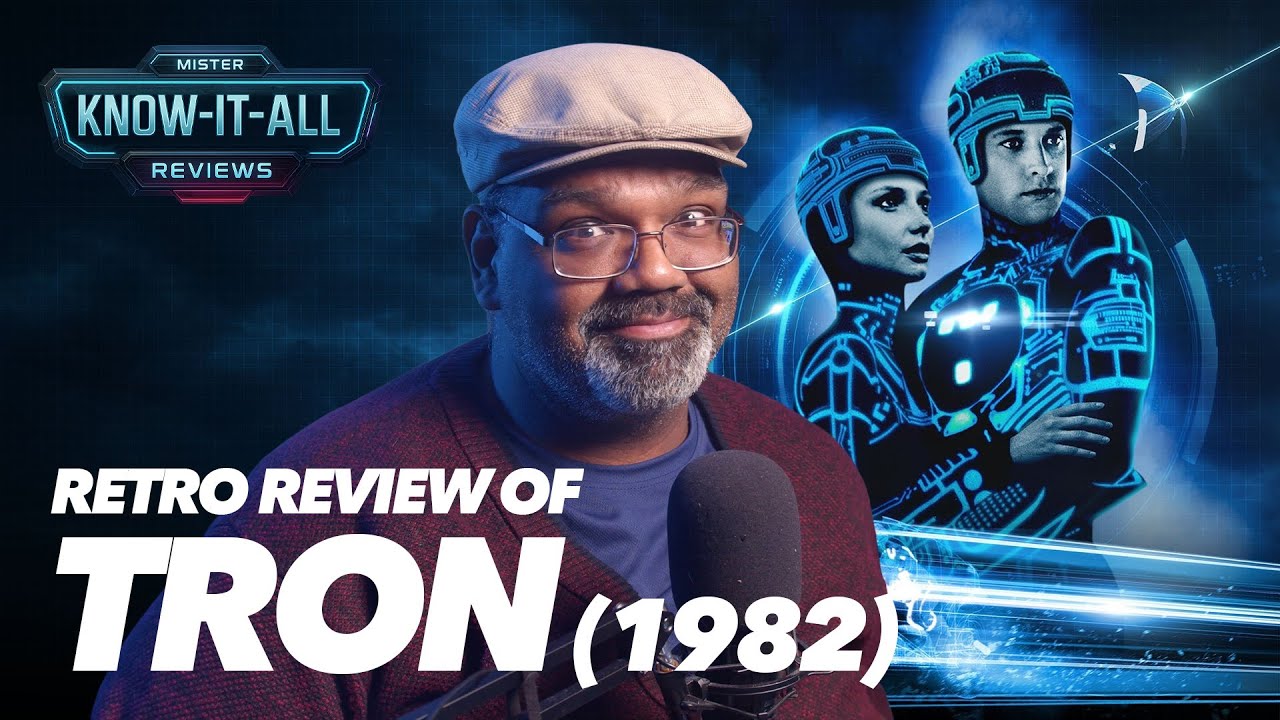
Before the metaverse, before virtual reality became a household buzzword, there was a world. A digital world where programs had faces, light cycles raced across the infinite grid, and a brave user fought for freedom against the tyrannical Master Control Program.
We’re talking about a film that dared to ask what happens if the inside of a computer is a living, breathing, high-stakes battleground. With Tron: Ares just around the corner, promising to redefine the grid once more, it’s time we journey back to where it all began.
Was the original 1982 Tron a groundbreaking masterpiece, a visionary ahead of its time, or just a dazzling but ultimately hollow tech demo with a killer aesthetic? This film still matters, and its legacy is far more complex than a simple childhood memory.
What’s up my know-it-alls!?
With Tron: Ares hitting theaters, we have to talk about the OG. This movie blew me away as a kid, but watching it now, it’s a completely different experience. The nostalgia goggles are off. I’m building up to the new film’s release this week by reviewing every one of these, so it’s Tron first, and then Tron: Legacy on Wednesday.
A Simple Premise, and the First of Its Kind
In short, Kevin Flynn, a rogue programmer, gets digitized and ends up inside a computer system. He teams up with programs to fight the oppressive MCP and return to the real world. It’s a simple premise, but the execution was revolutionary for its time.
It’s funny that they keep remaking these things, because everyone’s like, it’s the greatest thing ever, we can totally do this again. Listen, I need to explain this very carefully for Disney. The original Tron was unique for one very, very important reason. It was the first of its kind.
Marketing rule 101. The 22 Immutable Laws of Marketing literally starts with the rule: if you cannot be the first in a category, make a new category. This was the first in its category, ever. It will stand. Even though the original movie was arguably not much of a commercial success, it paved the way for a lot of modern cinema VFX today. Corridor Crew did an entire video about this that I thought explained it really well.
The Visuals Are the Star
The visuals are probably the star here. No film before it looked like Tron. The glowing lines, the black voids, the light cycles. God, the light cycles. It was utterly alien and mesmerizing.
There was a game in my town, at the local 7-Eleven, that was the original Tron game, and it was pretty awesome. Light cycle was my favorite.
Then there’s the painstaking rotoscoping and the practical effects combined with early CGI. The film was a statement. The feel of the grid, when you really think about it, the vastness, the danger, it’s almost a character itself. To borrow a term from another franchise of a similar time frame, the early ’80s, it was definitely more than meets the eye.
Beneath the Neon Glow
Beneath the neon glow, Tron explores surprisingly complex ideas. The nature of consciousness. Free will. Religious allegory, with users as gods. Corporate control, which is very, very prevalent today, or at least a topic I think people really want to talk a little bit more about. And ultimately, the blurred lines between humanity and technology.
All of that was explored first in Tron. Before the likes of The Matrix, before the likes of The Thirteenth Floor, there was Tron. And it’s funny, coming out of a studio that was amazingly forward thinking for a lot of its time.
Is the MCP truly evil, or just a program fulfilling its directive to organize? This film predates The Matrix by nearly two decades in asking these questions. So you’ve got to remember, these are not questions we haven’t asked before. From the earliest days of computer graphics, of computers themselves, this was one of the first movies that immediately started asking them.
And at the time this was coming out, the visual effects weren’t only groundbreaking, they were transformative. They were inventing things for this movie, which a lot of the early movies and classics we love today did. Whatever you can think of from that era, whether it’s Ghostbusters or Die Hard or Alien, they were inventing the rule book. The book that we would later on sequelize ad nauseam. They were inventing those exact scenarios, stage by stage, and they were asking big questions.
The idea of programs believing in users is a fascinating exploration of faith in a digital realm. And what a neat way to wrap it up, especially because it really does address a lot of the god complex issues of the modern day internet.
A James Cameron Movie Before We Had James Cameron
Okay, so here’s where Mr. Know-It-All has to be brutally honest. For all of its visual splendor and thematic ambition, the plot itself can feel a bit clunky at times.
Tron doesn’t start Tron-ing till like 45 minutes in, though they do these little clunky inserts. I think if you go back and actually look into this, the original cut of the movie didn’t have those. That was a much more modern edit.
And then you had the human characters. While iconic, they aren’t always the most compelling. Jeff Bridges is really charming as Flynn, but sometimes I feel like the emotional core got lost in a lot of the technical jargon and the visual spectacle.
It felt like Tron was a James Cameron movie before we had James Cameron. It’s true. It really is. It was like, hey, story be damned, we’re going to figure this thing out and try to make it look as good as we can possibly make it look, and the bigger and better it can look, we’re good. That was really it.
The Pacing, and What We Lost
When you really get down to the brass tacks of this thing, the pacing can definitely drag in the middle, especially by modern blockbuster standards.
If I’m being fair, it isn’t fair that I say that. You have to remember, today is all about quick-cut stuff. It’s all about the fast pace.
The last genuine action movie of a lost era, for me, is The Last Boy Scout with Bruce Willis and Damon Wayans. I watched it recently, and there’s this scene in it. They’ve been in gunfights. They’ve been running. They come back to the dude’s apartment, he sees a picture, and he asks a question. And Bruce Willis proceeds to give this massively compelling backstory for himself.
This is back when it wasn’t cliche to have characters expo dump or trauma dump. The music got somber. The cinematography changed tones, if you will. I remember thinking this moment in time felt crazy long. But it was character building. That’s what it was. And they don’t do that anymore, because modern movie sensibilities have changed. There’s no reason to. Why would we do it? Why should we do it? You know what I’m saying?
Does the Story Cash In on the Premise?
So does the story itself fully capitalize on its brilliant premise? I think that’s the crux of whether or not Tron is successful, and it speaks to a much broader reason why the franchise, while iconic, has not been able to be replicated effectively.
Mind you, I thoroughly enjoyed Tron: Legacy. I don’t have a problem with it. I know a lot of people do. The biggest issue you’re going to face with the Tron thing is that the first one was so groundbreaking that nothing else is going to be able to stand up to it.
Okay, I’m about to make Tron: Ares better inside the review of Tron itself. Make Ares an AI-driven movie. I mean a movie about AI. You immerse it, you wash this movie in the concepts of AI, and in fact you do utilize some AI in the process for the sake of the storytelling. I feel like there’s a world in which you can kind of try to recapture lightning in a bottle. The investment in budget would have been super cheap, but the investment in time would have been massive. Movies are not as iterative as AI is, and I think that’s probably going to be your biggest issue, overwhelmingly, moving forward with the concept of AI and filmmaking.
Sorry to go on that little rabbit trail. But again, it’s debatable whether or not the story itself capitalizes on the premise.
The Cult Classic
You have to remember, Tron was a box office disappointment initially, but it became a cult classic. Why? It inspired a generation of filmmakers, game developers, and artists. That’s the easiest line on it, and it’s the truth.
You can see its DNA in everything from early video games to Ready Player One to, obviously, Tron: Legacy and now Ares. It pushed boundaries even if the audience wasn’t quite ready for it. That’s a very polite way of me saying it was ahead of its time.
So there you go, now you know, and if knowing is half the battle, you’re halfway to being a know-it-all yourself.
The Verdict
Tron, the 1982 original, lands at a solid, unapologetic 7 out of 10 on the Know-It-All Index.
After all these years, is Tron a masterpiece? Not in the traditional sense of a perfectly crafted narrative. But it’s an undeniable milestone, a bold, audacious, visually revolutionary film that changed what we thought was possible on screen and sparked the imagination of millions.
I’m constantly doing this these days, because you really have to think about these things as a combination. My opinion as a film critic and reviewer, combined with the importance of this movie, is going to skew its score. For me, a solid seven, for sure.
You watch Tron for the experience as much as the plot. The sheer audaciousness of its vision. And for that, I think it deserves immense respect. It’s not perfect, but its sheer visionary audacity and lasting cultural impact make it more than a nostalgic curiosity. It’s essential viewing, I think, for any true know-it-all.
Never forget, everyone loves a know-it-all!
Your turn. What was your first exposure to Tron? Did it fry your circuits, or leave you feeling a bit de-rezzed? Are you a fan of the original, or is it one of those things where you’re like, eh, whatever, I’m going to go play another PlayStation game? Whatever works, man. The conversation lives in the comments on the video above.