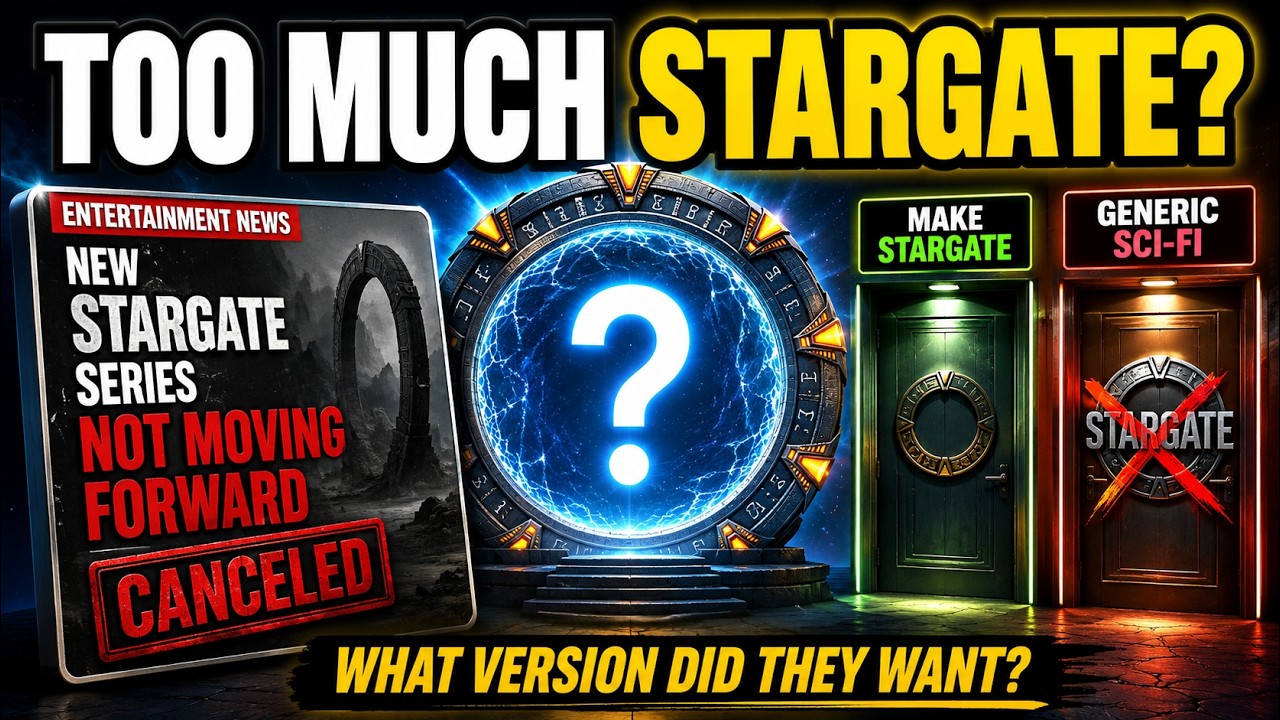
We need to talk about Stargate. And I think the cleanest way to say this is: Amazon bought Stargate because people care about Stargate. Then the reporting around the cancellation suggested there was concern the new show might appeal too much to the people who care about Stargate.
That’s the whole problem. That’s the contradiction in the room. That’s really why the fandom lit up.
Because yes, technically, what happened is simple. Amazon announced a new Stargate series. Fans got excited. Then Amazon canceled it before it ever actually happened. No episodes, no cast, no trailer, no chance for the fandom to even judge the thing. So if you’re outside Stargate and your first reaction is “okay, shows die in development all the time,” I get that, and normally you’d be right. But this one didn’t feel like normal development news. It felt like somebody sealed the gate from the other side.
And the weird part is, it wasn’t only Stargate fans who noticed. Star Trek fans were looking over like, wait, what happened? Star Wars fans were looking over like, why is that fandom suddenly on fire? That’s what made me stop and go: okay, this isn’t just disappointment. Because most fandom anger is about something that got made. A bad season, a divisive movie, a finale that didn’t land, a character that got mishandled. This is different. This is anger over something that didn’t get made. And that only happens if the canceled show represented something bigger than a show. It represented the possibility that the people who now control Stargate might finally understand what Stargate is. And then, almost immediately, fans got a reason to suspect they don’t.
That’s this piece. Not “Amazon canceled the show.” Not “fans are mad.” The real question is whether Amazon understands the machinery of the thing it bought. Because Stargate isn’t just a portal. And I know that because, weirdly, I was once the viewer who should have rejected Stargate changing.
The Viewer Who Should Have Said No
I saw Stargate in theaters, and I loved it. Ancient Egypt, alien mythology, a buried device on Earth that turns out to be a doorway to another planet. That’s a killer science fiction premise. And James Spader was a huge part of why that movie worked for me. His Daniel Jackson had this awkward brilliance to him: the guy everybody dismissed until suddenly he was the only person in the room who could actually understand what was going on. And Kurt Russell was Kurt Russell. You couldn’t ask for much more.
So when SG-1 came along, I wasn’t automatically on board. I know that sounds funny, because for a lot of people SG-1 is Stargate. But at the time I was looking at it like: how are you doing Stargate without James Spader? How are you doing Stargate without Kurt Russell? How do you take the movie, recast the main roles, and turn it into a weekly show?
And then it was on Showtime, and that pilot was very clearly Showtime saying, hey, this is premium cable. There was material in that first episode that didn’t leave much to the imagination. Nudity, some language, the whole early premium cable thing where the network wants you to know you’re not watching basic cable anymore. And I’m not going to pretend I checked it out for some noble artistic reason. A friend of mine called me and basically said, “Have you seen what they’re doing on this new Stargate show?” That got my attention. So I watched it, skeptical but curious.
And then the annoying thing happened. The show got good.
Don’t get stuck on that, but keep track of it, because it’s important. I was the viewer who should have rejected the changes. I loved the movie. I had the original actors locked in my head. I didn’t need weekly versions of Stargate. And SG-1 beat my resistance through craft. Michael Shanks didn’t just do a James Spader impression; he turned Daniel into a television character. Richard Dean Anderson didn’t try to be Kurt Russell; he found the television version of Jack O’Neill. And before long I stopped watching SG-1 as “the version without the movie actors.” I was just watching Stargate.
So when people say fans just hate change, that doesn’t work here, because Stargate already changed. Different actors, different format, different tone, different medium, an expanded mythology, a whole television identity built on top of a movie people already loved. The fandom went with it because SG-1 understood what it was changing. It didn’t treat the movie like disposable baggage, and it didn’t let the movie trap it. It built from it. That’s the difference. Stargate fans are not allergic to change. We’re allergic to people changing the wrong thing because they don’t understand the machine.
The Portal Is the Premise. The Program Is the Machine.
From the outside, Stargate looks simple. Ancient portal, military team, aliens, mythology, adventure. That’s the elevator pitch, the one-sentence version, the image you put on a streaming tile. But that’s not the engine.
The portal is the premise, but the program is the machine. The gate creates exploration. The SGC creates procedure. Continuity creates accumulation. The team creates the human stakes. That’s the format, and that’s what can’t be flattened.
The SGC isn’t just lore. It’s not just a base. It’s format. It gives the show a repeatable home position. It gives you a command hierarchy, a reason for exposition, briefing rooms and debriefings, ethical arguments, tactical disagreements, scientific problems, military pressure, diplomatic consequences, and a way to move between wonder and procedure. That’s why Stargate worked as television. The gate let the show go anywhere. The program gave the show a reason to come back.
And that structure let the franchise do something very difficult: it could be episodic enough to watch casually but cumulative enough to reward the people who stayed. A lot of television resets every week. Stargate had memory. Characters learned things, and that knowledge mattered later. Earth acquired technology, and that changed the balance of power. Enemies were defeated, and consequences rippled outward. Alliances mattered. Mistakes mattered. And the program evolved. Earth starts as the underdog: we’re the primitive ones walking into a galaxy full of ancient powers, false gods, advanced civilizations, and enemies we’re absolutely not ready for. Then, slowly, Earth gets better. Not cleanly, not without arrogance, not without cost. But we learn, we adapt, we reverse-engineer things, we make allies, we make huge mistakes, and ultimately we become dangerous in our own right.
That’s not just lore. That’s not just fan attachment. That’s the story engine.
The Job Amazon Accepted
This is where I think adapting Stargate gets genuinely hard, because a new Stargate can’t just copy SG-1. The old network rhythm can’t be reproduced unchanged. Shorter streaming seasons change the math of exploration. Earth isn’t the naive underdog anymore if you preserve continuity. The military procedural element plays differently now than it did in the late 90s. The visual grammar has to evolve. The mythology has to have weight, but too much weight can crush any new entry point.
So yes, Amazon has real creative problems to solve. A modern Stargate would have to decide what to preserve, what to compress, what to ignore, and what to rebuild. That’s not easy. But that’s the job. That’s what you accept when you buy Stargate. You don’t solve it by treating the existing audience like a liability. You solve it by understanding the difference between machinery and wallpaper.
The old characters aren’t all mandatory. The old briefing room isn’t sacred furniture. The exact pacing of 1997 isn’t the essence. But the machine matters. The program matters. The accumulation matters, and so does the feeling that Earth learned, changed, and carried consequence. That’s the leap you have to get right. If you keep the portal but lose that machine, you still have a sci-fi concept. I don’t know if you still have Stargate.
A Starved Fandom Hears an Announcement
Stargate fans haven’t been drowning in new Stargate. They haven’t had ten different shows to reject. They’ve mostly had rumors, false starts, almosts, and silence, and that changes the emotional weight of every announcement. When you’re saturated, a new project can feel like noise. When you’re starved, a new project feels like oxygen.
So when Amazon announced a new Stargate series, fans weren’t just asking “is there a new Stargate?” They were asking “what kind of new Stargate?” Because the fear was obvious: somebody brings it back, uses the name, uses the symbol, uses the portal, and sands off everything underneath. That’s not paranoia. That’s what legacy IP owners do all the time. They keep the recognizable surface and flatten the machinery underneath. So fans were watching for the signals. Who’s involved? Is this a continuation? Is it a reboot? Are the old shows being respected? Is the existing mythology a foundation, or an inconvenience?
That’s why Brad Wright was so important. Before this new version, Wright had been working on a pilot, and for Stargate fans that mattered more than almost anything, because he wasn’t just some random name on a pitch. He understood the television franchise from the inside. And when that became another almost, caught in timing, COVID, corporate change, the Amazon acquisition, all of it, that hurt.
Then the new announcement came. Martin Gero was attached. Brad Wright was involved as a consulting producer. Joseph Mallozzi (love you, man) was involved as a consulting producer. And the public messaging didn’t sound like “we’re throwing everything away and starting from scratch.” The message fans heard was: this is being made with awareness of the existing franchise. It sounded like the compromise. New showrunner, modern streaming platform, veteran involvement, a path for newcomers. Not a hard erase of the existing world, and definitely not a fan-service prison or reboot vandalism. It was going to be a bridge.
That’s what activated the hope. Not just the title, not just the brand: the possibility that after years of almosts, the people in charge might finally open the gate in a way that understood why we all still cared.
Then it was gone. And yeah, projects get canceled. But fans didn’t just lose some random pitch. They lost what looked like the reasonable version, the version that could bring in new people without telling the old audience to get out of the way. So when that version dies, the question becomes really obvious: if that was too much Stargate, what version do you actually want?
The Reported Reason Is the Insult
The cancellation was disappointing. The reported reason is what made it feel like an insult, and that’s the nicest, most polite way I can put it.
The reporting suggested Amazon was concerned the show might not appeal broadly enough beyond the existing Stargate fan base. Now, we don’t know every internal conversation. But that framing hits the nerve, because my immediate response is: wait. You bought Stargate because Stargate has value, but the people who kept that value alive are now the problem?
That’s a category error. Who preserved this franchise while it was dormant? Who kept talking about it, kept rewatching it, kept making the videos, podcasts, convention panels, discussion threads, campaigns, retrospectives, episode guides, all the oxygen around the franchise that the studio wasn’t actively feeding? The fans did. So when the explanation sounds like “we’re worried this appeals too much to the people who love Stargate,” that doesn’t land like business logic. It lands like contempt. Maybe that’s not how Amazon meant it, but that’s how it landed. Because the existing audience isn’t the ceiling. It’s the foundation. That’s the mistake: confusing the foundation with the ceiling.
And yes, Stargate needs new viewers. Of course it does. A new show can’t require ten seasons of SG-1, five seasons of Atlantis, two seasons of Universe, the movies, and a franchise syllabus before episode one. That would be insane. But accessibility isn’t amnesia. A new viewer needs a clean way in; they don’t need the show to pretend nothing came before. A good revival says to new viewers, “here’s a clean door into this world,” and to old viewers, “don’t worry, we know what room we’re standing in.”
That’s what broad appeal actually is. Broad appeal is clean character desire, legible conflict, emotional stakes, a world you can enter without a syllabus. Broad appeal doesn’t mean sanding off identity until the show could be called anything. That’s generic appeal, and broad appeal and generic appeal are not the same thing. You don’t make Stargate bigger by making it less Stargate. That’s how you get a recognizable title on top of a show with no reason to exist.
And that’s the fear: that Amazon may not be looking for Stargate at all. That it’s looking for a sci-fi brand with pre-existing search value. A recognizable title, a searchable label, a library asset. Metadata. A franchise name that can sit in a streaming menu and make the platform look deeper than it really is. That’s colder than wanting the house; that’s wanting the address because the address ranks in search. And fans can smell that. They can feel when a company wants the brand more than it wants the thing itself. That’s why the reaction got so sharp. Because if the version with veteran involvement, continuity awareness, and an actual bridge between old and new was considered too limited, then the question is unavoidable: are you even trying to make Stargate, or are you trying to make a broad sci-fi show with a Stargate logo on it? I’m sorry, but those are not the same thing at all.
The Warning
So there you go. Now you know, and if knowing’s half the battle, you’re halfway to being a Know-It-All yourself.
When people ask why Stargate fans are this angry, that’s my answer. It’s not just because a show got canceled. It’s because the gate almost opened again, and for a minute it looked like the people opening it understood why fans wanted to walk through it. And then it disappeared, and the explanation floating around made it sound like the people who kept the franchise alive might have been part of the problem.
The fear is not change. The fear is flattening. The fear is that Amazon looks at Stargate and sees a portal, a logo, and a library asset, while the fans see working television, an engine that took years to build. And if Amazon can’t tell the difference between the portal and the machine, it won’t modernize Stargate. It’ll flatten it.
That’s the warning. Stargate doesn’t need to be trapped in the past. It doesn’t need to be SG-1 again. It doesn’t need to pretend television hasn’t changed. The gate can lead somewhere new. It should lead somewhere new; that’s the whole point. But if you remove the program, the competence, the continuity, and the accumulated world around it, you’re not expanding Stargate. You’re taking something that had a machine inside it and turning it into a logo.
Stargate fans aren’t asking Amazon to keep the gate locked in the past. They’re asking Amazon to prove it knows what the gate actually opens into.
How are you feeling about the whole thing? Head to the comments on the video above and let’s keep the dialogue going. I signed all three of the big petitions floating around, and I’ve tried to gather links over there; if I missed one, drop it in the comments so others can find it. Stargate has to be respected, and we have to save Stargate. Never forget, everyone loves a Know-It-All.