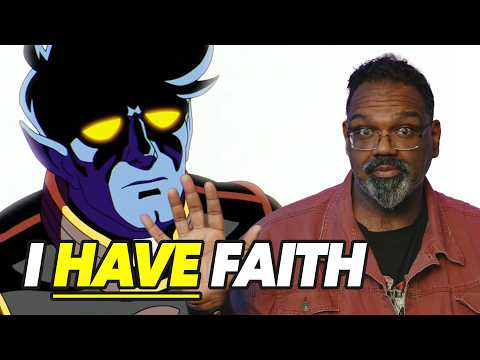
Heads up: there will be spoilers for the most recent episode of X-Men ‘97. You have been warned.
I want to start with the thing I’m least comfortable saying. About halfway through this episode, I caught myself feeling sorry for Graydon Creed. I wrote it down while I was watching, exactly like this: “Somehow they’re making us sympathetic with Graydon Creed. I don’t know how to handle that.” And I still don’t, really. Creed, the man who founded the Friends of Humanity. The man whose whole public career is built on getting people like the X-Men registered and rounded up.
Now look, this review is not going to be about the ending everybody’s talking about. It’s not going to be about the last 90 seconds where X-Force walks into that temple and Apocalypse is on the floor and there’s a burning playing card lying next to the body. We’ll get there, I promise, and I’ve got things to say about it. But I want to leave it alone for a minute, because that card only lands the way it lands because of what happened in the room before it.
Something got put on trial in that room, and it wasn’t Graydon Creed.
X-Men ‘97 Season 2 Episode 7, “Strange Land, Savage Heart,” dropped this morning, and I watched it taking notes in real time, which, I’ll be honest, is a terrible way to watch anything you actually enjoy. And here’s the problem I walked away with. I loved this. I also have a list of complaints about as long as my arm. For a good while those two things would not sit next to each other in my notes. It took me a minute to work out that they’re not actually two things.
The Call I Got Wrong
Let me back up, because I made a call while I was watching that I got wrong, and I think how I got it wrong is probably the more useful part.
Fourteen minutes and fifty-one seconds in, which is basically the midpoint of a 29-minute episode, Nightcrawler proposes the trial. I wrote down: “That’s very ambitious for a 29-minute episode.” And I meant it as a worry. You’ve got to set up a trial. You’ve got to establish stakes. You’ve got to give both sides a case. And we’ve really got half a runtime to do it in. Then right under that, I wrote: “I don’t think they’re redeeming Creed here. This is going to be one of those episodes where the X-Men get to be the better men.”
That second note is the one I want to take back. Not because they weren’t better men, but because “the X-Men are the better men” is a completely different episode from the one I got. That’s the safe version. The heroes extend grace to somebody who doesn’t deserve it, the grace is the point, everybody feels good about the franchise.
That’s not what this is. This is the show turning around and asking whether the grace works at all.
Because think about who’s actually in that chair. If you don’t know Creed, this whole thing is just a debate about a jerk. So quickly: he first shows up in Uncanny X-Men issue 299, cover date April 1993. He’s the son of Mystique and Sabretooth, two mutants, and he came out human. Now I need you to sit with that. What does that do to the central image of this franchise? Since ‘63 the machine has been: kid’s power comes in, the human world would throw the kid away. That’s Kurt. That’s Rogue. That’s every origin they’ve ever written. And Creed is that picture flipped completely over. The human kid the mutant parents threw away, and what he built out of it was a hate group, and then a run at the presidency on the back of it.
So when this show drags him into a room and puts him on trial, the thing in the chair isn’t a man. It’s the premise. It’s the whole Xavier proposition asked out loud in front of us: whether it survives contact with somebody who’s genuinely not sorry.
Both Sides Written to Win
And then they do the hard version of it, which I did not see coming. The easy way to write this is you make Exodus a straw man. You let Kurt give a beautiful speech, everybody learns a lesson, roll credits.
That’s not this. Exodus gets to be right. His case is that this man kills again the second you take the cuffs off, and the episode never undercuts him. It doesn’t hand him a villain line to discredit himself with. He just makes a good argument and the show lets it stand. And Kurt is over here defending Creed out of faith, out of the idea that you don’t get to decide which lives count. And Kurt is also right. Both sides written to win. And they tried doing that in 29 minutes with a dinosaur fight in the middle of it.
Look at who they hand the gavel to, because that’s the tell. Nightcrawler specifically asks for Colossus, and I think I know why. Because Peter is an honorable man, and because Peter, underneath everything, is an X-Man. What makes it cruel is that they load his grief in the same episode. The cold open puts us inside the Genosha attack this time. Instead of walking in afterward, that’s where he loses Illyana. So the man they put in the judge’s chair is carrying the freshest wound in the room, and Exodus is banking on it. Exodus stages this entire thing on the assumption that Peter’s rage is a lever he can pull.
And what a fool he was. Seriously, that’s just the dumbest choice. This is not who Colossus has ever been. Colossus is my favorite X-Man, and this is exactly the reason. The metal is the least interesting thing about him. That outer carapace pales next to the strength of his heart and his convictions. And yeah, he’s running with the Acolytes here. (By the way, look at those costume designs. That’s the Asteroid M look pulled straight out of X-Men volume 2, issue number 1, from 1991. Fabian Cortez, the whole crew.) He’s turned on people before, usually for reasons you can follow if you’re paying attention, but it has always been in service of protecting somebody who couldn’t protect themselves. Exodus read the armor and missed the man completely.
Then the fight, and I have to be honest, I was ready to be smug about this one. Exodus comes at Nightcrawler with a sword, and my note is literally: “My boy, you have no clue what you’re about to get into.” About four seconds later I remembered that Exodus can teleport too, which I had completely forgotten, and it makes the whole thing so much better. Now they’re both blinking around each other mid-swing. It turns into a sort of Dragon Ball fight, and it’s wonderfully executed. Somebody in that room knew this material cold.
The Verdict That Belongs to a Dead Girl
Here’s where it gets good, and I want to go slow, because the order of these beats is the whole thing.
Kurt wins. He makes his case. It lands. You can feel the room turn. And then Graydon Creed pulls a gun and shoots Exodus, right there, seconds after a man stood up and argued he was worth saving. And Kurt looks at him and says: “You may not be a mutant, but you are very much your parents’ son.”
I was beside myself. That is such a powerful assertion, because the violence, the Sabretooth in him, the thing he has spent his entire life running from, turns out to be the one piece of his parents he actually got. And the humanity he wears as his whole identity is not what pulled that trigger.
So the defense was right in principle, and the prosecution was right in practice, in the same room, about the same man, in the space of about ten seconds. And the show does not clean that up for you. It just leaves it there.
And then Peter rules, and his ruling isn’t about law at all. He tells Kurt flat out that Kurt wouldn’t have convinced him. “But you would have convinced Illyana.” He hands the verdict to a dead girl.
That’s the best writing this show has done, and I don’t think it’s even close.
Where That Capacity Came From
Which left me chewing on something, because franchise television doesn’t usually do this. Franchise TV flattens the bad guy. Flat is safer, and flat moves merchandise. So why can this show do the other thing?
I went looking, and honestly the first place I ended up was the credits card on this very episode: written by Brian Ford Sullivan and Beau DeMayo. DeMayo created the show, and Marvel fired him roughly two weeks before Season 1 ever aired. He also wrote a big chunk of Season 2, and he’s said publicly he did no production rewrites afterward, which tells you Sullivan is the one doing the punch-up here. But the name held on this one. And once I started reading what DeMayo has actually said on the record about writing this thing, the trial stopped looking like a swing and started looking more like an assignment.
Back in 2023, at Marvel’s own 60 Uncanny Years event, standing on Marvel’s stage, DeMayo said the company was interested in what his experience as a Black gay man was going to bring to the story they were telling. That’s not a leak. That’s not somebody’s hot take. That’s Marvel describing the job.
Then there’s Genosha. He told The Advocate that he built Genosha out of Pulse, the club in Orlando. His words: he partied there, it was his club, and it was, like Genosha, a safe place for him and everyone like him. He wrote a sanctuary for people like himself, and then it burned to the ground on screen, because he’d already watched that happen for real.
And then there’s the piece I keep turning over, and I’m not entirely sure what to do with it. In the Vanity Fair profile that ran at the top of this month, talking about his own time at Marvel, he says: “I thought I was in a safe place, and then quickly found out that I was not.” Same words he used for the club. Same words he used for Genosha. And I really want to be careful here, because I am not telling you the show meant anything by this. I’m telling you what’s on my screen. This episode, the one with his name still on it, opens by walking us straight back into Genosha. That’s it. That’s all I’ve got on it.
But when a show turns around and makes you feel something for a man who built a hate group, that capacity came from somewhere. And the somewhere is a room where a guy had been asked to put his own experience of being on the wrong side of that line into the work.
And I’d add this, because it’s the thing that made all of it really click for me. What we’re actually watching here is a bottle trial. A courtroom argument about whether a person counts as a person, staged inside a show that is otherwise about people hitting each other. That’s a straight line from “The Measure of a Man,” which works out nicely, because I’m covering Strange New Worlds tomorrow. The reason those two things live on the same channel is that the unit here was never the franchise. It’s the craft. Same job, different uniforms.
Four Complaints, One Shape
So if the trial is that good, why did I come out of this arguing with myself? This is the part I didn’t put together until I went back through my notes. It isn’t one complaint. It’s four, and they all have the same shape: every one of them happens outside the trial.
Start with the cold open. Killing Illyana is cheap, and I want to be specific, because “cheap” is a lazy word if you don’t put something under it. We basically get Magik in this show so that we can lose her. She’s a cameo brought in to be spent, and her death exists to load a gun for somebody else’s arc. That’s a real cost, and the episode never really pays it back to her.
Then Bishop, and this one I actually got wrong in the moment, so let me show you the work. Bishop gets caught mid-cycle when the inhibitor kicks on, and if you know his powers, that’s a smart setup, because his thing is two-phase: absorb, then release. Cut off the release and it just keeps stacking up inside him with nowhere to go. I wrote down, live: “They’ve added a time clock to everything. That’s pretty decent storytelling, I suppose.” Then I got to the end of the episode, went back, looked at that note, and no, it isn’t. Because the clock detonates nothing. He eventually lets it go, he gets a one-liner about going out with a bang, and that’s your payoff. Nothing was ever actually at risk. Nobody had to choose anything because of it. It doesn’t bend the plot one degree. That makes me wonder whether the clock was ever in the original script, or whether it’s a note somebody gave (“we need urgency in the middle here”) that got lost in the rewrite, in the edit, maybe all the way back at the animatic. I genuinely don’t know. But the tell is that you could lift it out clean and lose nothing.
Then the buttons at the end. Plural. All of them scattered across the last two minutes.
And then the title, which I keep coming back to. “Strange Land, Savage Heart” is a word flip on “Savage Land, Strange Heart,” the two-parter from the original series in ‘94. I went and checked it, because I wanted to know if there was something structural there. There isn’t. It’s a Sauron story. It shares the setting and really nothing else. No trial in it, no moral argument in it. So the title is signage. It’s a callback for the sake of having one. And that’s the thing about this show I can’t really get past: this attempt to keep shoving itself back into its original packaging in some attempt to be faithful to something. It feels weak to me. Nobody had to invoke 1994 to make Kurt and Exodus argue about a man’s soul. That part is just good on its own.
This episode was at its absolute best for the twelve minutes where it stopped being an X-Men ‘97 episode and let itself be a play. And it got worse every time it remembered it owed the season a body, a countdown, a Savage Land set piece, and three doors popped open for the finale. The show needs to let itself be what it is, whatever that turns out to be.
The Card
Now, the card. X-Force finds Apocalypse on that temple floor, burned, a playing card next to him, and everybody’s going to sprint at the obvious read, which is: Remy killed him.
I’m not going there. Two weeks ago I made the case that the Gambit resurrection was never a twist, that this show had been laying that track in plain sight the whole time. This is the receipt getting cashed. Fine. But I don’t think this is a murder scene, or at least not only one. Apocalypse spent decades in the comics hunting for a new body. That’s his actual pathology, to call it something. He finds a stronger vessel and then he moves in. And last week we watched him bring Remy back as Death. So the read where Apocalypse reached for that body and something went wrong is at least as available as the read where Remy just won a fight.
And here’s my honest problem with all of it: Apocalypse cannot be dead. One of the heaviest villains in this franchise does not go out in a post-credit style beat two episodes from a finale. So what is the scene actually doing? I don’t know, man. I don’t know. I’ve turned it over a few times and I don’t have it. And I’d rather tell you that than sell you a theory I don’t believe. I’m not going past what aired.
The Verdict
So what’s the Know-It-All Index for X-Men ‘97 Season 2 Episode 7? Here’s how it shook out for me. The trial is exceptional. The fight inside it is wonderfully executed. The verdict is arguably the best beat this series has ever written, and the ruling that hands it to Illyana is the kind of thing I didn’t think this show had in it. On the other side of the ledger: a fridged cold open, a clock that pays off nothing, buttons scattered across the last two minutes, and a title doing nostalgia work the episode never needed.
I went back and forth on how much to take off for that, and where I landed is that I’m not grading the wrapping. What this episode came to do, it did better than anything else in this run has done. That puts Episode 7 at a 9 out of 10 on the Know-It-All Index. I liked it. I liked it a lot.
For twelve minutes, this show stopped defending its premise and actually put it on the stand. And the most honest thing it’s done all season was refuse to tell us who won.
Your turn. Drop your Know-It-All Index for Episode 7 in the comments on the video above, and give me a real answer on this one, because I’ve flipped on it twice already: when Kurt tells Creed he’s his parents’ son, is that mercy or is that a conviction? I genuinely can’t decide. I cover every episode the day it airs, so stick around for the final run.