On July 15th I put out a video on this channel called “Why I Let X-Men ‘97 Get Away With This.”
That was the Wolverine episode. The adamantium, the bandana, the bone claws. And people had problems with it, real ones, and I stood there and said I was fine with it, because a show that takes a swing that big is a show that thinks you can keep up with it.
That’s the trade. You risk it, I extend the credit.
I watched the finale twice this morning. And I want to be careful, because the cheap version of this is me telling you I was wrong in July.
I wasn’t wrong in July. I ran the same test I always run. The show’s the one that changed.
So, season 2, episode 9, “Survival of the Fittest,” and I have to be honest with you about how this went, because I don’t think I hid it well on my own face.
I was excited. Genuinely. I got up early for this the way I get up early for all of these, and about ninety seconds in something started sitting wrong with me and I couldn’t name it. Not the plot, the plot’s fine, you can follow it. Not the animation, and I want that on the record early because I’m going to be hard on this thing today: the animation is gorgeous. It’s some of the best-looking work this show’s done.
But something was off, and by the end I was annoyed, and I don’t love being annoyed, because annoyed guys on the internet are a dime a dozen and they’re usually annoyed because a show didn’t go the way they wanted it to.
So I did the thing I do. I went away, I sat with it, I watched it again, and I asked myself the only question that actually matters here.
Am I mad about what happened, or am I mad about how it was built?
It’s how it was built. And the second watch is where I got it.
This finale was made for somebody who wasn’t going to look very closely. It tells you its payoff before it earns it. It cuts around the moments that would’ve been expensive to draw. And it hands you a spectacle in the spot where a consequence is supposed to sit.
I felt talked down to. Which is a strange thing to feel about a show I’d been defending four weeks ago, and it took me a while to be willing to say it out loud.
Let me show you what I mean, and let’s start where I think most of you already are, even if you haven’t put words on it yet.
The Shrine
Rogue, Beast and Nightcrawler get down to Apocalypse’s Ship. Rogue goes into the shrine, she faces Eson, she comes back out in the gold. And she leaves.
And Kurt watches her go, and he says out loud, wondering, what price is she going to have to pay for that.
And I went, oh, no.
Because I knew. Not suspected. Knew. The whole back half of the episode, from one line, from a guy it hasn’t even happened to yet.
Now, here’s where I had to check myself, because “I guessed the ending” is the weakest complaint in criticism. I guess endings all the time. Sometimes you’re just familiar with the shape of things and you get there early, and that’s not the movie’s fault.
But that’s not what this is, and here’s how I know the difference. When I guess an ending, I can’t point at the moment. I just gradually feel it coming. This one has an address. There’s a specific line, at a specific spot in the runtime, and everything before it is a story and everything after it is a receipt getting printed.
That’s not a thing I figured out. That’s a thing I was told.
And then twenty minutes later, we get the line. Kurt makes his case to Eson. He lays out what his sacrifice is going to produce, that his memory becomes a seed, that people grow something out of it. And Eson asks him, essentially, what makes you think any of that’s actually going to happen.
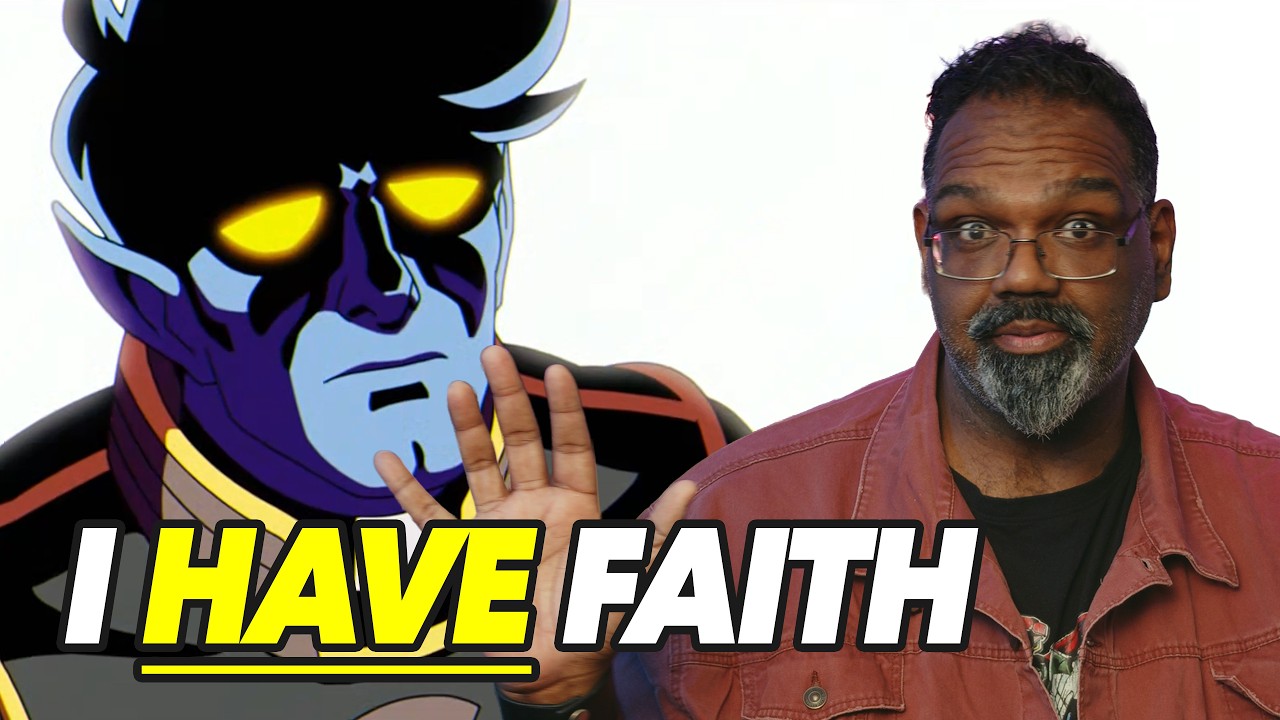
And Kurt says: because I have faith.
I watched it twice with subtitles on to be sure I had it right. That’s the line. And it lands like a thud. Not because it’s a badly written line, it isn’t. It’s because you can hear what it was built to do. You can hear the whole production leaning on it. This is the moment the show turns and goes: see? That Nightcrawler faith you’ve been watching all season? Here it is. This is what it was for.
And I didn’t feel anything.
Now let me steelman the other side, because there’s a good argument against me, somebody’s going to make it in my comments in about four hours, and they should. The argument is that Kurt’s faith was set up properly. And it was. Six weeks ago he stood in front of the Acolytes and defended Graydon Creed, and he didn’t change Creed’s mind, but he changed the judge’s, and Colossus walked away from Magneto’s people because of it. Nobody announced that. You watched it happen and you understood it later. That’s the real thing, and this show did it.
So why doesn’t that cover the sacrifice?
Because that setup already paid off, and it paid off somewhere else. It paid off in the post-credits, where Graydon Creed is the President of the United States on an anti-mutant platform. Kurt’s faith saved that man’s life, and now that man runs the country. That’s a payoff with teeth in it, and the show built it right.
It’s just not the same setup as the death. One of them you watched. The other one you were handed a program for. And the finale wants you to accept the second one on the credit of the first.
The Cuts
Alright. This next part’s the part I actually do for a living, so give me a minute with it.
Cable puts his gun on Gambit. This is the biggest thing that happens in the episode. A son executing a man in front of the man who raised his father’s whole worldview.
Here’s how it’s shot. Wide, all three of them in frame. Cut in tight on Cable, and the gun comes up into frame, and he fires. Cut way out, establishing distance, and Gambit’s body is falling.
Three shots, and not one of them is the two-shot. Nobody ever has to board those two men in frame together while it happens.
And before somebody tells me that’s restraint, or that it’s a kids’ show, let’s be serious. This series has shown you blood. It’s shown you evisceration. It showed you Magneto vaporized. Whatever’s going on in that sequence, it isn’t about protecting anybody’s sensibilities. The camera goes exactly where the drawing is cheapest.
And then there’s the Ship, and this one’s the one I keep coming back to.
They break a hole in the top of Apocalypse’s Ship to get in. Rogue drops down into the shrine. And Kurt and Beast are standing there, and Kurt teleports the two of them, and now we’re in the throne room.
That is an enormous vessel. And we get nothing in between.
Which, fine, teleporting is what he does. Except think about what a walk through that ship would’ve been. Two old friends, one of them about to make the biggest decision of his life, moving through the birthplace of the thing that’s been hunting them all season. Nobody says anything, nobody sees anything, nobody works anything out.
The episode skipped the walk.
And that’s the space where you build the thing you’re about to spend. That’s what it’s for. And because it isn’t there, twenty minutes later a man has to stand at the bottom of that same ship and announce the ending out loud, because there’s no version of the scene where you could’ve worked it out on your own.
I want to be precise about what I’m accusing this show of, because I’m not accusing anybody of being bad at their job. The animation on this is beautiful, and I mean that. The surface of this episode is high-quality work. It’s the connective tissue that’s gone. Those aren’t the same department and they’re not the same decision, and I’ve sat in both of those rooms.
Somebody Told Me in July
This is the part where I have to take my own medicine, because I went back through the comments on the July video this morning and somebody had already handed me this and I didn’t take it seriously enough.
Skywalker3248, July 16th, under the video where I said I was fine with the Wolverine episode. He wrote me a small book, and I’d encourage you to go find it, but here’s the end of it: “Like too much in the show, there are often no consequences, things just get dropped and forgotten as soon as it’s inconvenient. With far too much done just to key-jangle iconic comic moments just to have them, with no intention of following up on them or having them have lasting consequences.”
Key-jangle. That’s his word, not mine, and it’s better than anything I came up with this morning.
At the time, I read that and I thought: sure, but that’s the cost of the swing, and I’m buying the swing. Four weeks later I’m watching a finale that key-jangles a Horseman, key-jangles a Celestial, key-jangles a Sentinel, and drops all three the second they’ve been looked at. He wasn’t complaining about one episode. He was describing a habit, and I called the habit a risk.
So, that one’s mine.
(There’s a lot more on the storyline he’s talking about, the actual comics run for the adamantium, which is genuinely wild and which almost nobody has read, in this week’s sidebar for members. If that’s your thing, I hope you’ll join me over there.)
The Substitution
Here’s the pattern, and once I saw it in the small stuff I couldn’t stop seeing it in the big stuff.
Six weeks ago this show dug up Gambit’s corpse and made him Horseman Death. Black skin, white hair, the cards turning into Tarot. That’s a real thing out of the books, that’s Blood of Apocalypse, X-Men vol. 2 #185, cover date June 2006, Peter Milligan writing, Salvador Larroca on art, and it’s one of the great Rogue and Gambit scenes. She’s standing in front of him telling him there’s got to be some part of him left that loves her.
Two weeks ago the show said: actually, he isn’t Death. He’s a vessel. Apocalypse is riding around inside him. And this week Cable shoots the vessel, and Apocalypse just steps out of him, and now we’re looking at whatever that thing is.
That’s three different ideas in four episodes. And the villain of this finale isn’t a Horseman at all. There’s a track on the soundtrack album that dropped this morning called “The Horsemen of Apocalypse,” and the Horsemen aren’t what any of this turned out to be about.
And the thing we got instead looks amalgamated. It looks thrown together. It’s Gambit’s silhouette with Apocalypse’s parts hung on it, and it’s on screen about three minutes before Rogue takes a glove off and it’s finished.
But the cleanest version of this in the whole episode is the one nobody’s talking about, and it made me sit up in my chair.
X-Corp’s headquarters is built in the ruins of Genosha. On purpose. Charles put it there and said so out loud, as a memorial to Magneto and to every mutant who died the day the Sentinels came.
And in this episode, the United States government attacks it with Sentinels.
Human-piloted, sure. Mechs, fine. But the silhouette coming over that horizon, at that location, is a Sentinel. And nobody says a word about it.
I went back through a second time specifically listening for it, because I assumed I’d missed a line. They call out that Sentinel mechs are inbound, as a tactical fact, as information. Storm gets a moment about being careful with the pilots. That’s the whole acknowledgment. That’s the emotional center of that entire battle, sitting right there on the ground, free. In better hands somebody stops for one second and says, do you understand where you’re standing. Instead those things are in the episode because an army was needed and Sentinels look good.
It’s used as function. Not in service to anything.
What a Finale Owes
Let me get to the part that’s actually my whole deal, which is what a finale is supposed to do for a living.
It’s got two debts. It owes the season behind it, and it owes the season in front of it.
Behind it, I’ve just spent twelve minutes on. In front of it is the thing I genuinely wasn’t prepared for.
There’s no cliffhanger.
And I want to be clear that I’d made my peace with a lot going in. I’d watched this season. I knew there was no universe where all of this got resolved cleanly in twenty-odd minutes, and I was fine with that, because I assumed they were going to do what season 1 did. Season 1 ended in a way that carried the first three or four episodes of season 2 on its back. That ending was an engine. It had a job after the credits rolled.
This one hands almost nothing forward. And the thing it does hand forward is a character introduced in a post-credits sting, and that’s a different instrument.
A sting is a promise. A cliffhanger is a debt.
Those feel similar for about eight seconds, and then only one of them is still working on you in October.
And I’ll say the quiet part, which is that a lot of you had Val Cooper called a long time ago, off things planted in the show itself. So I’m not going to stand here and pretend the room got surprised.
Now I want to put one thing up, and this isn’t me deciding what the show was going for, this is the show saying it. Back in May of 2024, while this season was still in animatics, Jake Castorena, a supervising producer on this show, sat down with CBR to talk about season 2. And he said, quote, “we wouldn’t plant stuff if it wasn’t going to go on.” And he said everything is “meticulously done for a reason.”
And I believe he meant it. I think you can see where they meant it. The Creed thread is meant. The Val Cooper thread is meant. But that’s the standard. That’s their word for what they’re doing, and it’s the same standard I gave them credit for in July.
Plant it, and let it go on.
This finale plants things by saying them out loud, and then goes on in the same scene. Sometimes in the same sentence.
The Verdict
So I moved my own number while I was working on this, and I’ll tell you both halves because I think the movement is the honest part. Coming off the second watch I had a 5, and 5 is average, 5 is mediocre, and I hated writing that down about this show. Then I sat with it and I came up to a 6, and the entire reason is what’s on the screen. This thing is beautiful. The fight is legible, the Celestial material looks like nothing else on television, Rogue coming down out of the sky in the gold is a great image, and none of that is cheap and none of it is an accident.
What I can’t get past is what it’s in service of. I never once felt a stake in this episode. And I’m a guy who loves the rule of cool. I’ve defended the rule of cool on this channel, but cool that isn’t attached to anything is just noise with a good render on it.
A 6 out of 10 on the Know-It-All Index.
In July I let this show get away with things because it was swinging at me. This week it wasn’t swinging. It was hoping I wouldn’t look.
Your turn, and I want the real answer, not the polite one. Where were you when you knew Kurt was going to be the one? Was it the line at the shrine, like me? Did you get there earlier? Or did it land clean for you, because if it landed clean I want to hear why, and I’m not setting a trap. I’d honestly rather be talked out of this one. The conversation lives in the comments on the video above.
For the full-season autopsy, all nine episodes, receipts on the table, read the Season 2 verdict.


