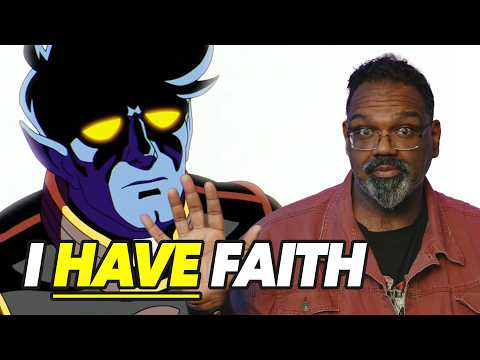

There’s a shot about four minutes into the last act of this finale I’ve now watched maybe fifteen times. And I still can’t get past it.
Cable’s leading the charge on Genosha. And coming in behind him is a legion of Sentinel Squad One fighters.
Sentinels. On Genosha.
His mother died there. Madelyne Pryor, killed in that massacre, by machines that looked exactly like the ones flying in formation behind her son.
And nobody says anything. The Sentinels get called in as a tactical fact, Storm gets a line about being careful with the pilots inside them, and the episode keeps moving.
That’s not a plot hole. A plot hole’s a mistake. Somebody had to decide not to write that line. Somebody had to decide not to board that look.
So the question isn’t what went wrong in the finale. The question is what kind of season produces that, four minutes from the end.
This is the one I promised, the special edition of the Files, all nine episodes of season 2, and there’s a number at the end. And I’ll tell you now: I came in with an answer in my pocket and I threw it out about forty minutes into the rewatch.
Receipts on the table, same as every Files.
The Answer I Threw Out
The answer I came in with was rushed.
And it isn’t a stupid answer. It’s what a lot of you said this week and it’s what I’d have told you Tuesday. L-J Kelty said the season felt like “X-Men with hyperactivity disorder,” which I haven’t been able to shake. Nine episodes instead of ten, everybody knows that number.
Here’s the problem with it. Rushed is a word about absence. It describes the thing that should be there and isn’t, and yeah, this season’s full of those.
But go look at what got made.
Three organizations. X-Corp and X-Force and X-Factor, each with a roster and a base and a chain of command. A government apparatus. A Celestial, with a name and a mythology and a visual language nobody had animated before. A retcon that turns a resurrection into a possession. A hybrid villain who didn’t exist eight episodes ago.
That’s an enormous amount of new construction. Rushed productions cut. This one kept adding.
So this season had the resources to design a Celestial, and it didn’t have thirty seconds for Cable to look at a Sentinel.
That’s not a calendar problem. Calendars don’t work like that.
Episodes 1 Through 4
“Days of Past Future.” “A Force to Be Reckoned With.” “Rise of Apocalypse,” parts one and two. The first three on July 1st, the fourth on the 8th.
Best four consecutive episodes this show’s made, and I’ll go further than I did at the time: better than anything in season 1.
And here’s the specific thing I want you watching for, because it’s the whole case. These episodes build. Magneto dies early, Xavier watches it happen, and the show refuses to tell you what that means. It makes you carry it for weeks. Apocalypse gets set up as the thing you don’t beat, and it lands because Larry Houston, who ran the original series in ‘92, has said Apocalypse was always the one villain they couldn’t overpower. The show knows you know that, and it plays off it instead of explaining it.
That’s expensive storytelling. Not expensive to draw, expensive in screen time, which is the only currency a nine-episode season actually has.
Paul D 5185 said in my comments that the first four were amazing, the show was on fire, and then something shifted. I had almost that exact sentence in my notes before I read his. He’s right. And you can date it.
Episode 5
“Weapon X, Lies, and DVDs.” July 15th.
I made a whole video about this one the day it dropped. The adamantium comes back, it isn’t explained, and I said I was fine with that, because a show swinging that big is a show that thinks you can keep up.
I still think that was the right call on what I knew then.
But watch the shape of the season change here. Through episode 4, everything is pointed forward. Episode 5 stops and steps sideways.
It’s a good episode. It’s a good episode standing in a hallway.
Episode 6
“Danger.Exe.” July 22nd. Danger Room episode, done a hundred times; this is a solid version.
Then the post-credits, and I stood up. Apocalypse in Athens, Gambit’s corpse, the playing cards turning into tarot and wrapping the body. Horseman Death, black skin, white hair. Lifted straight out of 2006 and put on screen without blinking.
I want that reaction on the record, because I’m about to be hard on where it went.
Episode 7
“Strange Land, Savage Heart.” July 29th. Savage Land episode, and the best five minutes of writing in the season.
Nightcrawler stands in front of the Acolytes and argues for the life of Graydon Creed, a man who built a career on hating mutants. He doesn’t change Creed’s mind. Creed turns around and shoots Exodus practically on the spot. But Kurt changes the room, and Colossus quietly walks away from Magneto’s people over what he just watched.
Nobody announces any of it. No speech. You watch it happen and you understand it later, in a jungle, in an episode with dinosaurs in it.
Hang onto that scene.
Episodes 8 and 9
“The Dead Man’s Hand,” August 5th. “Survival of the Fittest,” August 12th.
And here the season stops building anything at all and just starts spending.
Candra shows up having never been mentioned, dies, and a gem comes out of her and goes into Rogue. It does nothing. When Rogue gets her power in the finale it comes from a bargain with Eson the Searcher, not from the gem. Don Mega PLP asked it flat out in my comments, what was the point of killing Candra and implanting that gem, why did it do nothing, and said they’d turned Rogue into a deus ex machina. And that’s the thread. A character introduced, killed, and harvested, and it never comes up again.
Gambit gets redefined twice more. Dead, then Death, then vessel, then fused. Four versions of one character across four episodes, and the interesting one’s on screen about three minutes. Illuminate 8321 found the real cost of it: they did the entire death credits scene last season, he said, for Gambit to essentially just be Apocalypse instead of being his own character.
And Apocalypse gets extracted into a gem and handed to Cable. Gem, grave, same outcome. He’s off the board until some future writer decides he wants him back. Two seasons of you can’t beat him, and he leaves as an object in somebody’s hand. Gee Money 84 asked how you build up Apocalypse just for him to go out like Jafar, and I’ve been trying to beat that line for three days.
The Part I Do for a Living
So I’ve got a season that builds beautifully for four episodes and then stops building and starts spending. And the question I could not answer until yesterday is why a production does that.
Because that’s not a writing failure. Writers don’t forget how to write in week five. It’s a resourcing decision, and somebody made it.
Apocalypse Zero said it in my comments and I answered him at the time, and I want to give him full credit now, because he got there before I did. He said the show was rushed, perhaps due to new management or budgeting. He’s not far off. He’s the closest anybody’s got.
So here’s what I think happened, and I’m going to walk you through it the way I’d walk through any production.
Beau DeMayo, on the record, September 24th and 25th, 2024: they were rewriting the season because they blew up episode 10, which paid off a season-long mystery of clues and foreshadowing that led to Onslaught. And separately, we know this whole season existed in animatics before he left.
Sit with that for a second, because if you don’t work in animation the word animatics sounds small, and it is not small. Animatics is the entire show. Every shot boarded, every scene timed, dialogue recorded and cut against picture. That’s the season, built, in cheap form. And that is where the money goes on an animated production. You spend it in development, up front, before a single finished frame exists.
Then he’s out, and they choose to regroup. Internal politics, studio politics, pick whichever reason you like, I genuinely don’t care which one it was.
They kill episode 10, and they kill Onslaught.
And my read on Onslaught, for whatever it’s worth, is that Onslaught was never meant to be season 3. Onslaught was the on-ramp. Onslaught is what takes you to Age of Apocalypse, and Age of Apocalypse is the season you actually build.
Now. If you retool an animated season after animatics, you are not doing a rewrite. A rewrite is a writer and a weekend. You are re-boarding, re-timing, re-recording, re-cutting. You pay for a chunk of that season a second time.
And when a show pays twice, here’s what survives and what doesn’t, and this is the part that finally explained the finale to me.
The design survives. The Celestial survives, the factions survive, the character redesigns survive, because all of that was already bought. It’s sunk. Throwing it out doesn’t get you your money back; it just means you have nothing.
What gets cut is the building. Because building is a live invoice. Connective tissue is thirty seconds here, forty seconds there, and every one of those is a new board, a new shot, a new line in a booth. It’s the last money you spend and it’s the easiest money not to spend, and nobody in a budget meeting has ever had to defend cutting a scene where two guys walk down a hallway.
That’s the season. It’s overengineered because the engineering was already paid for. It’s underbuilt because the building is the only thing left you can afford to lose.
That’s why the Celestial and the missing reunion scene are in the same episode. They were never competing for the same money.
(There’s a piece of this I can’t stop chewing on: the post-credits sets up a story about Nightcrawler’s family, and Nightcrawler is dead. I get into that one, and what I think Onslaught was actually for, in this week’s sidebar for members. If that’s your thing, I hope you’ll join me over there.)
The Proof
Now, if I’m right about all that, there should be exactly one thing in this season that came through clean. One thread that didn’t need episode 10 and didn’t have to be re-aimed.
There is. It’s Nightcrawler.
It landed, and it landed on a lot of you, hard. The top comment on my finale video right now is Ken Biggs, 156 likes, saying he teared up when Kurt showed up, that Kurt’s such a pure character, that he did it with a smile on his face. Scholar Hobbitz found the reason it worked for them: at the top of episode 8, Kurt hugs Rogue and promises her everything’ll be okay, and then he goes and makes sure that’s true.
Kurt’s arc runs from season 1 episode 5, unbroken, straight through the Acolytes scene I told you to hang onto, all the way to the sacrifice. It never pointed at Onslaught. Nothing had to be unplugged.
That’s the control. That’s what everything else in this season would have looked like if it hadn’t been re-aimed halfway.
What It Costs
And here’s what I actually want to say, and it’s the thing under all of it.
There are two camps watching this show. There’s the camp that says it’s a kids’ show, take it easy, and honestly, fine, no argument, watch it however you want. And there’s the camp that takes it seriously, that’s been reading these books for thirty years, that watched season 1 and thought: oh, they’re going to treat this like it’s worth something.
The second camp is the one that got hurt this season, and not because the show got bad. Because the show stopped showing its work.
Canuck Duke put that in my comments in five words, and I wish I’d had them Tuesday: this show isn’t showing its work.
What you cut when you cut connective tissue is the visible evidence that somebody cared how you got from one thing to the next. That’s all connective tissue is.
It’s care, made out of screen time.
What Happens Next
Season 3’s confirmed and dated for 2027. Season 4’s in development for 2028. Brad Winderbaum said both of those to Collider on August 6th.
And on paper that’s everything I wanted. It’s time. It’s the thing this season didn’t have.
Except time was never the problem, and that’s what this whole review has been. They had time. They spent it on the wrong half. A calendar doesn’t tell you whether the next one gets built or just gets designed again, and nothing I watched this season tells me which way that goes.
So I’m in. I want to be clear about that, because it’s not where the angry version of this lands. I love this show, I love the artwork, the ideas it’s putting up are good ideas, and I’ll be here in 2027 on day one.
I just don’t trust everybody behind the wheel yet.
That’s not the same as being out. It’s the difference between showing up excited and showing up hopeful, and I’d rather be excited.
And that’s the reason I’m going back to 1992. Mike Case 2372 put it in my comments better than I’m about to: the show outran its own context. It always moved fast, but it got away with it before, because the context was already there, it was burning background the original show and the comics had built.
That’s a loan. The show that made the deposit is the ‘92 series. And I want to go look at the account, because a lot of what this season couldn’t build in nine episodes, that show built in three, week by week, twenty-two minutes at a time, on a budget you wouldn’t believe.
It’s not a nostalgia lap. It’s the control group.
The Verdict
I had this at an 8 when I sat down, and honestly, that was the number for how much I enjoyed watching it. Then I went and counted, and the counting is what moved me. Not the finale, the count. Because I’m going to remember this season in pieces, and I can’t hand it to somebody in three years and tell them it holds together.
Which puts season 2 of X-Men ‘97 at a 7.5 out of 10 on the Know-It-All Index.
They paid for this season twice, and we got the half they’d already bought.
Your turn, and give me the real answer, not the polite one: are you in for season 3, or are you waiting to see who’s driving? And if you were in the comments this season, thank you, and I mean that as more than a pleasantry. Most of what’s in this review came from you, by name. The conversation lives in the comments on the video above.
For the episode-level breakdown of the finale, read the “Survival of the Fittest” review.