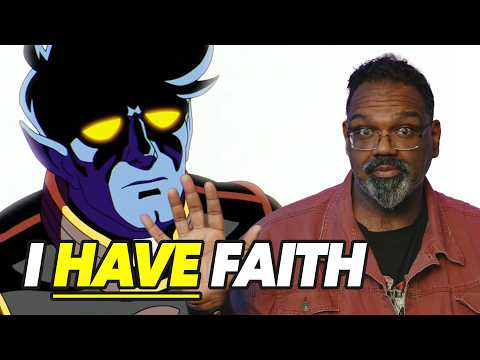
The easy review of X-Men ‘97 season 2 is that it starts strong. It does. The first three episodes are confident, clear, emotional, and packed with the kind of comic book madness that only works when somebody behind the wheel actually believes in it. The X-Men are scattered across time. Bishop and Forge are trying to put the team back together. X-Force gets its own intro. X-Factor steps into the vacuum. Apocalypse is rising. Rama-Tut is lurking around ancient Egypt. Michael Dorn is out here dropping Worf energy into survival-of-the-fittest theology.
So yeah, the show starts strong.
The interesting question is whether Marvel knows why it starts strong. Because X-Men ‘97 did not become what it was by accident.
Season 1 worked because it felt authored. It felt like somebody understood that nostalgia is useless if all you do is preserve the corpse. When I watched X-Men ‘97 a couple years ago and was blown away (that’s an understatement), I don’t mean I liked it. I mean I sat there feeling like the show had somehow found the version of X-Men: The Animated Series my childhood brain thought I was watching in the first place. The original show was already ahead of its time. It dealt with prejudice, fear-mongering, public panic, and the way society turns people into monsters by deciding there were monsters first. Season 1 took that history and grew it up.
And whether Marvel wants that conversation to be easy or not, a huge part of that sits at Beau DeMayo’s feet. He’s still listed as an executive producer on the series, funny enough, even after Marvel dismissed him. I’m not here to relitigate the whole situation. That’s another video and probably another migraine. But season 1 felt like it came from somebody who spoke X-Men as a language, not somebody using the comic as a reference folder.
That’s what makes season 2 such a fascinating case. These first three episodes are very good. But DeMayo’s scripts and the season’s architecture were reportedly far along before his exit, with animatics already seen for the season. Then the show kept moving through revisions, polish, and completion after he was gone. So I’m not watching this season wondering, is this good? Because so far it is. I’m watching it wondering who’s steering the thing that ultimately made it good.
The Standard Is Evolution, Not Recognition
The standard for X-Men ‘97 was never just whether it could remind us of the old show. That’s a trap a lot of revivals fall into. They confuse recognition with meaning. They think if the theme song hits, the costumes look right, and somebody says the thing you remember, the job is done.
Season 1 knew better. It paid homage to the original series, but it also passed the torch in a way that made us feel like we were watching the evolution of the thing we grew up with. Not just a visual upgrade. An evolution in maturity, a mutation, if you will. The original animated series had ambition most children’s television didn’t have, but it was still working inside ’90s broadcast limits, ’90s animation limits, and the limits of what people thought a cartoon could get away with. The new series had time, hindsight, better tools, and a fan base that had grown into the material. And season 1 took advantage of that. It let Cyclops stop being treated like the boring rule guy and start being treated like a man collapsing under leadership. It let Magneto remain dangerous without flattening him into “the villain is wrong because the story says so.” Magneto is interesting because he’s almost right in ways that make all of us very uncomfortable.
Season 1 didn’t say “remember being a kid.” It said “remember what this was really about.” So season 2 is not being judged against nostalgia. It’s being judged against evolution.
The Art Style Argument
I know some people don’t like the new art style, and I have no idea what they’re thinking. I don’t mean that in a fake-objective, everyone’s-entitled-to-their-opinion way. Obviously you can like what you like. But for me, the new art style is one of the clearest examples of why this revival works. Because, and I say this with love, the original ’90s art style kind of sucked sometimes.
The designs were iconic. The silhouettes, same thing. The costumes, same. And the title sequence is burned into the genetic memory of an entire generation. But the actual animation had issues: heavy shadows, stiff movement, weird proportions, that very specific ’90s syndicated cartoon feeling where the imagination of the show was often bigger than what the production could actually execute.
X-Men ‘97 didn’t copy all that, thank god. It feels like the memory of the original show rebuilt with better tools. It keeps the integrity of the old visual language, but it cleans it up, strengthens it, and gives it a kind of American anime energy: bigger motion, better faces, better staging, more emotional precision. The style works because it doesn’t reproduce the old show’s limitations. It reproduces the emotional effect of the old show.
A lazy revival asks, “How do we make this look old?” A smart revival asks, “How do we make this feel like people remember it?” So if someone says the new show doesn’t look exactly like the old show, sure, technically that’s true. But that’s also the point. The new art style does not in any way, shape, or form betray the show. It rescues the version of the old show we remember from the limits of what the old show could actually execute.
The Fracture Becomes the Format
Season 2 starts from a genuinely strong place because the X-Men are not just missing. Their absence has consequences. The team has been scattered across time. Some are in the past, some are in the future. The present is left exposed, unguarded, politically unstable. That immediately gives the season more than one engine: Bishop and Forge trying to recover the X-Men, the future timeline creating emotional fallout around the Summers family, ancient Egypt pulling us toward the rise of En Sabah Nur, and back in the present, the world having to answer the very uncomfortable question of what happens when the X-Men are gone.
That’s a much stronger starting point than simply asking how the team gets back together. The show could have done the easy version: episode 1 is a rescue mission, episode 2 is another rescue mission, episode 3 reunites everyone enough to get the regular format back on track, everybody back in their normal costumes. Instead, the season lets the fracture become the format.
And the plotting is smarter than a simple rescue chase. Bishop has identified that the X-Men have landed at pivotal moments in Apocalypse’s timeline. That changes the shape of the story: the rescue mission and the Apocalypse story are tangled together, because saving the X-Men may mean interfering with the formation of one of the most dangerous figures in mutant history.
This should be a mess. Past timeline, future timeline, present timeline, Apocalypse, Cable, Rachel Summers of all people, X-Force, X-Factor. That’s a lot of plates to spin in three episodes. But somehow the show keeps the story readable. The three-episode premiere helps. Episode 3 ends as Rise of Apocalypse Part One, and yeah, the split is a little strange. From what I understand, some critics and influencers had access to the first four episodes, so it would have made sense if Marvel had released this as two episodes one week and two the next. They gave us three instead. And honestly, it worked for me. By the time episode 3 ended, I wanted episode 4. That’s the job.
Those three episodes give you enough runway to understand the season’s board. You know who the X-Men are. You know why Bishop and Forge are moving. You know the present is vulnerable. You know Apocalypse is not just coming, his origin is now part of the case. That’s good comic book plotting: big, messy, potentially insane, but not confusing. And with X-Men, that balance is important. If Chris Claremont taught us anything, it’s that you can juggle a lot of things.
X-Force ‘97 and the Living Ecosystem
Episode 2 giving us an entire X-Force intro should not have worked as well as it did, but it absolutely did. And it’s not just “hey, remember X-Force?” It’s not some random Easter egg thrown in so people can point at the screen. The bit works because the show has created a situation where the main X-Men are gone and the world still needs mutant actors to fill the vacuum. So when the intro shifts, when the moves echo the original opening, when it suddenly becomes X-Force ‘97, it doesn’t feel forced. No pun intended. Okay, maybe a little bit intended.
Same thing with X-Factor. Polaris is here, which is a great callback. Havok is here. Rahne is here. All the fun people are suddenly on the board. And depending on which comics you’re pulling from, some of these affiliations get a little fuzzy. Rahne is technically connected more directly to the original X-Force material in certain contexts. And if this show ever wants to give me a full Rob Liefeld-flavored X-Force, I’m not going to pretend I wouldn’t watch that with a stupid grin on my face.
But the show is expanding the mutant ecosystem without making it feel like homework, and that really is the key. X-Force and X-Factor are not just proof that the writers know the toy box. They’re proof that the world of the show is still alive, especially when the main team is gone.
Apocalypse as an Investigation
The thing I was most nervous about was Apocalypse. Specifically his voice, from the trailers. I thought Apocalypse sounded a little different, and that worried me more than I expected. Young En Sabah Nur should absolutely sound different. He hasn’t become the giant blue cybernetic nightmare man with the huge A belt buckle and the double-voice doom-god delivery. But when Apocalypse is Apocalypse, that voice matters. The old animated series gave him one of those voices you never forget. That layered, booming, double-overlaid sound was part of the character’s identity. You hear it and your brain immediately knows: this guy is not just another villain. This guy thinks he’s history with a jawline. When season 2 still gives us that feeling, I relaxed. The show knows what ultimately has to be preserved. Not everything, not every surface detail, but the things that carry memory.
More important, episode 3 is not just using Apocalypse as a threat. It’s using En Sabah Nur as an investigation. The ancient Egypt material is not simply there so the show can say “look, Apocalypse origin story.” It’s asking how someone becomes Apocalypse. What pressures him? What wounds harden into ideology? What kind of world teaches a person that survival of the fittest is not just a belief but the only truth worth organizing reality around?
That’s where Magneto becomes a fascinating character in all this. Magneto looks at En Sabah Nur and sees possibility, a young man who might be redirected. Maybe if Charles could change Magneto, then Magneto can change Apocalypse before Apocalypse exists. There’s something almost beautiful about that idea, and also, I think, unbelievably arrogant. Charles sees the danger, because of course he does. Trying to rewrite a person before they become a monster sounds noble until you realize you might be bringing the monster into focus faster. And that’s what gives the Apocalypse story real weight. He’s not just the villain waiting at the end of the season. He’s the subject of the season’s historical inquiry.
My Star Trek Brain Is Also Getting Fed
Casting Michael Dorn as En Sabah Nur’s father figure only adds to that. Hearing that very Worf-like voice speak in the language of survival and strength is just cool. I don’t have a more elegant way to say it. Rule of cool applies here for sure. “You were just a broken child when I found you in the desert. Now look at you. Not just a survivor, but a leader.”
Then you bring in John de Lancie as Rama-Tut, and suddenly my Star Trek brain is also getting fed. Rama-Tut, for anyone who doesn’t know, is the ancient Egyptian persona of Kang the Conqueror. Or an earlier version of Kang. Maybe a later version. Whatever Kang timeline nonsense we’re pretending makes perfect sense these days. Either way, John de Lancie showing up in the role is wild.
Then you have Gates McFadden as Rachel Summers, a much older version of course, and now Dr. Crusher is in my X-Men show helping carry the future Summers family trauma. I’m sorry, but I’m only human. I love that. Genuinely, I dug it. And I have a feeling you did too.
The Rachel Summers and Nathan of it all could easily become a hodgepodge continuity soup. Alternate futures, Cable, the Summers family line, time travel. That’s a lot. And yet the emotional idea is simple: Scott and Jean get to see Nathan not as a baby taken from them, not as a tragedy, not only as Cable, the grim time soldier who shows up with guns, warnings, and unresolved trauma. They get to see him as a fully realized person with a life, a purpose, and a family context beyond their absence. That lands. The lore is doing what lore is supposed to do. It’s not just explaining timelines. It’s creating emotional contact.
And that’s where X-Men can be deceptively powerful. The franchise has some of the most ridiculous continuity in superhero fiction, and I say that as someone who absolutely adores it. Time travel, clones, alternate futures, and that’s before we even get into all the resurrection nonsense. But when X-Men works, all that chaos funnels into something very human. A parent sees a child they lost. A child becomes a soldier because the future demanded it. A family is rebuilt across time with all the wrong pieces and somehow still hurts in exactly the same way. That’s why these episodes are not hard to follow. The details are comic-book complicated, but the emotional throughline is clean. Honestly, that might be the best compliment I can give these first three episodes: they’re dense without being muddy.
The Verdict
So, there you go. Now you know. And if knowing is half the battle, you’re halfway to being a know-it-all yourself.
X-Men ‘97 season 2 has come out of the gate doing almost everything it needed to do. The opening run is engaging, emotional, readable, beautifully executed, and loaded with exactly the kind of comic book confidence that made season 1 feel special. The X-Men are fractured across time, but the show itself doesn’t feel fractured. The mutant world is expanding, but it doesn’t feel like a cameo checklist. Apocalypse is rising, but the season is treating him like a historical question instead of just a giant blue boss fight. That’s why episodes 1 through 3 get a 9 out of 10 on the Know-It-All Index.
And no, that’s not me hedging because I secretly think there’s a problem. The opening is that strong. I’m not giving it a 10 yet because I need a ceiling. Season 1 got better and better as it went. It earned its biggest swings. It turned early confidence into late-season devastation. Season 2 has started in a place that makes me believe it can do that again, but the full test is still ahead. The show has to prove the fragmentation pays off. It has to prove the Apocalypse origin material deepens the season instead of crowding it. It has to prove X-Force and X-Factor are part of the structure and not just shiny new mutant ornaments. And most of all, it has to prove that the creative intelligence we felt in season 1 is still alive once we move deeper into the post-DeMayo handoff.
So no, I’m not worried yet. But I am watching. Because the first three episodes don’t make me ask whether X-Men ‘97 season 2 is good. They make me ask whether Marvel understands why it’s good.
That’s where I’m landing for now. But I want to know where you’re landing. Did these first three episodes feel like the show still has the season 1 magic, or are you already watching the seams and the handoff?
Drop your Know-It-All Index in the comments on the video above. I’m very curious where people are on this one, and I have a feeling season 2 is going to give us a lot to talk about.