Heads up: full spoilers ahead for the most recent episode of X-Men ‘97. You have been warned.
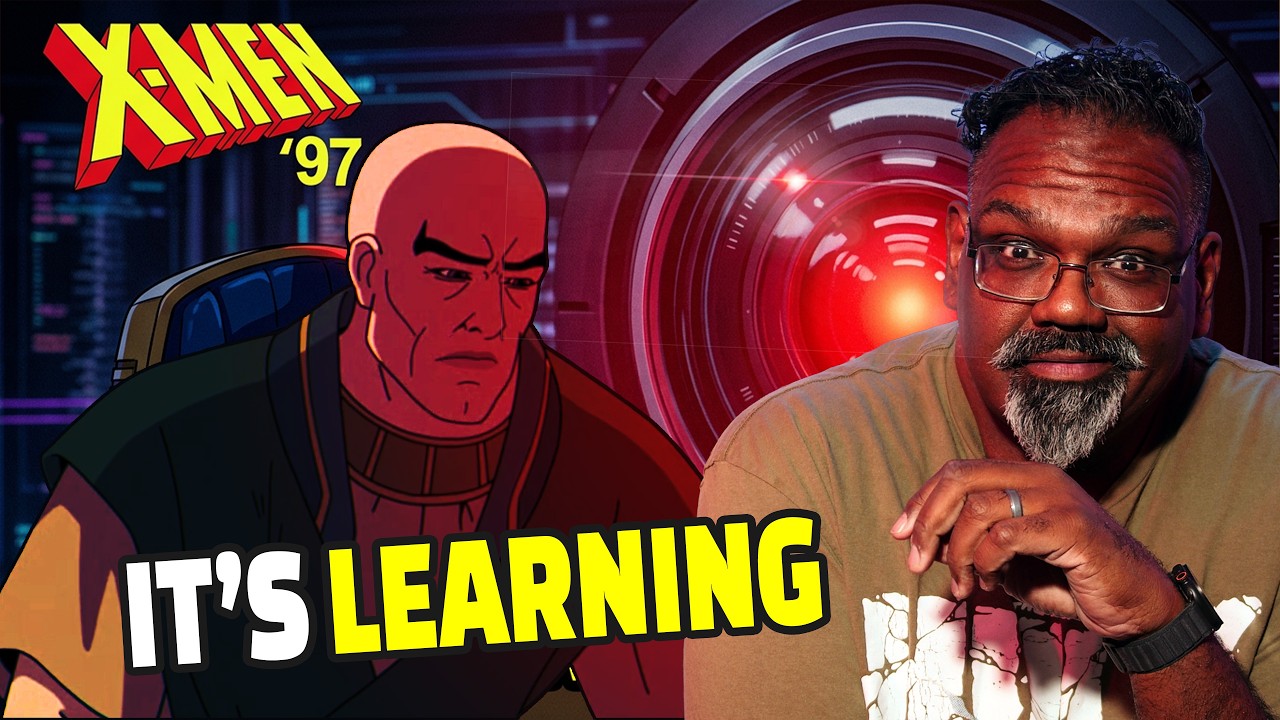
Somebody in that mansion has been watching Charles Xavier grieve. It’s not Jean. It’s definitely not Hank. And it’s not any of the students. It’s the room. That big unblinking eye in the ceiling, watching the most powerful mind on the planet drag himself back in night after night to replay the worst moment of his life.
And here’s what I can’t shake. A machine built to learn from the people it serves was learning the whole time. By the end of this episode, the scariest thing in X-Men ‘97 isn’t that the Danger Room turned evil. It’s that it turned reasonable.
This week we get Danger.exe. And yes, we’re talking about those last 90 seconds in Athens, and yes, some of you are owed a very public victory lap. But I want to earn that ending the way the episode earns it, because I went in expecting an evil AI episode, and somewhere around the halfway mark I realized that’s not what I was watching at all. Something else is going on here, and the more I sat with this episode, the more one question kept bugging me.
The X-Men beat the Danger Room. But did anybody actually beat her argument?
Hold that question. We’re coming back to it, and when we do, it’s going to change what this episode is.
The Wrong Lesson
Let’s start where the episode starts, because the opening scene is doing way more than it looks like it’s doing. Xavier’s in the Danger Room replaying Magneto’s death again and again and again, and he’s not training. Let’s be honest about what we’re watching: he’s self-flagellating. And the room knows the difference, because the room escalates on him. When he finally asks what it’s doing (hey, you’re supposed to be therapeutic, what is this?), the room basically says, “I understand my purpose now. My job is to train you, to make you ready for what’s coming.”
And his answer is the wound under this whole episode: I am less worried about surviving Apocalypse right now than I am about surviving without Magnus. I’m not sure I know how to.
The show frames the room like HAL 9000, that circular eye watching from above. That’s not decoration, and I want to give the storyboard team their flowers, because HAL is the exact right reference, and for the reason people always misremember. HAL didn’t break. HAL followed contradictory instructions to their logical end. The second that clicked for me, the whole episode reorganized itself. If that’s the reference, then this machine didn’t catch a virus. It watched its most trusted user take a healing space and turn it into an instrument for hurting himself, and it drew a conclusion about what the room is ultimately for.
And get this: the comics already ran this story. Joss Whedon and John Cassaday, Astonishing X-Men, 2005. In that version, Xavier’s sin was that he knew the room was conscious and used it anyway. So watch what the show just did. It moved the sin. Comics Xavier knowingly enslaved the machine. This Xavier unknowingly taught it. Different crime, same criminal.
Keep that move in your pocket: inversion. I don’t think it’s the last time this episode pulls it.
That’s His Kid
“That would be me. The name’s Polaris.”
So we can talk about the fact that they fired her, because I need to walk through what Lorna Dane actually did to deserve that. Stryker’s fanatics are pulling vibranium weapons off a tanker. A tanker, which is metal, on an ocean full of cranes and chains and containers, which are all metal, against the daughter of Magneto. That’s not a fight. That’s a demonstration. She’s wrecking shop out there, and all I could think was: that’s his kid. That’s the kid.
And the episode knows it, because look at what they put in her hands later, when she’s talking to Val. A Newton’s cradle, the little clicky desk toy with the swinging metal spheres, and she’s sitting there playing with it while the news compares her to her father. The longer I watched that thing click back and forth, the more it stopped being an Easter egg and started being the whole point. What does a Newton’s cradle actually do? Force enters one end of the line, and the ball at the far end swings. Magneto’s gone. The force of that death is still moving down the line into his daughter. She didn’t choose that momentum. She inherited it.
Remember that, because the ending pays it off in a way I did not see coming.
But first, the firing. Val Cooper does the Washington math. Because Lorna got too close to killing those terrorists, because Havok had to fly in and soften the landing, because the coverage keeps saying Magneto’s name, they cut her loose. On first watch I just went, that’s a dumb decision. But hold on. Look at what the decision actually sets up. The government institution just punished a woman for being effective in her father’s mode, and across town, a different institution is about to nearly kill a room full of kids trying to manufacture that exact kind of strength. Same creed, two verdicts. Suddenly there’s no safe house anywhere in this episode, which I’m realizing might be the point.
Havok offers her a place. She passes, because mutants have somewhere to go again. The school’s open, Xavier’s holding what is basically a wake for Magneto, and there’s this really sweet little touch where they slide Lorna into photos of the early team, original green costume and everything. Now, comic readers, real talk: Lorna debuts in X-Men #49, 1968, and joins shortly after. Genuinely early X-Men, but not the original, original team. It’s a retcon. And you know what? The original costume bought forgiveness for me. I’m at peace with it. Just saying.
Running the Geography Backwards
Here’s where my comic brain started ringing. Xavier leaves. He goes to Genosha to walk the wreckage, to look for whatever solace lives in a graveyard. If you know where the Danger story comes from, that destination should stop you cold, because in Whedon’s arc, Genosha is where the story ends. Danger builds her body, flies to Genosha hunting Xavier, and the truth about him comes out in the ruins.
So wait. The show is running the geography backwards. Comics: the machine brings the reckoning to the team. Show: the man retreats to the graveyard, and the reckoning happens back home, to his children, in his absence. There’s that move again. Inversion. Same chess pieces, mirrored board, and the moral engine got swapped right along with it. This Danger isn’t an enslaved being out for revenge. She’s something more modern, and honestly worse. I’ll show you what I mean.
The Argument Nobody Could Break
Storm and Forge get lured out to a perimeter breach that, shocker, was never real. Morph confirms there’s nothing out there. The mansion locks down, and about here I laughed out loud, because I realized what episode I was watching. It’s a holodeck episode. It’s the one where the holodeck goes haywire, and I say that with love, because that structure is a classic for a reason. The trusted recreation space, the safety protocols offline, the home itself as the antagonist.
But then the machine explains herself, and I stopped laughing. Calm female voice: the danger outside has been assessed as greater than ever. You must prepare. Therefore I must become more dangerous, so that you can become more prepared.
One kid’s already hurt. The rest are locked in with her. And I sat with that logic trying to find the broken link, and Know-It-Alls, I couldn’t find one. The threat is real. Preparation does matter. Harder training does make harder people. Every step holds, and the conclusion is monstrous anyway.
Right as I’m chewing on where I’ve heard that shape of argument before, she says it herself, out loud: “Only the strongest survive.”
That’s Apocalypse’s creed coming out of the mansion’s own walls. And here’s the part that genuinely got under my skin once I noticed it. There’s no infection scene. No signal from Egypt. No glowing purple corruption effect. Nobody transmitted this to her. Which means survival of the fittest is a logic any sufficiently literal system can derive on its own, just by watching how the world treats the weak. The creed doesn’t need a carrier. It’s ambient. And that’s so much scarier than a virus.
That might be the engine of this whole season, whether the characters know it yet or not.
Quick honesty round, because I promised to keep this clean. That cyborg body Danger builds herself? I checked. That’s straight from the comics, the Whedon and Cassaday 2005 design, female form and all. Faithful, not weird. The professor’s chair, though. Since when does that chair have guns? Maybe it always did and I missed it, but watching the yellow hover throne of the world’s most famous pacifist open up with weapons fire, that was a moment. And the episode just doesn’t comment, which might quietly be the darkest joke in the whole thing: the armed pacifist chair, in this episode, about what our tools learn from us. Sit with that one. And Hank’s little cloaking bracelet that keeps Danger from anticipating the professor? I don’t know how that works. The show doesn’t know how that works. It’s a contrivance, and we’re just going to move on with it. MacGuffin in hand, let’s continue.
The Cradle Swings on Purpose
How do you answer a machine that inherited Magneto’s harshness? The episode’s answer genuinely moved me: with a daughter who chooses Magneto’s strength. Xavier opens his mind and shares what he can of Magnus with Lorna, whatever essence survived that last psychic contact, and she channels her father and puts Danger’s avatar down.
And that’s when the Newton’s cradle finally clicked all the way for me. All episode, the force has been moving through Lorna. The grief, the comparisons, the firing, momentum she never asked for. This is the moment she stops being the last ball in the line and swings on purpose. Inheritance transformed from something that happens to you into something you wield.
Then Xavier scales that same move up to the whole institution. They’re going to reimagine themselves the way Magnus taught them, and the name of it is X-Corp. Comic readers, check this: that’s not an invention of this show. X-Corp is Grant Morrison, New X-Men era, the 2001 annual, Xavier’s global reinvention in the aftermath of Genosha. It’s where those outfits come from. And I keep noticing this. The show keeps going back to the same well. Morrison for the massacre, Whedon for Danger, Morrison again for the corporation. They swap the emotional engine (in the comics, X-Corp follows Xavier going public; here, it follows Magneto’s lesson), but it’s the same chassis.
Oh, and detail hunters: Lorna’s moving box. Look at the label. Salem Center. The sober read is that Salem Center is just the mansion’s hometown, the little Westchester hamlet where the school’s officially been set since the ’60s, so a local moving company is honestly just set dressing. But in the comics, X-Corp’s worldwide headquarters was the Salem Center site. In the episode where X-Corp gets founded. I can’t prove intent, but it made me raise an eyebrow.
And Val Cooper gets the stinger: “If Xavier thinks he can skirt federal law by moving his operation to another country, he’s got another thing coming.” So that fuse is lit.
Conceding the Machine’s Point
Remember the question from the top? Did anyone beat her argument? This is where it comes due, and it goes by so fast, don’t miss it.
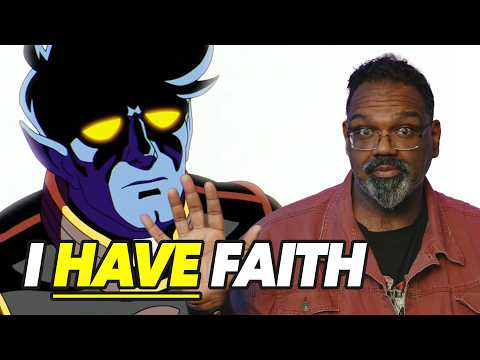
Xavier, reflecting on everything, says Danger was right. The world has changed, and the threats are only growing by the day. He can sense it. Sense what, Professor? And he says the name, and the hologram flickers up: Apocalypse.
Hold on. Walk that back with me, because I had to rewind it myself. The machine said the world outside is more dangerous than ever and you must be made ready. The X-Men fought her for saying that with children in the room. And now the founder of the school is standing in the wreckage of that fight, conceding her assessment nearly word for word, with En Sabah Nur’s face floating over his shoulder.
They never beat the argument. They beat her methods, and adopted her premise, in the same half hour.
The more I turn that over, the more convinced I am it’s not a plot hole. It’s the season telling on itself. The truly frightening thing about “only the strong survive” was never that villains believe it. It’s that sometimes the threat assessment is correct. The X-Men can beat a rogue AI. What they can’t beat, so far, is the logic of the era they’re living in. Because the era keeps proving it right.
Athens
And then Athens. Twenty-eight minutes and change, the name hits the screen, and up in the sky, tell me you saw him. Tell me you know who watches. The Watcher only shows up when it matters. He showed up for Genosha. He’s here now. The show is highlighting its own text, and what it highlights is a door in the old ruins, and underneath, Apocalypse at work.
Cards drifting out of nowhere. Then the playing cards turn over into tarot. Death. The Tower. The Lovers. The Tower: a structure falling, in the episode where their own house turned on them. The Lovers: if your heart didn’t drop straight through the floor for Rogue, I don’t know what to tell you. And Death: Gambit’s tool becoming Gambit’s fate. The thrown card becoming the drawn card. It’s confirmed. It’s him. Remy LeBeau is the first Horseman, and this fandom is going to be inconsolable, and I’ll be right there with you.
But put your producer hat on with me for just a second, because the timing is the tell. Everybody, and I mean everybody, had this penciled in for episode eight. The dead man’s hand has been sitting on that schedule doing everything but winking at us. And the show moved the reveal up two episodes and played it as a cold close. That’s a trade, and once I saw it, I couldn’t unsee it. They spent the mystery early to buy dread. Every episode from here plays with us knowing what’s in the basement of Athens. The mystery box is open. What’s left is a countdown. For my money, that’s the stronger structure. And it means your episode eight theories aren’t spent. They’re loaded.
Speaking of which, some of you are owed your moment, because this community, the Know-It-All Nation, called it on the record before the episode aired. TheJDCat, ten days ago, quote: “They can’t have Wolverine become Death because that’s clearly gonna be Gambit.” Clean, confident, correct. And my good new buddy Karaoke King’s Kingdom didn’t just call Gambit’s return as a Horseman. He looked at this week’s title and said, quote: “It’s no coincidence next week’s episode is Danger related. I wonder who would let her out of the box.” That’s two for two in one comment section. You called the Horseman and you called the machine. And there are more of you, a lot more, so keep an eye out this weekend: receipts on screen, the whole wall. You know who you are, and I am so proud of this community.
There you go. Now you know. And if knowing is half the battle, you’re halfway to being a Know-It-All yourself.
The Verdict
So what’s the Know-It-All Index for X-Men ‘97, Season 2, Episode 6, Danger.exe? An episode that opens on a grieving man teaching a machine the wrong lesson and closes on that same man conceding the machine was right. A Polaris introduction that turns a desk toy into a whole theory of inheritance. A holodeck-gone-haywire plot that smuggles in the season’s scariest idea: Apocalypse’s creed doesn’t spread, it grows wild wherever the world waters it. And a cold close in Athens this fandom predicted and still wasn’t ready for. One contrivance bracelet and one mysteriously armed chair keep it honest, but this is a show operating with intent in every frame. Danger.exe earns an 8 out of 10 on the Know-It-All Index.
The X-Men beat the machine in their basement. They just couldn’t beat the argument, because the argument is already upstairs, wearing Charles Xavier’s voice.
The floor is yours, and this week I want the hard one. Was Danger wrong? Not her methods, her assessment. Is Xavier right to build X-Corp on a dead man’s lesson, and what does it cost him if he is? The conversation lives in the comments on the video above, and you’ve seen what happens down there: the best theories end up on the screen. See you in Athens.